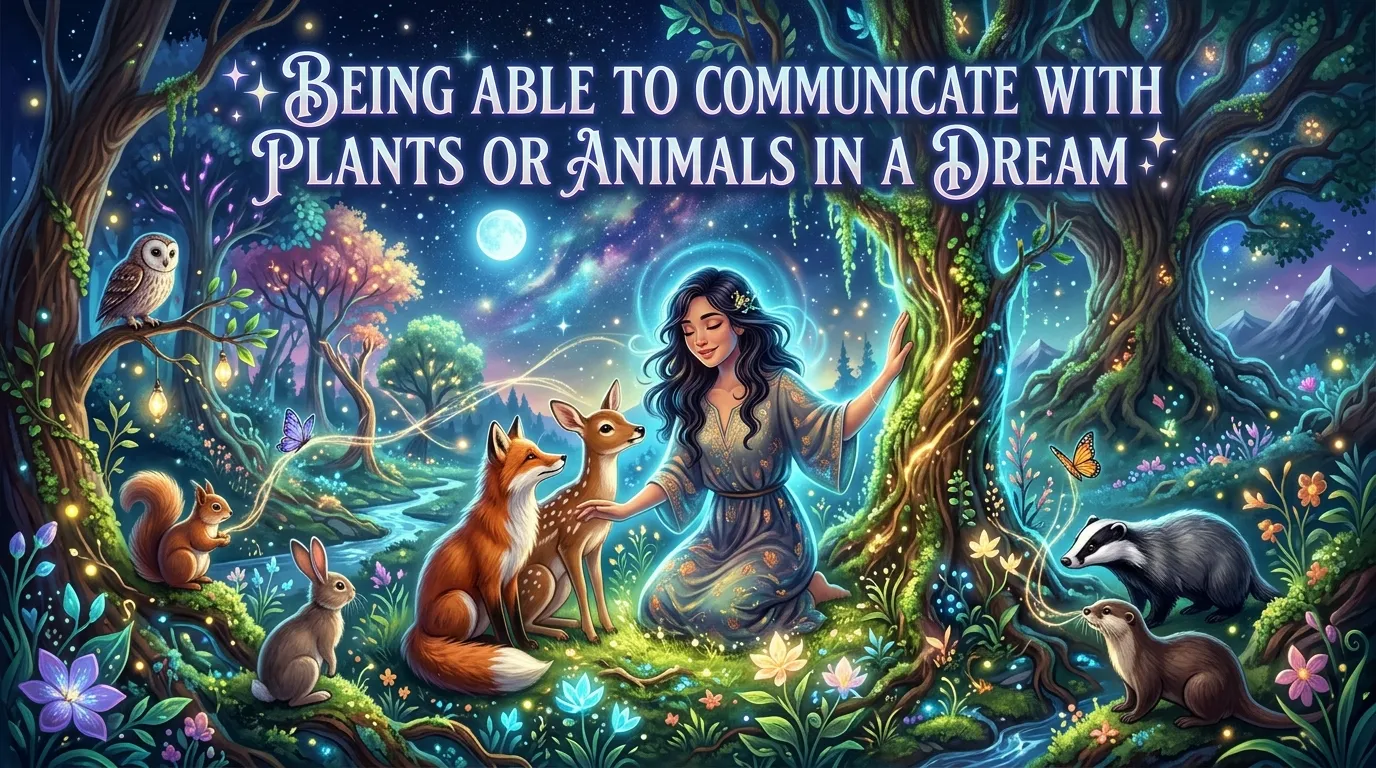
There is an old story in almost every culture about someone who could understand the speech of animals — a prophet, a saint, a child, a fool. The story survives because the longing survives: to be spoken to by the living world, and to be understood in return. A dream in which you can talk to animals or plants is that story arriving in your own sleep, wearing your own face.
The dream is a conversation, so start with who spoke
These dreams are unusually specific about their cast, and the speaker is the first clue. A dream of talking to a dog often concerns loyalty, companionship, or the part of you that loves without complication. A dream of talking to a bird often concerns perspective or a message you are ready to hear. A dream of talking to a snake often concerns fear, healing, or a truth that has been shedding its skin. A dream of talking to a wild animal — a wolf, a bear, a deer — often concerns instinct: a part of your nature that has been kept at a distance.
Plants speak differently. A tree that answers you often stands for rootedness, ancestry, or a long view — something that has been growing quietly for years. A flower that speaks often concerns tenderness, beauty, or a part of life that needs gentle attention rather than force. A plant that warns you often concerns a neglected area of health, home, or relationships — something alive in your life that has been asking for water.
What was said — and what was felt
Dreamers often report that the communication was not quite speech. It arrived as understanding: you simply knew what the animal meant, the way you know what a friend means from a look. That quality is important. It suggests the dream is about a channel of knowing that bypasses words — intuition, empathy, body sense. The dream may be telling you that you already understand something you have been trying to reason your way toward.
The emotional tone divides the readings cleanly. A warm, joyful conversation usually signals connection: to nature, to your own instincts, to a part of yourself that has been silent. A frightening conversation — an animal that accuses, a plant that mourns — usually signals a neglected need. A conversation that felt sacred often marks a spiritual opening: a sense that the world is more alive and more communicative than your ordinary routine allows.
Why the mind uses nature as a language
Human beings evolved alongside animals and plants, and the brain still treats them as emotionally legible. A dog’s face, a bird’s call, a tree’s sway — these are among the oldest signals the human mind knows how to read. In dreams, where language is unreliable and feelings run the show, nature becomes a natural vocabulary. The animal says what the feeling cannot.
There is also a simpler, kinder explanation. Many people dream of talking to animals during lonely seasons. The dream invents companionship where waking life has been short of it. That is not a delusion; it is the mind doing what minds do — reaching for connection in the only workshop it has. If the dream left you comforted, let it. Comfort is a legitimate message.
A story worth remembering
Saint Francis is said to have preached to the birds; the poet Rumi wrote of a chickpea learning to boil; Indigenous traditions across continents describe humans learning law and medicine from animals. You do not need to believe any of these literally to see the pattern: every culture keeps a shelf for the idea that wisdom does not belong to humans alone. Your dream belongs on that shelf. It is a reminder that attention is a form of conversation, and that the living world has been speaking all along — in behavior, in seasons, in the body — to anyone willing to listen.
Carrying the conversation into the day
Two practices keep this dream useful. The first is a listening walk: go outside without headphones, and spend ten minutes noticing what is alive around you — birds, insects, trees, wind. You are not trying to hear words. You are practicing the posture the dream gave you: receptive, unhurried, willing to be addressed.
The second is to write down what the dream’s speaker said, or seemed to say, and then ask where in your waking life that message belongs. Animal messages in dreams are often blunt: slow down, protect this, let go of that, come home. They are the kind of advice a good friend gives — simple, hard to argue with, easy to postpone. The dream has delivered it. What you do with it is now yours. On how real animals communicate — through calls, signals, scent, and gesture — the Wikipedia article on animal communication is a fine companion to the dream.










