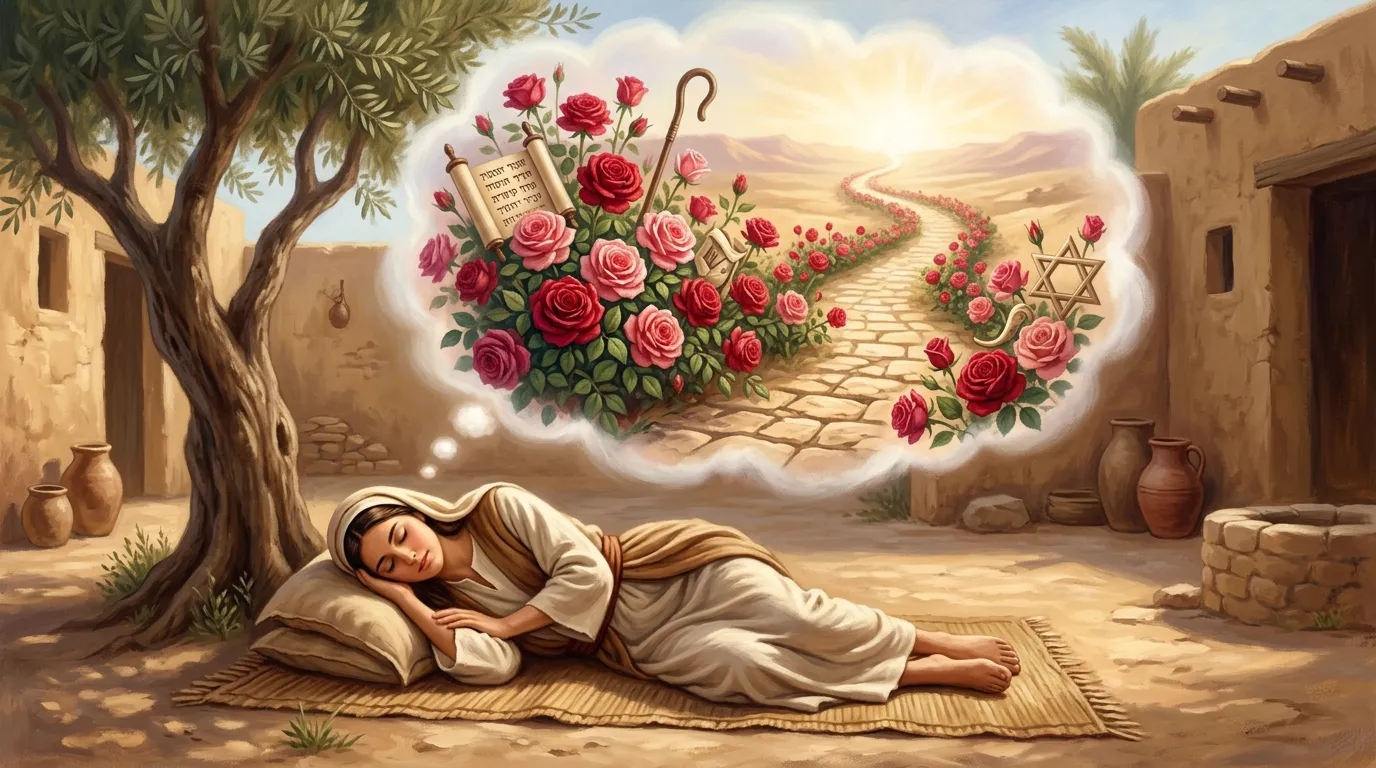
Roses in the Bible are never just flowers. They are the Song of Songs’ image of beloved beauty, the prophet’s picture of a desert in bloom, the emblem of a love so costly it carries thorns. A dream of roses inherits all of that — and the first task of reading it is to notice which rose you saw, because the Bible’s roses are never generic. They are always doing something.
The rose of Sharon and the lily of the valley
The most famous biblical rose appears in the Song of Songs: “I am the rose of Sharon, and the lily of the valleys.” Scholars debate which flower the Hebrew writer actually meant — the “rose of Sharon” may have been a crocus, a lily, or a wildflower of the Sharon plain. The debate is a gift to the dreamer, because it proves the point: the biblical rose is not a botanical specimen. It is an image of belovedness. To dream of roses in this register is to dream of being loved, or of love itself — romantic, divine, or the quiet love of a life that is blooming.
Blooming, thorns, and the two sides of the rose
Every rose carries its contradiction: beauty and wound, softness and thorn. A dream of roses is often a dream about that same contradiction in your own life. A blooming rose — open, fragrant, vivid — usually speaks of a love, a faith, or a project in full flower: something you have tended that is now returning beauty. A rosebud — closed, still forming — usually speaks of a beginning: a love not yet declared, a faith not yet mature, a gift not yet opened.
Thorns change the reading, and they should. A rose that pricked you in the dream often concerns a love that has cost you: a relationship with a sharp edge, a devotion that demands sacrifice, a beauty that came with a wound. The biblical imagination is comfortable with this. The crown of thorns and the rose belong to the same garden. Love, in Scripture, is never only sweetness. It is sweetness that has been willing to bleed.
A withered or fallen rose often concerns a love or a season that has ended — or that you fear is ending. The dream’s tenderness matters here. A withered rose handled gently suggests grief honored. A withered rose discarded suggests something beautiful being thrown away too quickly. A rose that bloomed in an impossible place — a desert, a stone wall, a winter garden — is the most hopeful variant of all. Isaiah’s desert blooms with roses, and the dream that borrows that image is saying: life is returning where you thought nothing could grow.
The colors speak
Rose color in a dream carries its own layer. A red rose leans toward passionate love, sacrifice, and the heart fully given. A white rose leans toward purity, peace, and spiritual devotion — the rose of a forgiven and cleansed heart. A pink rose leans toward gentle affection, gratitude, and grace. A yellow rose leans toward friendship, joy, and delight. A black or dark rose, rarer in dreams, often concerns a love that has passed through darkness: grief, mystery, or a devotion tested by suffering.
Do not treat these as fixed codes. The color’s feeling in your dream — whether it gladdened you or unsettled you — is the truer guide. A red rose that felt menacing is not a love letter. A white rose that felt cold is not peace. The dream’s emotion outranks the dictionary.
Receiving, giving, and tending
What you did with the rose completes the reading. Receiving roses in a dream often reflects love being offered to you — by a person, or by God, in the dream’s logic — and the question of whether you can accept it. Giving roses often reflects love you are ready to offer, or gratitude you have been meaning to express. Tending roses — watering, pruning, planting — often reflects the quiet work of maintaining love: the daily, unglamorous care that keeps a relationship or a faith alive.
Smelling a rose in a dream is worth noticing. Scent is the most memory-laden sense, and a rose’s fragrance in a dream often belongs to a memory of love: a grandmother’s garden, a wedding, a person now absent. The dream may be returning that memory to you as a gift, not a puzzle.
The garden the dream points to
The biblical garden is not a decoration. It is the story’s beginning and its end: Eden at the start, the new creation at the close, and in between, the garden of the Song, where love is tended like a plot of ground. A dream of roses places you in that garden. Its question is the gardener’s question: what are you growing, and what are you willing to tend? Answer with a small act of tending — a kindness, a prayer, a conversation, a forgiveness — and the dream has done its work. On the flower behind the symbol, the Wikipedia article on the rose covers its botany, history, and cultural life.










