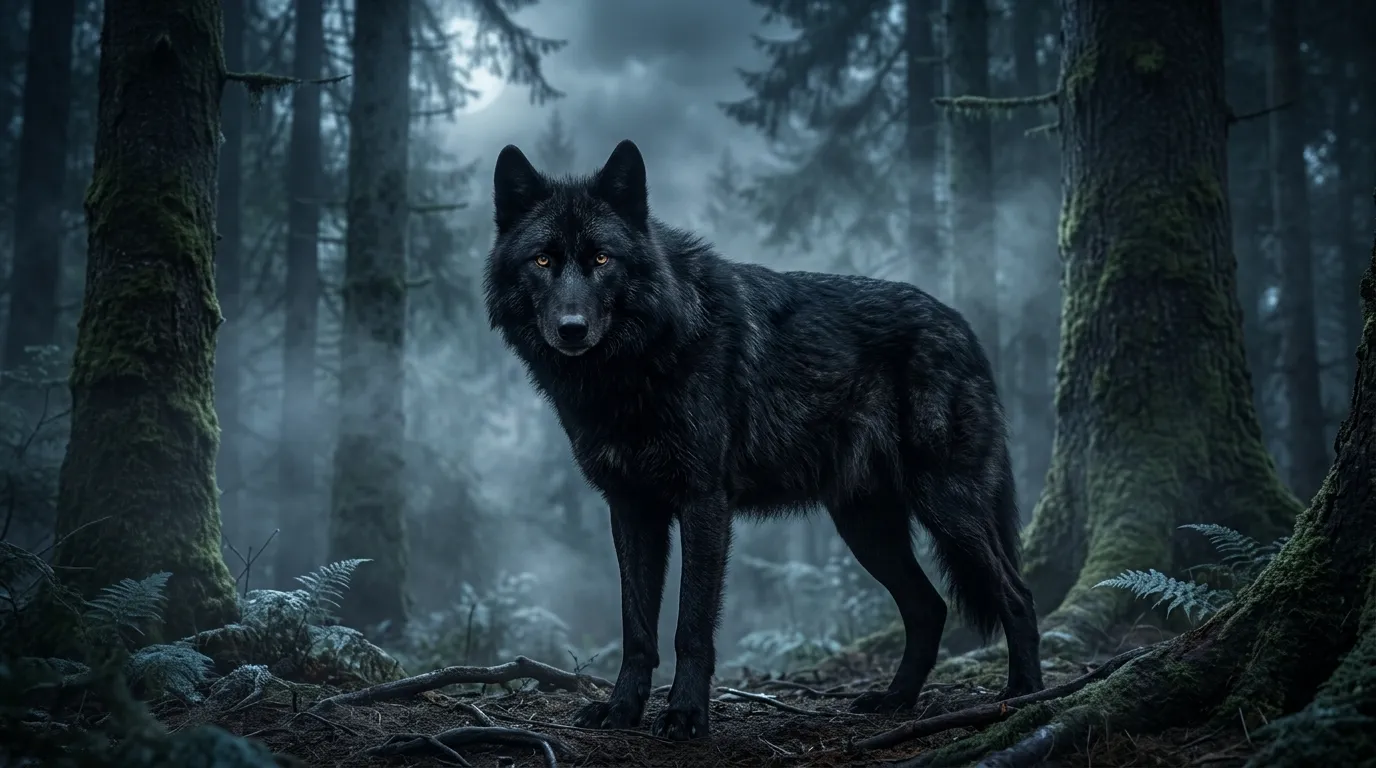
Most dream animals are symbolic at a distance. The black wolf is not. It arrives with presence — eyes that hold yours, a body that moves with intent, a silence that feels like attention. Whether it is hunting you, watching you, or walking beside you, the black wolf in a dream is hard to dismiss as mere scenery. It feels like an encounter. That feeling is the interpretation’s starting point.
Wolves are among the oldest figures in the human imagination: pack animals and lone hunters, loyal and dangerous, social and wild. The black wolf adds darkness to that doubleness — shadow, mystery, the unknown. The dream is introducing you to something powerful that you have not yet fully faced.
The Wolf’s Behavior Is the Message
Of all the details in this dream, the wolf’s behavior matters most. A wolf doing one thing means something entirely different from a wolf doing another:
- A wolf chasing or attacking you often represents a fear, an instinct, or a part of yourself that you have been running from — anger you have not expressed, a desire you have not owned, a truth you have not faced. The chase is the avoidance made visible.
- A wolf watching you, still and silent, often represents something waiting: an opportunity, a threat, a part of yourself that is observing and biding its time. The stillness is the point — the dream is asking you to pay attention to something you have been ignoring.
- A wolf walking beside you or guiding you is the dream’s most positive form: a guardian, a guide, an instinct that has become an ally. It often appears when a person is learning to trust their own intuition, or when they have found a protector in waking life.
- A wolf pack shifts the theme to the social: belonging, loyalty, hierarchy, the group. A pack that welcomes you suggests finding your people. A pack that threatens you suggests feeling like an outsider, or fear of a group that has turned against you.
- A wolf that speaks is rare and pointed: the instinct has found words. Whatever it said is worth writing down, because it is often the sentence the dream exists to deliver.
Black, the Color of Shadow
The wolf’s blackness is doing specific work. In dream symbolism, black is the color of the shadow — the parts of ourselves we do not acknowledge, the unknown, the feared, the hidden. A black wolf is therefore often a picture of the shadow self: the anger, the hunger, the wildness, the grief that civilized life asks us to keep leashed.
This is not a condemnation. The shadow is not evil; it is unacknowledged. It contains aggression, yes, but also vitality, assertiveness, passion, and instinct — all the energies that a too-tame life suppresses. A black wolf dream often arrives when the shadow needs attention: when a person has been too accommodating, too controlled, too cut off from their own force, and the wild part of them is knocking.
There is also a simpler reading of the blackness: it can represent the unknown itself. A black wolf can be a fear of what you cannot see — an uncertain future, a hidden motive, a situation whose depths are dark. The wolf is the shape the unknown takes when it comes to look at you.
The Lone Wolf and the Pack
Whether the wolf was alone matters. A lone wolf in a dream often mirrors a feeling of independence or isolation — the person who walks apart, by choice or by exclusion. It can be a proud image, or a lonely one, and the dream’s feeling decides. A lone wolf that seems strong suggests self-reliance. A lone wolf that seems lost suggests the cost of walking apart.
A pack, as noted, is social. But it is also hierarchical: wolves live by rank, loyalty, and role. A dream of a pack can be asking where you stand in your own groups — whether you are leading, following, belonging, or being pushed out — and whether your place in the group is one you chose or one you were assigned.
An Ancient Encounter
Wolves have lived alongside human fear and reverence for tens of thousands of years. They appear in the founding myths of Rome, in the folklore of the steppe, in the stories of the Norse and the Native American nations — sometimes as destroyers, sometimes as teachers, sometimes as kin. In several traditions, the wolf is a guide between worlds: the animal that leads the soul through darkness, or that appears at the threshold of transformation.
The dream inherits that lineage. A black wolf at the threshold of sleep is an old image arriving in a new mind, and it carries the old message: there is something wild in you, and it is not your enemy. It may be frightening, it may be hungry, it may need to be faced — but it is yours. The dream’s task is not to banish the wolf. It is to decide what kind of relationship you will have with it.
After the Dream
Ask yourself one question: what in my life is the wolf? Is it an instinct you have been suppressing, a fear you have been outrunning, a loyalty you have been testing, or a wildness you have been missing? The answer is the dream’s subject. And if the wolf was walking beside you, consider the possibility that the dream was not a warning at all, but a recognition: the wild part of you has stopped chasing you, and started keeping pace. For the real animal behind the symbol, the Wikipedia entry on the wolf covers its behavior, its social life, and its long history with humans.










