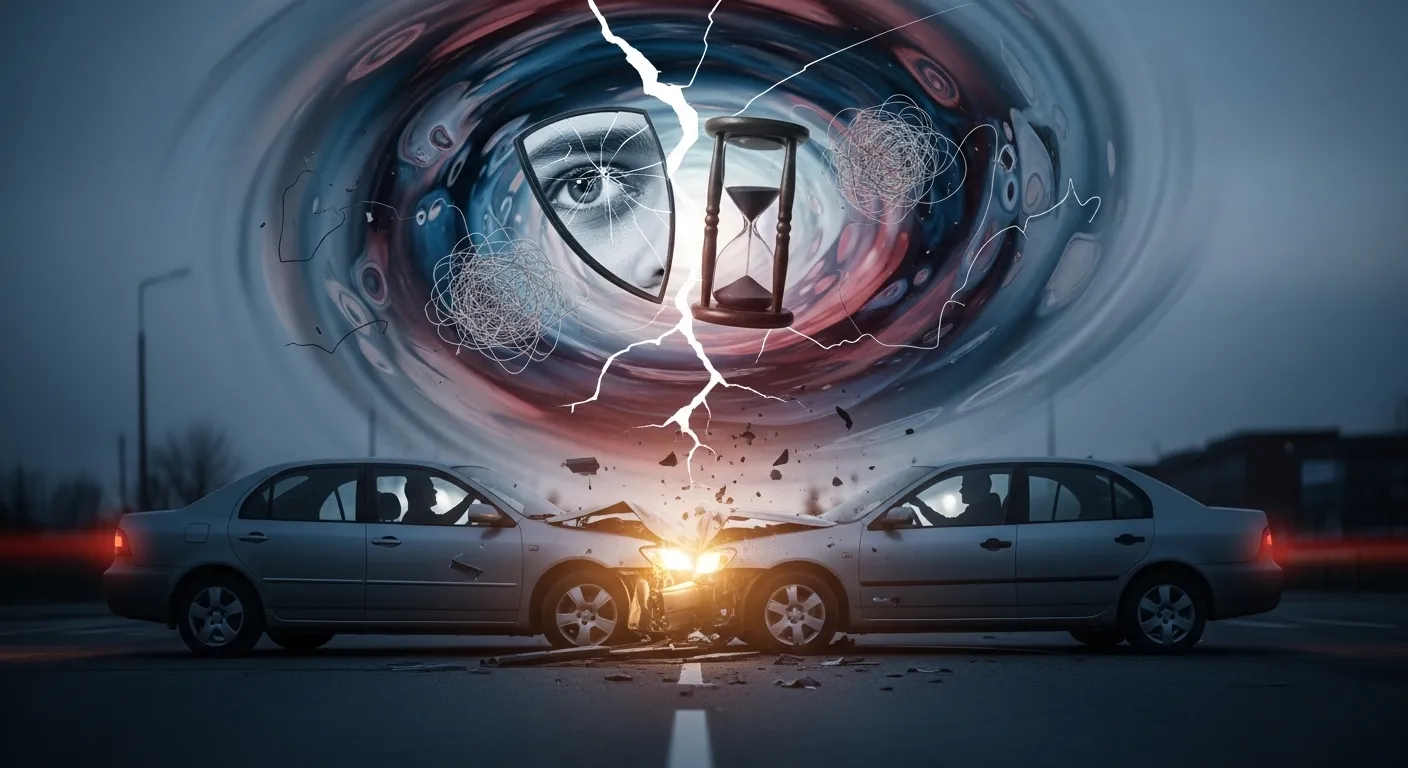
The sound comes first, even in memory: metal folding, glass starring, the world rearranging itself in a fraction of a second. Then the silence after — that strange, ringing quiet in which you understand that something has changed and cannot be unchanged. Dream car crashes are rarely about cars. They are about collision: two areas of your life, two commitments, two versions of yourself, meeting at speed with no time to brake.
This is among the most viscerally upsetting dreams people report, and the first thing to say is the most important: it is not a premonition. Dream crashes essentially never predict real accidents. What they predict — with unsettling accuracy — is the feeling of impact: the sudden, irreversible change that your waking mind senses coming before it arrives.
Two Lives, One Collision
The core symbolism is structural. In dreams, the car is your life’s trajectory — and a crash is what happens when trajectories intersect violently. The interpretive work is identifying the two things that collided. The dream usually casts them as vehicles, drivers, or obstacles, and the casting is deliberate:
- You crash into another car. Two commitments or relationships in conflict: work vs. family, ambition vs. health, the person you are vs. the person someone needs you to be. The other driver often represents the competing demand — sometimes a specific person, sometimes a whole domain of life.
- Someone crashes into you. An external force disrupting your trajectory: a layoff, a betrayal, a diagnosis, someone else’s decision rearranging your plans. The dream stages the helplessness of being hit by something you didn’t choose — and the anger that comes with it.
- You crash alone — into a wall, a tree, off a road. Self-collision. This is the dream of the person whose own choices, habits, or pace are the hazard: burnout driven by your own foot on the gas, a pattern you can see but can’t seem to stop, the wall you’ve been driving toward with your eyes open.
- You witness a crash. Impact at one remove. Usually about anticipating someone else’s collision — watching a loved one’s trajectory with dread, or sensing a coming disruption in your environment that hasn’t touched you yet.
The Moment Before Impact
Dreams are often most revealing in the seconds before the crash, and it’s worth replaying them. Were you driving too fast? The dream is about pace — a life moving at an unsustainable velocity, with the crash as the inevitable arithmetic of speed. Were you distracted — phone, passenger, looking away? The dream is about attention: something important isn’t getting yours, and the unconscious is staging the cost. Were the conditions bad — rain, darkness, ice? The dream is about circumstances: you’re navigating legitimately difficult terrain, and the crash reflects the real risk of the situation, not a personal failure.
And then there’s the variant where you see it coming and can’t move — hands frozen, foot unable to find the brake. That paralysis is the dream’s purest image of powerlessness, and it belongs to situations where you can see the outcome approaching and feel unable to intervene: a relationship’s slow-motion end, a workplace disaster in progress, a family pattern repeating with you watching.
After the Crash
What happens after impact in the dream changes everything. Dreams that end at the moment of collision are about the fear of change — the dread is the whole message. But many crash dreams continue past it, and the aftermath is where the unconscious shows its hand:
- You walk away unharmed. The most reassuring variant. Whatever disruption is coming — or has come — you will survive it intact. The dream is bigger than the damage.
- You’re injured but alive. The change will cost you something real — comfort, certainty, an old identity — but it won’t destroy you. The injury is usually proportional to what the transition actually requires.
- You’re helping others at the scene. The crash isn’t really about you; you’re the steady one in someone else’s disaster. This variant visits caregivers, eldest siblings, and team leads — people whose role is the aftermath.
- The dream loops the crash repeatedly. Unprocessed impact. Something already happened — the layoff, the breakup, the diagnosis — and your mind is still replaying it, trying to find the frame where it makes sense. Repetition is how the psyche files what it hasn’t yet accepted.
When the Dream Repeats
Recurring crash dreams deserve to be taken as a standing notification, not a nightly nuisance. They persist while the underlying collision remains unaddressed — the two life-areas still on course for each other, the pace still unsustainable, the impact still unprocessed. The dream will keep staging the crash until waking life changes the trajectory or absorbs the blow.
The practical response is to name the collision out loud, in plain language: “My work demands and my health are going to crash into each other.” “The way I’m living and the person I want to be are on a collision course.” Naming it doesn’t prevent every crash — some impacts are already in motion — but it moves you from passenger to driver, from the frozen hands to the hands on the wheel. And sometimes, naming the collision early enough is exactly what lets you brake in time.
Not every crash in a dream is a warning. Some are memorials — the mind’s way of marking a collision that already happened and honoring the fact that you walked away. Either way, the dream’s final message is almost always the same: you survived the impact in the dream, and the part of you that staged it believes you can survive it awake. For perspective on how real collisions are understood — the physics, the causes, the aftermath — the science of traffic collisions is a sobering reminder that in waking life, unlike in dreams, the best strategy has always been the same: slow down before the impact, not after.










