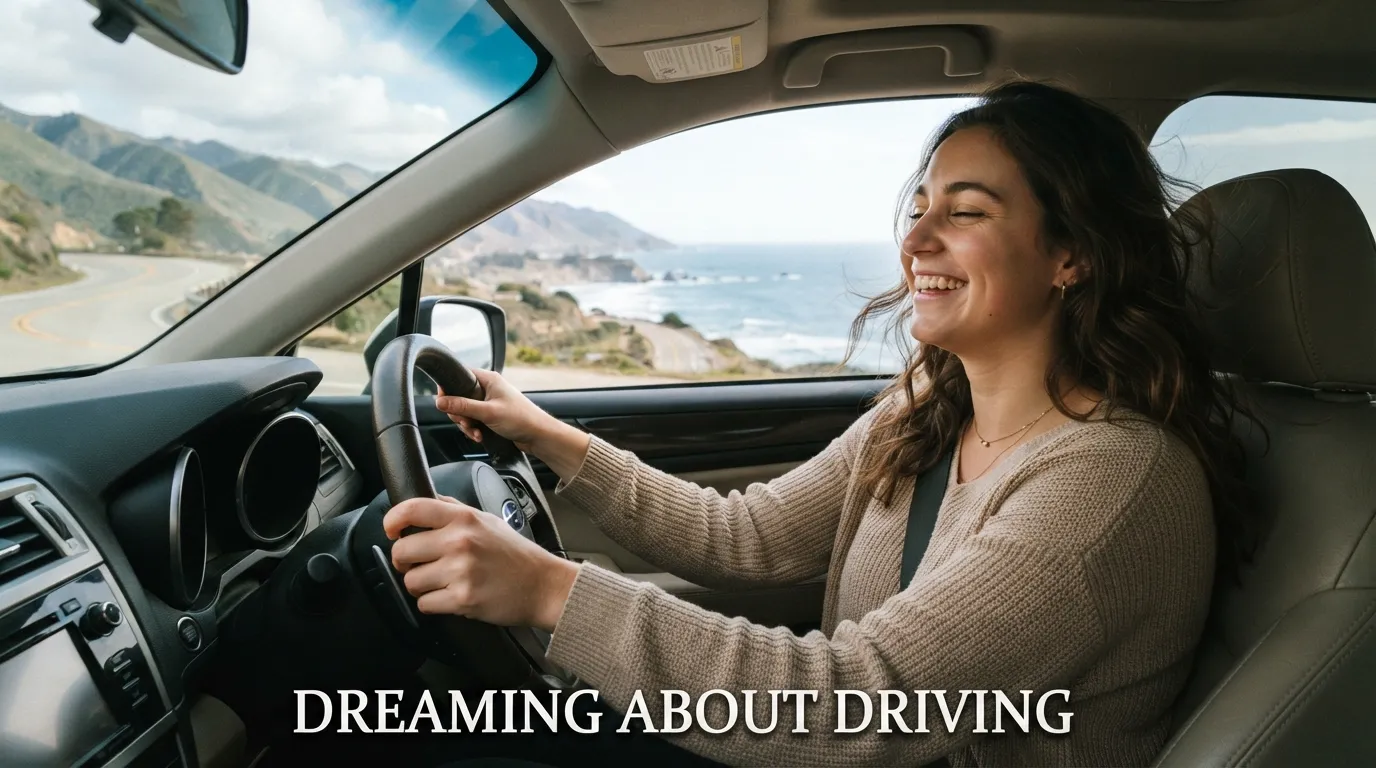
Driving is the most ordinary act of control most people perform. Every day, without thinking much about it, you decide a speed, choose a lane, brake, accelerate, and arrive. So when driving shows up in a dream, the mind is usually not talking about traffic. It is talking about that daily act of steering — and how it feels right now. Are you steering your life, or is it steering you?
This is a close cousin of the car dream, but the emphasis is different. A car dream asks about the vehicle and the journey. A driving dream asks about the act itself: your hands on the wheel, your foot on the pedal, your eyes on the road. The question is not “where am I going?” but “how am I handling the going?”
Speed: the dream’s emotional speedometer
Speed in a driving dream is rarely about actual velocity. It is about pace.
Driving too fast usually pairs with pressure. Life may be moving at a tempo you did not choose — deadlines stacking, expectations rising, a sense that everything is urgent. Sometimes, though, fast driving feels exhilarating in the dream, and then the reading flips: the dream may be expressing excitement, ambition, or a hunger for freedom after a confined period.
Driving too slowly, or being unable to speed up, tends to pair with frustration or caution. You may feel held back by circumstances, by other people, or by your own hesitation. A dreamer stuck behind an endless line of slow traffic is often describing a waking life full of obstacles that are not dramatic enough to name but numerous enough to exhaust.
Losing control of the car — skidding, brakes failing, the wheel going loose — is the most common distress variant. It almost always maps to a situation where control feels lost: a relationship sliding, a project unraveling, emotions running hotter than you can manage. The dream is not predicting an accident. It is reporting the feeling of one already happening inside.
Getting lost, missing turns, and roads that change
Driving dreams have a special fondness for confusion. The road forks and you cannot decide. The GPS gives nonsense directions. Familiar streets rearrange themselves. You miss the exit again and again.
These dreams usually arrive at decision points: a career choice, a relationship crossroads, a move, a fork between safety and risk. The mind rehearses indecision in the language of navigation. One detail is worth noting: in many getting-lost dreams, the dreamer is not actually afraid — just puzzled, or mildly annoyed. That tone often matches the waking situation accurately: not a crisis, but a genuine uncertainty about which way to go.
Driving in the wrong direction, or discovering you have been driving backward, can add a sharper note: the sense of having invested in a path that no longer leads where you want. The dream may be asking whether the route needs changing, not whether you need to drive faster.
Who is driving?
If someone else is driving in your dream, pay attention to who — and how you felt about it. Being driven peacefully by a trusted person can reflect comfort with letting someone else lead for a while. Being driven by a stranger, or by someone you distrust, can reflect a feeling that your direction is being set by forces outside you: family expectations, workplace demands, financial pressure.
Being a passenger who wants to grab the wheel is a particularly telling image. It often belongs to people who have strong opinions about their own lives but feel unable to act on them. The dream stages the exact tension: you can see where you are going, you disagree with it, and you are not driving.
Passengers, night driving, and other textures
Passengers in a driving dream often represent the people affected by your choices — family in the back seat, friends along for the ride. Driving alone at night tends to pair with solitude or introspection: a period of figuring things out privately. Driving with a full car and loud passengers can mirror a life crowded with other people’s needs.
Driving off a cliff or into water is the most alarming variant, and also one of the most commonly misread. It rarely signals literal danger. More often it marks a fear of a decision’s consequences — the feeling that one wrong move will send everything over the edge. If you survived the fall in the dream, that survival is part of the message: the fear is larger than the likely outcome.
A short practice for the morning after
When you wake from a driving dream, try finishing three sentences: “In the dream I was driving toward…”, “The thing I could not control was…”, and “In my waking life, that matches…” The third sentence is the interpretation. Dreams about driving reward this kind of plain translation because their symbolism is so close to everyday experience: steering, speed, direction, control.
And if the dream left you uneasy, remember what it is not. It is not a forecast of a road accident, and it is not a verdict on your driving. It is a report on how the steering feels from inside your own life — and reports, unlike verdicts, can be acted on. The modern history of driving itself, from early automobiles to today’s roads, is traced in the Wikipedia article on driving.










