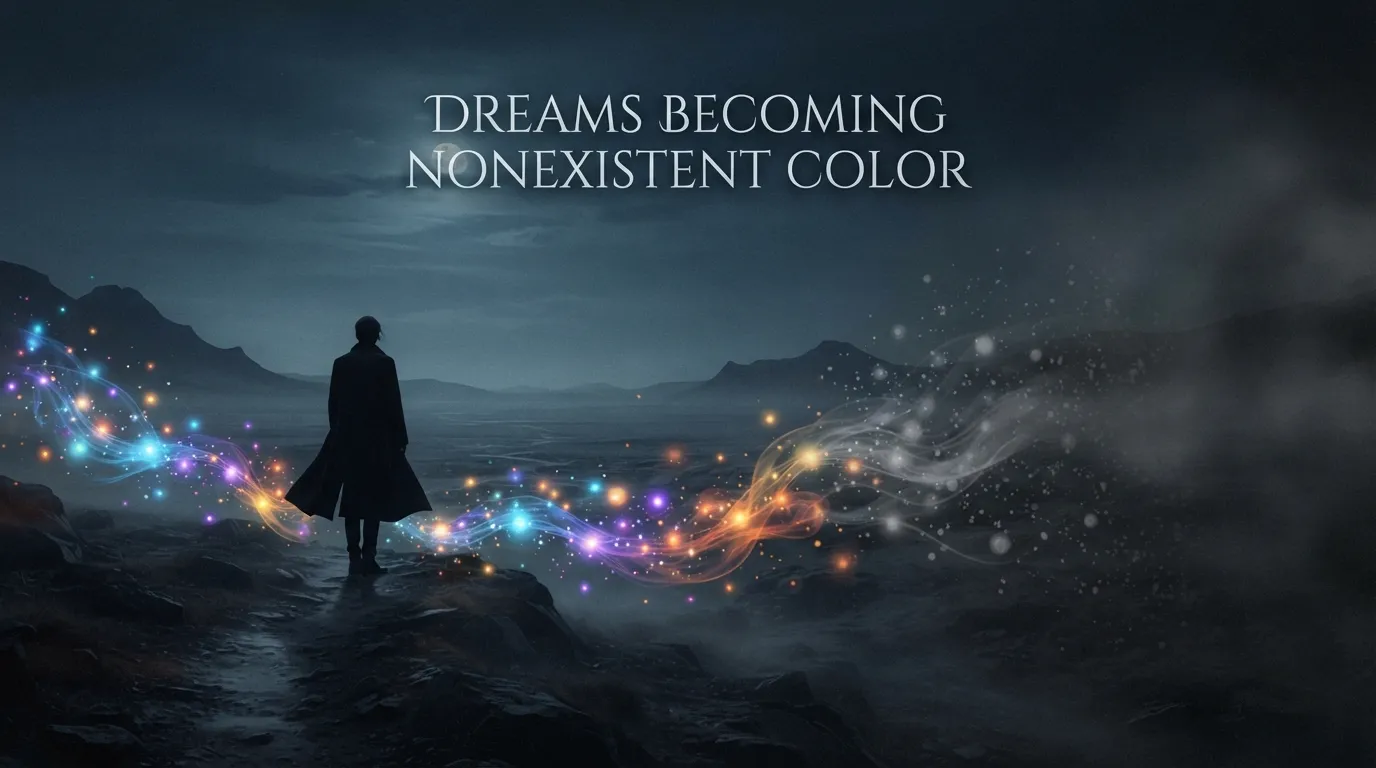
The color has no name. That is the strangest part of the dream. You are looking at something that should be red, or blue, or green, and instead it is a color that does not exist: a shade your eyes have never seen and your language has never needed. Trying to describe it afterward, you fail, because there is no word for it.
Dreams of a nonexistent color can symbolize a feeling, idea, or part of yourself that has no ready name: emotional numbness, loss of excitement or motivation, a period of uncertainty, inner conflict, emotional exhaustion, fear of losing something meaningful, a major life transition, a desire to withdraw, spiritual reflection, or a changing sense of identity.
A color with no name for a feeling with no name
Most dreams give you familiar symbols: a house, a road, a person. A nonexistent color refuses that comfort. It is the mind’s way of saying: something here is new, or something here has been unnamed for a long time.
The dream may reflect emotional repression, loss of pleasure, fear of change, unconscious conflict, unresolved memories, or feelings that are difficult to express. It may also reflect the opposite: creativity, joy, emotional expression, personal power, connection, or inner peace trying to find a form. The same impossible shade can feel beautiful in one dream and dreadful in another. The feeling is the guide.
What the color may be covering
These dreams often arrive after a period of emotional strain: ignored sadness, avoided difficult conversations, suppressed anger, hidden fear, prolonged stress, losing something important, feeling disconnected from yourself, or continuing to function despite emotional exhaustion. The mind, unable to find a word for the accumulation, invents a color for it.
It helps to ask what the color felt like rather than what it looked like. Was it warm or cold? Did it pull you closer or push you away? Did it feel like a warning, an invitation, or a relief? The answers may tell you more than any description of hue.
The shadow in the impossible shade
In Jungian psychology, the shadow represents aspects of ourselves that we do not fully acknowledge, accept, or express. A nonexistent color may be the shadow’s disguise: a part of yourself that has not yet found a form you recognize. Being chased through a landscape of impossible colors may reflect avoidance of something that feels too strange or too large to name.
From a Freudian perspective, dreams can express unconscious wishes, fears, and conflicts. An impossible color might dramatize a wish for something beyond ordinary experience, or a fear of losing contact with what is familiar. These are frameworks for reflection, not proven explanations.
Energy, awakening, and the language of the unseen
Some spiritual traditions interpret dreams of impossible colors through the language of energy, awakening, or expanded awareness, seeing the color as a sign that perception is shifting or that the dreamer is becoming aware of something previously hidden. These are spiritual frameworks rather than established scientific explanations. Used as metaphors, they can be useful: the dream may be asking what in your life is changing in ways you do not yet have words for.
Stress, transitions, and the sleeping brain
Stress is one of the most common factors associated with vivid and emotionally intense dreams. When waking life contains unresolved pressure, the brain continues processing emotional information during sleep. During REM sleep, the brain becomes highly active while the body experiences reduced muscle movement. Dreaming can involve memories, emotions, images, and fragments of recent experiences. Your brain does not necessarily create a logical story; it can combine emotionally important material into a symbolic narrative.
Dreams of impossible colors can also occur during transitions, when an old identity has loosened and a new one has not yet formed. If the dream leaves you deeply distressed, or if it repeats alongside poor sleep and daytime anxiety, speaking with a qualified mental health professional can help.
What the dream may be asking you to do
The dream may be pointing toward a need: more rest, emotional honesty, time alone, a meaningful conversation, freedom from an unhealthy pattern, space to grieve, a creative outlet, greater self-acceptance, or a new sense of purpose. The color itself may be less important than the longing underneath it.
Write down the dream soon after waking: the colors, the people, the places, the emotions, the actions, the symbols, the repeated themes, and how the dream ended. Then try to give the feeling a name, even an imperfect one. The act of naming is often the point. A feeling that has a name can be worked with. A feeling that remains an impossible color stays mysterious, and mystery, in dreams as in life, can be either a hiding place or an invitation.
Conclusion
A dream of a color that does not exist is the mind admitting that something in you has outgrown the words you have for it. Whether it points to numbness, grief, creativity, or a self that is still forming depends on the feelings it carried and the life it landed in. You do not need to solve the color. You only need to notice what it was standing in for, and to give that feeling a name of your own. If you are curious about colors that the eye cannot normally see and how scientists think about them, Wikipedia’s article on impossible colors explores the science behind shades that should not exist, yet sometimes do.










