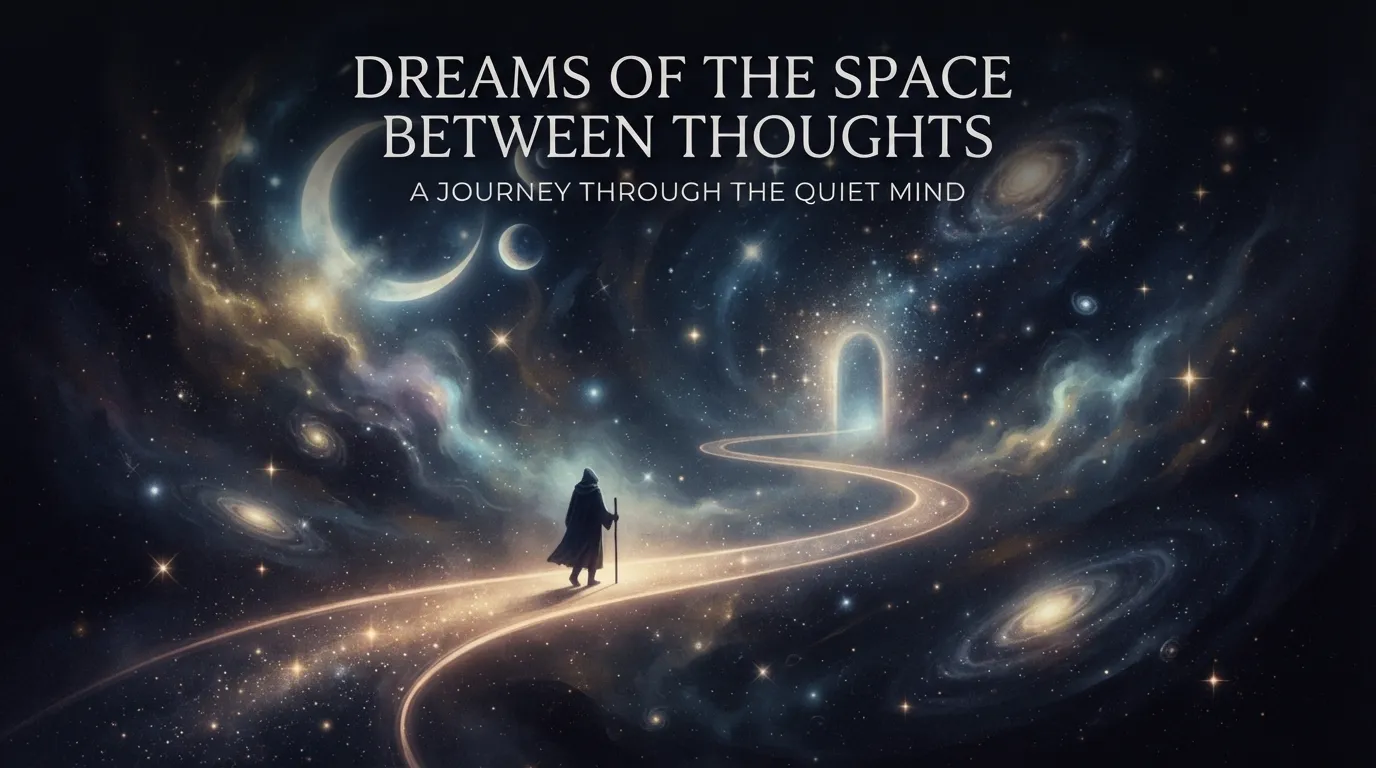
There is a gap between one thought and the next. Most of the time you never notice it. In this dream, you fall into it. No ground, no direction, no clear destination, no familiar surroundings, no obvious source of safety. Just a space that is not quite emptiness and not quite something, and the strange feeling that you are finally seeing what your mind looks like when it stops talking.
Dreams of the space between thoughts can symbolize a need for mental rest, unprocessed emotions, uncertainty about the future, a transition between different stages of life, a desire to escape overwhelming thoughts, curiosity about consciousness, spiritual reflection, or a feeling of emotional disconnection. They often arrive when the mind has been loud for a long time.
The void as rest
The most generous reading of this dream is also the simplest: your mind is tired. If your waking life has been full of decisions, notifications, conversations, and worries, the dream may be showing you what rest looks like: a place where nothing is required of you. The void, in this reading, is not a threat. It is a pause.
People who meditate sometimes describe a similar experience: a moment when the chatter drops away and something quieter remains. The dream may be your mind’s version of that moment, arriving uninvited in sleep because waking life has not made room for it.
The void as confrontation
But the space between thoughts is not always peaceful. Sometimes it feels like falling, or like being erased. In that form, the dream may be staging a confrontation with an unfamiliar part of yourself: the part that exists beneath the roles, the plans, and the noise. Without thoughts to hide behind, you meet whatever has been waiting underneath.
In Jungian psychology, the shadow represents aspects of ourselves that we do not fully acknowledge, accept, or express: suppressed anger, fear, shame, jealousy, grief, insecurity, unmet needs, unexpressed desires, past emotional wounds, and traits we believe are unacceptable. A shadow in a void dream may represent the material that surfaces when the mind finally goes quiet. Being chased through the void may reflect avoidance: a difficult conversation, a painful memory, a relationship decision, a personal weakness, an uncomfortable truth, a major life choice, or feelings of guilt or grief.
The questions that live in the gap
The space between thoughts has a way of asking questions that daily life keeps postponing. The loud questions are usually about identity and control: How do others see me? Am I successful? Am I safe? Am I accepted? Am I in control? The quieter questions, the ones that tend to matter more, are different: What do I truly feel? What am I avoiding? What matters to me? What needs healing? Who am I beneath my social identity?
From a Freudian perspective, dreams can express unconscious wishes, fears, and conflicts. A void dream might dramatize a wish to escape overwhelming pressure, or a fear of what remains when the distractions stop. These are frameworks for reflection, not proven explanations.
Energy, awakening, and the language of stillness
Some spiritual traditions interpret void dreams through the language of energy, awakening, or consciousness, seeing the gap between thoughts as a sacred space where awareness expands or where the self is renewed. These are spiritual frameworks rather than established scientific explanations. Used as metaphors, they can be useful: the dream may be inviting you to make room for stillness in waking life, not as an escape but as a practice.
Stress, transitions, and the sleeping brain
Stress is one of the most common factors associated with vivid and emotionally intense dreams. When waking life contains unresolved pressure, the brain continues processing emotional information during sleep. During REM sleep, the brain becomes highly active while the body experiences reduced muscle movement. Dreaming can involve memories, emotions, images, and fragments of recent experiences. Your brain does not necessarily create a logical story; it can combine emotionally important material into a symbolic narrative.
Dreams of the void can also occur during transitions, when an old identity has loosened and a new one has not yet formed. If the dream leaves you deeply distressed, or if it repeats alongside poor sleep and daytime anxiety, speaking with a qualified mental health professional can help.
Working with the dream: a short practice
Write down the dream soon after waking: where you were, what the void looked like, whether there was a shadow, what the shadow did, whether you were running, how your body felt, what emotions appeared, what happened at the end, and how you felt after waking.
Then try a waking version of the dream, in small doses. Sit quietly for two minutes, breathe slowly, and let the thoughts come and go without chasing them. Notice what surfaces in the gaps. If the gaps feel restful, your waking life may need more stillness. If they feel frightening, the dream may be telling you that something unprocessed is waiting for your attention. Either way, the practice is the same: notice, do not judge, and give yourself time.
Useful questions include: What makes you unusually angry? What do you envy in other people? What criticism hurts you most? What emotions do you hide? What qualities do you reject in yourself? What do you fear other people will discover about you? These are not accusations. They are doorways.
Conclusion
A dream of the space between thoughts is the mind showing you its own quiet room. Whether that room feels like rest or like falling depends on what you bring into it and what your life has been asking you to face. The void is not empty. It is full of everything you have not yet had time to hear. If you want a broader frame for thinking about awareness, attention, and the gaps between thoughts, Wikipedia’s article on consciousness offers a clear survey of how philosophers and scientists have approached the subject.










