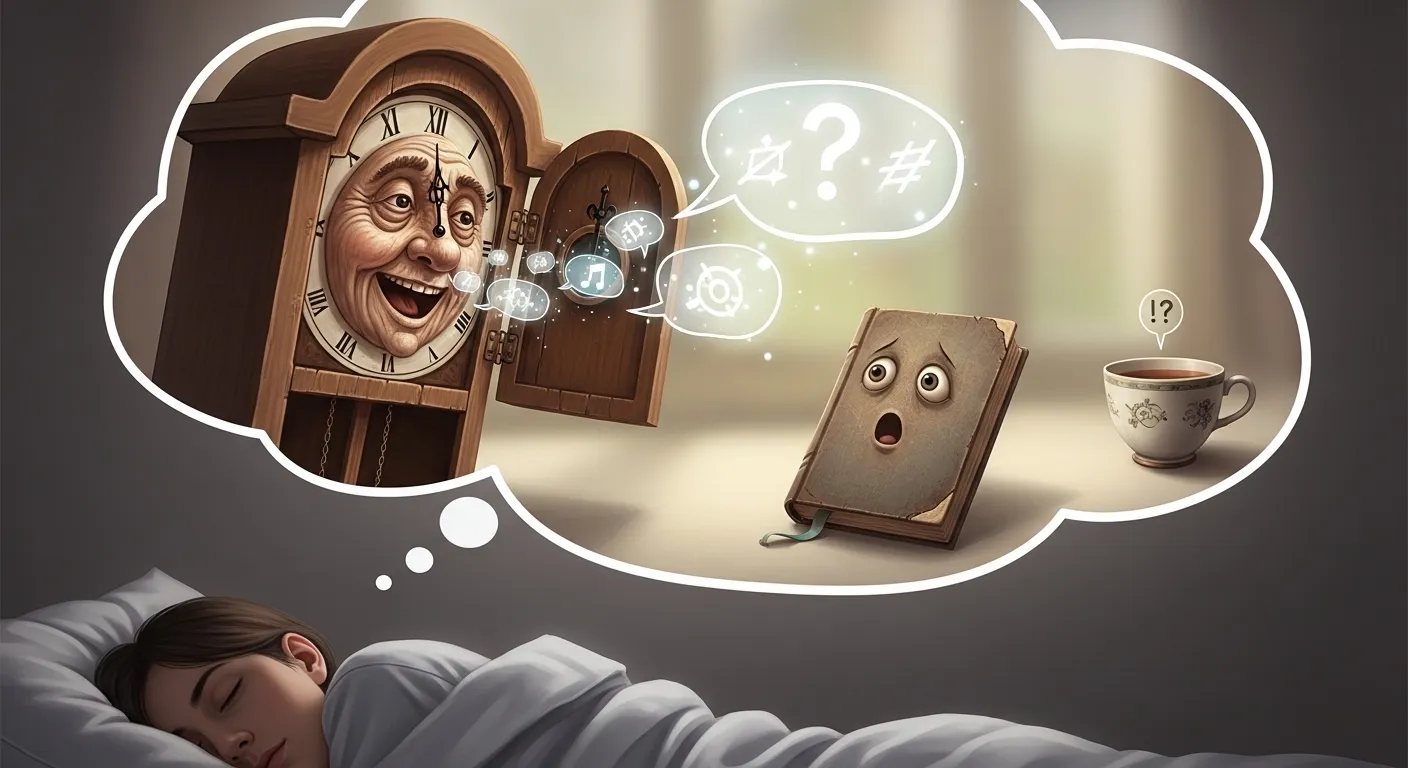
It’s the teddy bear that does it first. Not in a horror-movie way — there’s no malice in its button eyes. It just looks up from the shelf where it’s sat since you were seven and says, in a voice you almost recognize, “You never asked me how I was.” You wake up unsettled, and it takes you an embarrassingly long time to admit what unsettled you: the bear had a point.
Dreams of talking objects are the subconscious using its favorite trick — displacement. There’s something you need to hear, and some part of you that needs to say it, but saying it directly would be too much. So the mind hands the lines to a lamp, a mirror, a childhood toy. The object becomes a mouthpiece for the unspeakable.
Why objects get the voice
Children do this naturally: the stuffed animal speaks the feelings the child can’t. Dreaming adults are doing the same thing with better props. Psychologists note that we assign voices to objects in dreams for the same reason we did as children — because some truths need a character to carry them.
The mechanism is worth understanding because it tells you where to look. When an object speaks in your dream, ask: whose voice is this, really? The scolding clock is often your own anxiety about time, given authority. The kind mirror is often the self-compassion you won’t extend directly. The locked box that whispers is usually a memory asking — politely, for now — to be opened. The object is never the author. It’s the stage.
A small field guide to common speakers
Certain objects recur as dream-mouthpieces, and they’ve developed fairly stable associations across dream journals:
- Mirrors that speak — the self, demanding an audit. What the mirror says is usually what you’ve been avoiding saying to yourself. Listen especially if you argued with it.
- Clocks and watches — time anxiety, given a voice and therefore a volume. A clock that speaks the time, rather than showing it, suggests the pressure has become impossible to ignore quietly.
- Phones — communication breakdown. A phone that talks instead of connecting you to someone often means the message you need is one you could give yourself.
- Doors — thresholds and decisions. A talking door is the choice itself, asking to be acknowledged. What it says is usually the thing you already know about the decision.
- Childhood toys and dolls — the younger self, which is why these are the most emotionally potent. The toy almost always speaks for a feeling from childhood — or for the child-part of you that’s still running some of your adult reactions.
- Statues and portraits — frozen authority coming alive: the parent, the tradition, the old rule. When the statue speaks, an “unquestionable” thing is being questioned.
- Books and letters — the unread message. The dream is telling you the information exists; you just haven’t opened it yet.
What it said versus how it said it
Dreamers obsess over the content of the object’s speech, but therapists who work with these dreams often find the delivery more revealing. Consider:
Tone. Was it kind, urgent, mocking, sad? The tone is usually the true emotional content, with the words as its costume. A kind voice saying frightening things is reassurance in disguise. A mocking voice saying true things is your own self-criticism, externalized so you can finally hear how it sounds.
Repetition. Objects that repeat themselves — the clock that says the hour over and over, the toy with one looping sentence — are flagging something the waking mind has been looping too. The dream didn’t invent the repetition; it’s quoting you.
Your response. Did you answer? Run? Argue? Pretend not to hear? Your behavior toward the talking object mirrors your behavior toward the underlying issue. Dreamers who argue with the object are usually arguing with themselves about the same thing while awake — and the dream, helpfully, lets them hear both sides.
The animist intuition
There’s a reason these dreams feel ancient rather than merely strange. For most of human history, the idea that objects could speak — that rivers, stones, and tools had voices — wasn’t dream-logic but cosmology. Animist traditions worldwide treat the world as populated by speaking presences, and the dreaming mind seems to retain fluent access to that older way of perceiving.
This reframes the dream usefully. Instead of asking “why did the lamp talk,” you might ask what the lamp knows. The objects that speak in dreams are always objects with history — the chair from your grandmother’s house, the watch you wore through the hard year, the toy that witnessed your childhood. They speak because they were there. The dream is treating your possessions as witnesses, and calling them to testify.
If an object speaks to you tonight
Try the dream’s own method while awake. Pick the object — or if you can’t pick, let one pick you; the first that comes to mind is the right one. Then write, in its voice, what it would say to you right now. Don’t edit. Don’t be reasonable. Let the lamp be blunt.
People who do this exercise report two things: first, that the writing comes faster than expected, and second, that what’s written is something they already knew. That’s the whole secret of talking-object dreams. The object never tells you anything new. It tells you what you’ve been carrying past every day, waiting for something — a bear, a clock, a mirror — brave enough to say it out loud.
The intuition that the world is full of voices isn’t a glitch in your dreaming mind; it’s one of humanity’s oldest ways of knowing, studied under the name of animism. Your dream last night was, in its way, a brief return to that older cosmology — a night in which everything had something to say, and you, for once, stayed to listen.










