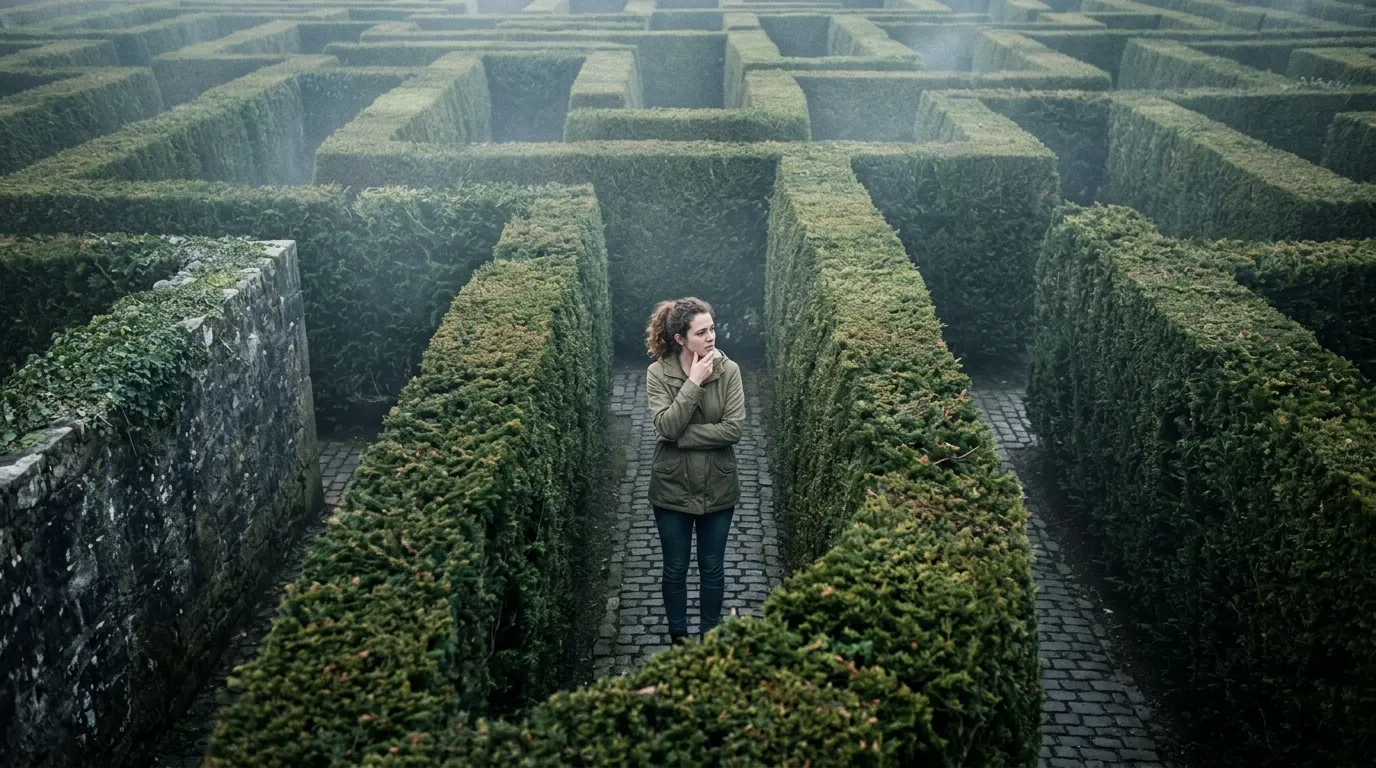
Every maze has two stories: the one about the walls, and the one about the person walking between them. A dream of a maze with no exit belongs mostly to the second story. The walls matter less than the feeling they create — the slow tightening of options, the sense that every choice leads back to itself, the quiet fear that you may have been walking in circles for longer than you realize.
The oldest maze in the world
Long before mazes became puzzles on paper placemats, they were sacred architecture. The labyrinth at Knossos, the turf mazes cut into English hillsides, the prayer labyrinths still walked in cathedrals — all of them share one design idea: a path that confuses the feet so the mind can pay attention. In the myth of Theseus, the labyrinth held the Minotaur, a monster at the center. The hero did not escape by being cleverer than the maze; he escaped by holding a thread.
That detail is worth keeping in mind when this dream appears. A maze with no exit is rarely a dream about intelligence. It is a dream about orientation — about what thread you are holding, and whether you still trust it.
What the dream is usually pointing at
In waking life, the maze tends to map onto one of three situations. The first is a decision that refuses to stay decided. You choose a direction — a job, a relationship, a move — and then a new corridor appears, and the choice has to be made again. The dream repeats the loop because the loop is real.
The second is emotional congestion. Grief, guilt, resentment, or worry can each feel like a corridor with no door at the end. You think about the same thing, reach the same conclusion, feel the same ache, and start over. The maze is the shape of rumination.
The third is a season of life without a clear role. New parents, new graduates, people between careers, people recovering from a loss — all of them describe the same sensation: everyone else seems to have a map, and you are the only one still walking. The dream gives that sensation a floor plan.
The feeling at the center matters more than the walls
Two people can dream of the same maze and wake with opposite messages, because the emotion inside the dream changes the reading. Notice which of these felt closest:
- Calm curiosity. You explored without panic. This often signals a mind that is comfortable not knowing yet — a search that is honest rather than desperate.
- Frustration. You knew there had to be a way out and resented the maze for hiding it. This often mirrors a waking situation where effort is not producing results.
- Dread. The walls felt hostile, or something felt close behind you. This often points to avoidance — a conversation, a decision, or a truth that the dream is circling because you are circling it.
- Resignation. You stopped walking and sat down. This can be the dream’s version of surrender, and not always a bad one: sometimes the way out of a loop is to stop running it.
Small details that change the meaning
The maze in your dream probably had texture. A hedge maze suggests a problem that is natural, grown over time, and possibly beautiful from above. A stone or concrete maze suggests something institutional — a bureaucracy, a family pattern, a system with rules nobody remembers writing. A dark maze suggests a problem you have not yet named. A maze that kept rearranging itself suggests shifting circumstances, where the rules change as you learn them.
And then there is the question of company. Walking alone points to a private struggle. Walking with someone who vanished points to a relationship that changed. Finding another person inside the maze often means the problem is shared, even if the other person does not know it yet.
A different way to work with this dream
Instead of asking, “What does the maze mean?” try asking, “What would my thread be?” The thread is whatever connects you back to yourself when a situation gets confusing: a value you refuse to trade, a person who tells you the truth, a practice that steadies you, a question you return to. In the myth, the thread was not a solution. It was a way back. Some problems are solved by moving forward; others are solved by remembering where you started.
It also helps to name the maze out loud, in plain language, the morning after. “I feel stuck in my career.” “I keep replaying the argument.” “I don’t know who I am now that this chapter is over.” A maze drawn on paper — even a rough sketch — often shrinks once it has a name. The dream’s power comes partly from vagueness; specificity is the thread.
If the dream recurs, keep a short log: date, the maze’s material, the dominant feeling, and one waking situation that resembles it. Patterns usually show within three or four entries. The exit, when it appears, is rarely dramatic. It is usually a small decision you had been postponing, finally made.
The labyrinth tradition holds a final idea worth carrying: the point of a labyrinth was never to escape it. The point was to walk it to the center, stand there, and walk back out changed. A maze with no exit may be asking for exactly that — not a frantic search for a door, but a pause at the center long enough to see the situation clearly. For the history of real labyrinths and how people have used them, the Wikipedia entry on the labyrinth is a good place to begin.










