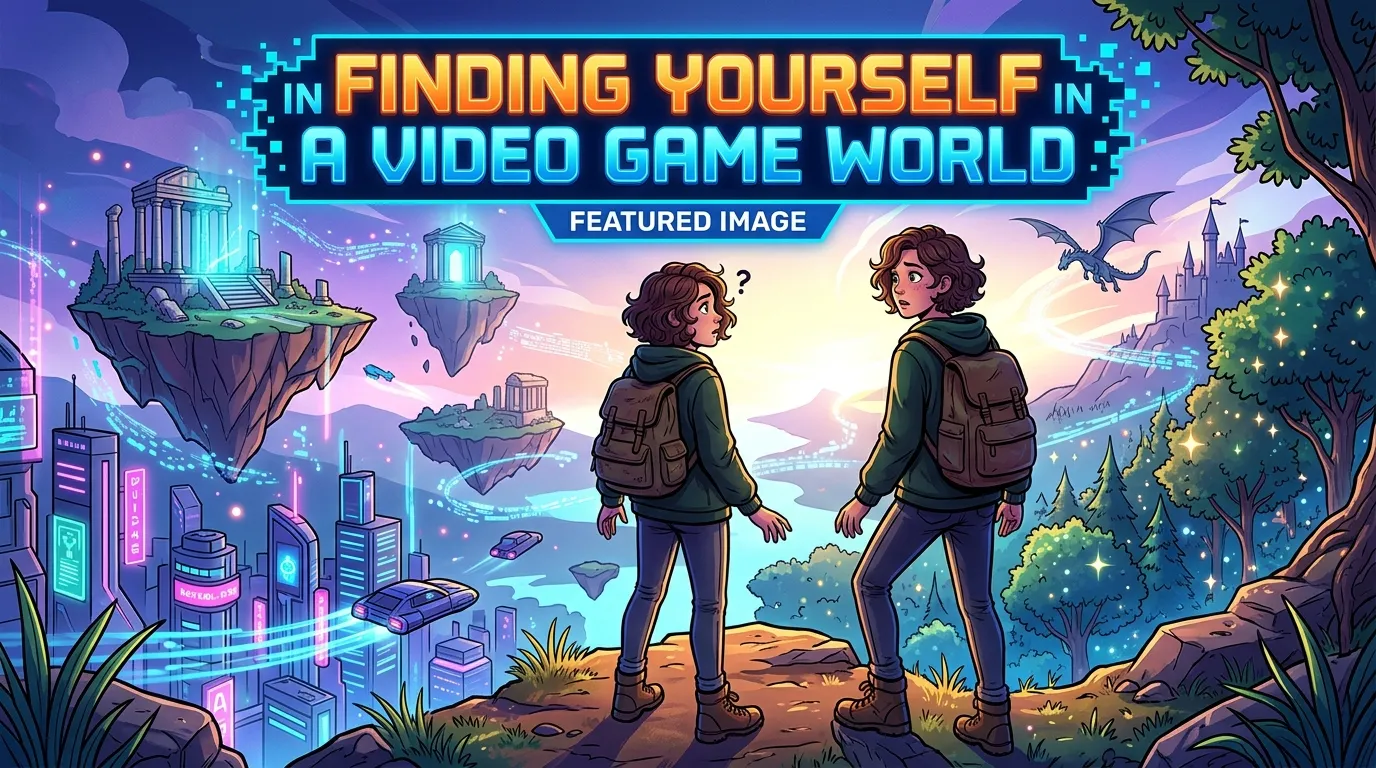
You are not just playing the game. You are inside it. The health bar hovers at the edge of your vision. The world is blocky or luminous or impossibly detailed. Somewhere there is a quest, a level, an enemy, a timer. And some part of you knows that none of it is real — yet it feels urgent anyway. A dream set inside a video game world is the sleeping mind borrowing the language of games to talk about real life: rules, levels, scores, restarts, and the strange feeling of being both the player and the character.
Games are systems with clear rules and measurable progress. Life is not. When the dreaming mind drops you into a game world, it is often trying to impose order on something that feels chaotic — or to expose the ways in which your waking life already feels like a game you did not agree to play.
Which game is it? The genre is the message
The kind of game world you enter shapes the dream. An adventure or quest game — open landscapes, missions, treasures — often reflects a life that feels like a journey: you are searching for something, completing tasks, leveling up. The dream may be asking what your current quest actually is, and whether you chose it.
A puzzle game — mazes, locked doors, riddles, patterns — often reflects a problem you are trying to solve in waking life. The dream may be rehearsing the feeling of being stuck, or the satisfaction of finding a solution. If the puzzles felt impossible, the dream may mirror a situation that feels unsolvable. If they felt satisfying, it may reflect a growing sense of competence.
A combat or survival game — enemies, weapons, health bars, danger around every corner — often reflects conflict or stress. The dream may be dramatizing a waking battle: a difficult workplace, a hostile relationship, a struggle with your own habits. The question is whether you felt capable in the fight, or overwhelmed by it.
A simulation or building game — towns, farms, cities, characters to manage — often reflects responsibility and control. You may be juggling many parts of a life and wondering whether you are managing them well. The dream turns that juggling into a world you can literally see.
Player, character, or both?
Your role in the game world matters. If you were the character — running, jumping, fighting, feeling every hit — the dream is immersive. You are living the experience, not observing it. That often means the waking situation the dream mirrors feels immediate and inescapable.
If you were the player — watching a character, pressing buttons, aware of a screen — the dream carries a sense of distance. You may be observing your own life rather than living it, going through motions, or feeling detached from your own choices. The dream may be asking whether you are truly participating in your life or merely operating it.
If you were both at once — inside the game and aware of playing it — the dream is about self-awareness itself. You are living and watching yourself live, the way people do when they are self-conscious, reflective, or undergoing change. The doubled perspective can feel eerie, but it can also feel liberating: you are both the actor and the author.
Lives, levels, and the fear of game over
Game mechanics carry their own symbolism. Extra lives can represent second chances, resilience, or a belief that mistakes are survivable. Losing a life can represent a setback, a failure, or a fear that you are running out of chances. A game over screen can represent a fear of finality — or, paradoxically, relief: the game is over, the pressure is off, you can start again.
Levels are a natural image for progress. Being stuck on a level can mirror a waking plateau: a career that will not advance, a relationship that will not deepen, a habit that will not change. Advancing to a new level can mirror growth, achievement, or a threshold crossed. A level that keeps resetting can mirror a pattern you cannot break — the same argument, the same mistake, the same situation, replayed.
Scores, coins, and inventories point to how you measure your own worth. Are you collecting approval, money, achievements, or experiences? Do you feel rich in the game or poor? The dream may be showing you what you are keeping score of in waking life — and whether that scoreboard is one you actually believe in.
When the game feels like real life
Sometimes the most unsettling part of this dream is how seriously you take the game. You know it is a game, yet you feel real fear, real urgency, real grief when something goes wrong. That feeling is the dream’s core insight: the line between “just a game” and “real life” is thinner than we pretend.
Many waking situations are, in a sense, games: social media with its likes and followers, careers with their ladders and scores, relationships with their unspoken rules. The dream may be asking whether you are treating something serious as a game, or something playful as life-or-death. It may be inviting you to step back and ask which rules you are following, who made them, and whether you want to keep playing.
There is also a hopeful reading. Games allow restarts. They allow practice. They allow you to try, fail, and try again without permanent consequences. A dream set in a game world can be a rehearsal space: your mind practicing courage, strategy, or persistence in a world where failure is survivable, so that you can carry that practice into a world where it matters. Games themselves have grown from simple amusements into vast worlds with their own stories and economies, and the history of video games shows how deeply humans love structured worlds with rules and rewards — which is exactly why the dreaming mind borrows them when life feels unstructured.










