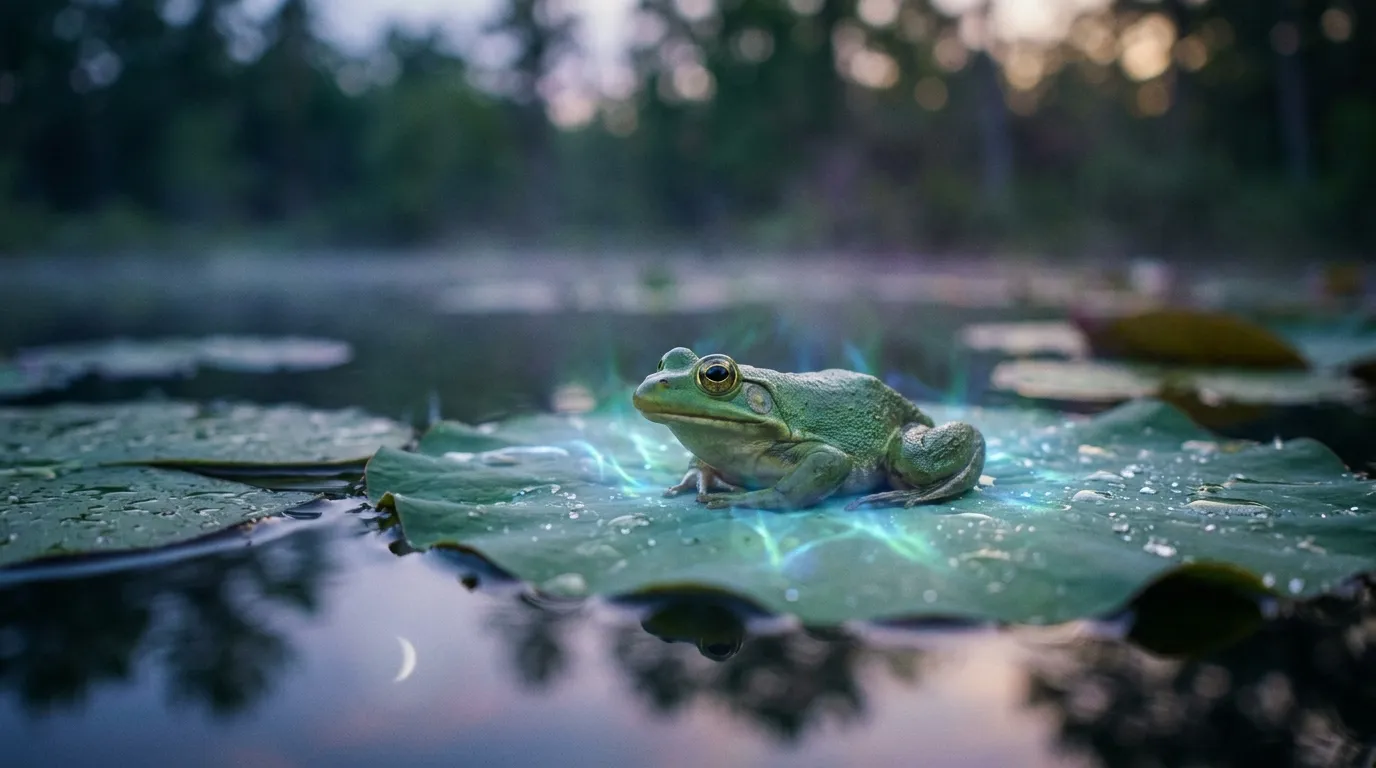
Of all the animals that hop through human dreams, the frog may be the most underrated. It doesn’t command like a lion or mystify like an owl — it simply shows up near water, mid-transformation, and waits for you to notice what it knows: that change doesn’t have to be graceful to be complete.
A frog begins as something entirely different from what it becomes. That single biological fact — egg, tadpole, frog — is why this small amphibian has carried transformation symbolism across cultures for millennia, from Egyptian rebirth imagery to the fairy-tale prince in the pond.
The Tadpole-to-Frog Arc in Your Own Life
When a frog appears in your dream, the first question worth asking is: what am I in the middle of becoming? Frog dreams cluster around transitions — not the dramatic, single-moment kind, but the slow, slightly awkward kind: growing into a new role, healing at an unglamorous pace, developing capacities you didn’t know you had.
Unlike butterfly dreams, which tend to celebrate finished transformation, frog dreams honor the messy middle. The tadpole doesn’t look like a success story while it’s growing legs. If your life currently feels like that — in-between, unpolished, not yet what it will be — the frog may be your subconscious saying the process is working even when it doesn’t look like it.
Water, Land, and the In-Between
Frogs live in two worlds: water and land. In dream symbolism, water typically represents emotion and the unconscious, while land represents the practical, conscious, everyday world. A creature comfortable in both can symbolize your own growing ability to move between feeling and action — to honor emotions without drowning in them, and to handle practical life without going numb.
Pay attention to where the frog was:
- In water — emotional territory. The dream may be about feelings surfacing, intuition strengthening, or emotional healing underway.
- On land — the change is entering your practical life: decisions, actions, visible new directions.
- Moving between the two — integration. You may be learning to carry emotional wisdom into everyday choices, or vice versa.
Field Guide: Frogs You Might Meet
A single calm frog
Often the simplest and most positive version: transformation is present but not urgent. Something is developing at its own pace, and the dream suggests trusting the timing.
A jumping frog
Movement, momentum, leaps. This frog tends to appear when stagnation is ending — you may be ready to act on something you’ve been circling. The leap doesn’t have to be huge; frogs remind us that progress is progress.
Many frogs
Abundance and multiplication. Multiple frogs can symbolize several opportunities arriving at once, emotional richness, or a season where growth is happening on many fronts simultaneously. In some traditions, frogs also carry fertility and prosperity associations.
A green frog
Green is the color of the heart in many symbolic systems — healing, renewal, emotional openness. A green frog often points specifically to emotional recovery: the heart mending, compassion expanding.
Holding a frog
To hold the symbol of change is to accept it. This dream often appears when someone has stopped resisting a transition and begun working with it — a quiet milestone the conscious mind may not have registered yet.
A dead frog
Unsettling but rarely ominous. Like all death symbolism in dreams, this usually marks completion: a phase fully ended, a transformation concluded, something released so thoroughly it no longer has life in it. Closure, in amphibian form.
A Frog Croaking or Calling
Sound matters in dreams, and a croaking frog often symbolizes a message trying to surface — your own voice, or your intuition, asking for volume. If the croaking felt insistent, the dream may be about something you need to say out loud: a truth, a need, a boundary. Frogs call to be heard; the dream may be asking you to do the same.
What to Ask Yourself
Rather than filing the frog away as “good” or “bad,” try interviewing it. Dreams respond well to curiosity:
- What in my life is currently between forms — no longer what it was, not yet what it will be?
- Am I resisting a change that, like metamorphosis, is happening whether I cooperate or not?
- Where do I need to be more amphibious — more able to move between feeling and doing?
- What would it look like to trust this transition the way a tadpole trusts its legs?
- What is trying to get my attention loudly enough that my dreaming mind gave it a voice?
The frog’s wisdom is humble and practical: keep the skin moist, stay near what nourishes you, and let the change finish. You don’t have to understand metamorphosis to undergo it — though it doesn’t hurt to know that the frog’s real-life transformation is every bit as strange and complete as the one your dreaming mind is picturing.










