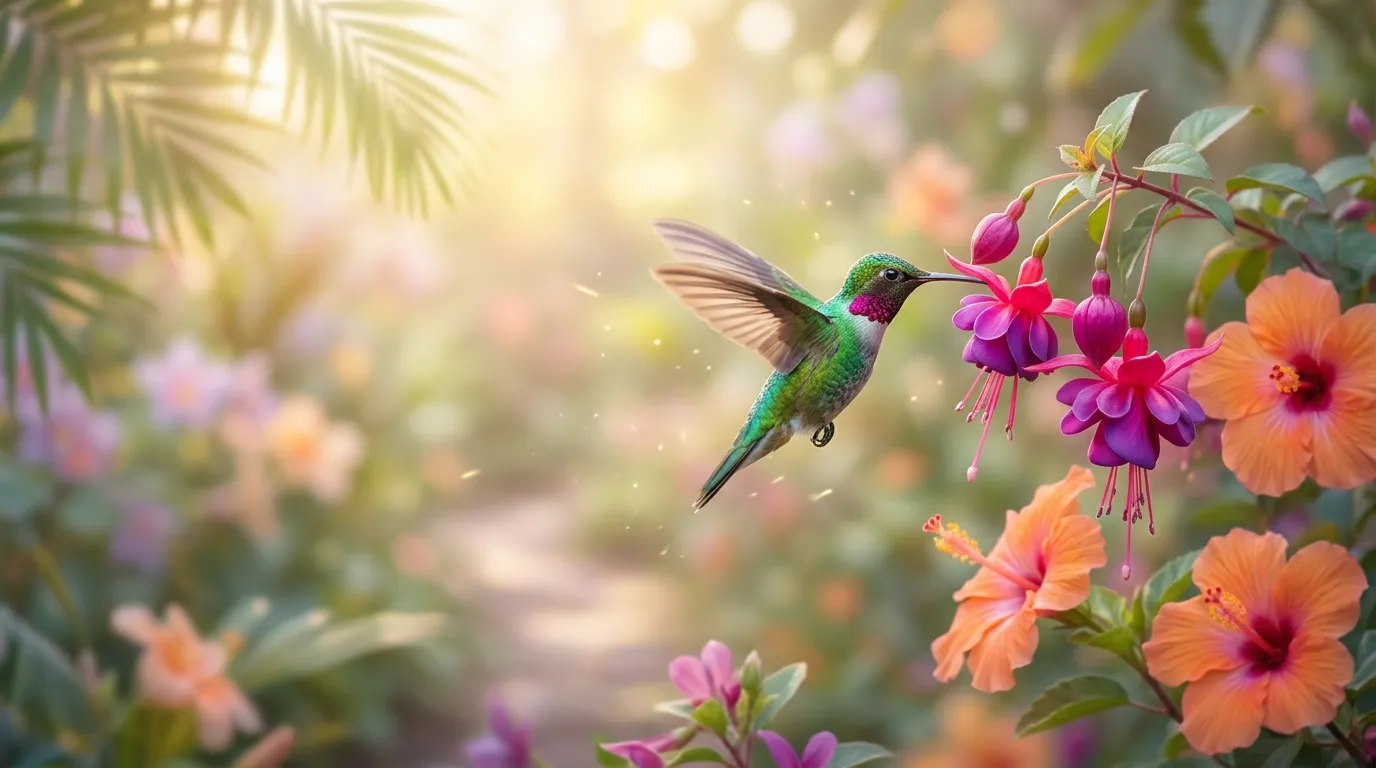
For the Aztecs, the hummingbird was not a small bird. It was a god of war and the sun, Huitzilopochtli, whose warriors believed they would return after death as hummingbirds, drinking nectar in the gardens of paradise. For the Taino people of the Caribbean, the hummingbird was a symbol of love and rebirth. For the Andean peoples, it was a messenger between worlds. A dream about a hummingbird arrives carrying all of that history in its tiny wings — and the first task is to hear which story it is telling you.
A bird that lives between worlds
Hummingbirds are biologically improbable. They fly backward, hover in place, beat their wings up to eighty times a second, and live on the edge of starvation, visiting hundreds of flowers a day. Their hearts beat faster than almost any other vertebrate’s. They are, by every measure, creatures that live at the limit — and they thrive there. That is part of why they have always symbolized resilience: not the resilience of the oak, which endures by standing still, but the resilience of the spark, which endures by moving brilliantly.
In dream symbolism, the hummingbird carries that same double nature: fragility and ferocity, delicacy and endurance. It is the smallest bird with the largest reputation. A dream that chooses it is usually a dream about surviving beautifully — about keeping joy alive under pressure.
What the hummingbird was doing
As with any dream, the action is the message. A hummingbird feeding at flowers often points to nourishment — emotional, spiritual, or creative — and to the small pleasures that sustain a life. A hummingbird flying freely often points to freedom, or to a part of you that is ready to move without permission. A hummingbird in a cage or a house often points to joy that feels trapped: a happiness you have confined, or a part of yourself that needs more air.
A hummingbird that came close to you — landing on your hand, brushing your face — often carries a message about intimacy: a closeness you are ready for, or a tenderness you have been avoiding. A hummingbird that you watched from a distance often carries a message about longing: a joy you can see but have not yet touched.
What the dream asks of you
A hummingbird dream is not a verdict; it is an assignment with only one task. Find the flower. That means: identify one source of genuine nourishment in your life right now — a person, a practice, a place, a piece of work — and give it the attention it deserves. Hummingbirds do not sip from every flower in the meadow. They return to the ones that feed them, again and again, with fierce loyalty. The dream may be asking you to do the same: to stop sampling every option and to commit to the few things that actually sustain you. Joy, in this reading, is not something you chase. It is something you return to.
Joy as a spiritual discipline
Many spiritual traditions treat joy as a lightweight emotion — nice, but not serious. The hummingbird disagrees. In the traditions that honor it, joy is a discipline: a practice of returning, again and again, to what is sweet and alive, even in hard seasons. A hummingbird dream often arrives when joy has become a casualty — when grief, work, or worry has crowded out delight. The dream’s prescription is small and specific: find one flower. One moment. One drop of nectar. Begin there.
There is also the hummingbird’s famous relationship with the present moment. A creature that must feed constantly cannot live in the past or the future; it lives now, or not at all. A dream of one may be the mind’s way of calling you back to the present — away from rumination about what was and anxiety about what will be, toward the single hour in front of you.
The other side of the symbol
Honesty requires the shadow reading too. A hummingbird that would not sit still, that darted and vanished, can mirror a life of frantic motion: always feeding, never resting, burning energy to stay in place. If the dream left you exhausted rather than uplifted, consider whether it was showing you your own pace — and whether that pace is sustainable. Even hummingbirds sleep. They enter a state called torpor, slowing their bodies to survive the night. The dream may be suggesting a torpor of your own: a real rest, not just a pause between flights.
Carrying the bird into the day
Keep the dream practical. Ask one question: where in my life is joy trying to survive on very little? Then give it something: a phone call to someone who makes you laugh, a walk without a destination, ten minutes with a book you love, a meal eaten slowly. The hummingbird’s lesson has never been about grandeur. It is about the discipline of small delights — and the fierce, hovering persistence it takes to keep finding them. For the Aztec god who wore the hummingbird’s feathers, the Wikipedia article on Huitzilopochtli tells the story behind the symbol.










