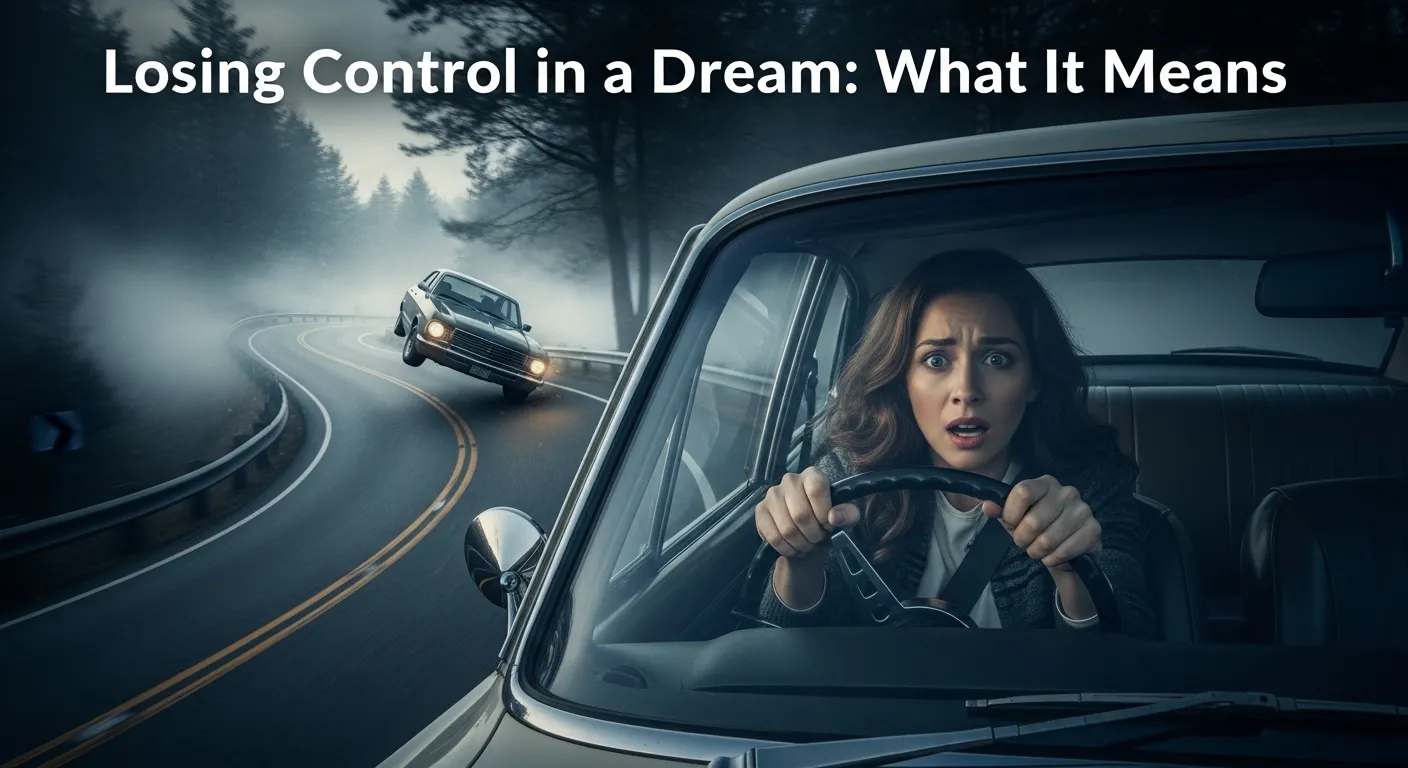
The brake pedal goes to the floor and nothing happens. The steering wheel turns but the car keeps going straight, or it veers with a mind of its own. The speed builds. Your hands are on the controls and the controls have stopped listening. If there is a single dream image for the feeling that your life is moving faster than your ability to direct it, this is the one.
Vehicles in dreams are among the most stable symbols in the entire dream lexicon: the car is your life’s direction, your agency, your forward motion. Losing control of it is the unconscious stating, without euphemism, that something has outpaced your steering. The question the dream poses is not whether you are in trouble — it is what, exactly, has gotten too fast.
Speed Is the Tell
Before interpreting anything else, notice the speed. Dreams are precise about this, and the velocity calibrates the meaning.
- Slow drift, gentle veering. A quiet loss of direction rather than a crisis. This belongs to drift periods: routines on autopilot, months passing without deliberate choice, a life being steered by habit rather than intention.
- Moderate speed, failing controls. The classic version. You are trying to steer and the car won’t fully obey. This maps to the overloaded middle of life: responsibilities multiplying, demands competing, the sense that you are managing everything and directing nothing.
- High speed, total loss. The terrifying version — hurtling, brakes gone, curves ahead. This is crisis velocity: a situation accelerating beyond your influence, whether a relationship spiraling, a work situation deteriorating, or an emotional state gaining momentum you cannot arrest.
The Three Ways Control Slips
The dream usually specifies how control is lost, and each mechanism points to a different kind of waking-life helplessness.
The brakes fail
You cannot slow down. This is the dream of the person who cannot stop: the overcommitter who keeps saying yes, the worker who cannot take the weekend off, the mind that cannot stop rehearsing at 3 a.m. The issue is not direction — you may be headed somewhere fine — it is the inability to pause, rest, or set a boundary. The dream is asking what it would take to install a working brake pedal in your actual life.
The steering fails
You cannot change direction. This belongs to people locked into a course: the career path that no longer fits but pays too well to leave, the relationship dynamic that repeats, the life decision that feels irreversible. The car goes where it goes regardless of your hands. The dream’s question is whether the course is truly locked, or whether you have simply stopped believing the wheel can turn.
Someone else is interfering — or the car drives itself
Hands on the wheel that aren’t yours, a car with its own agenda. This version is about external control: a domineering partner, a demanding boss, family expectations, cultural scripts. Your life is being steered and you are technically in the driver’s seat — which is, in some ways, the most frustrating version, because the loss of control comes with the appearance of control.
Who Else Is in the Car
Passengers change the reading. Alone, the dream is about your own agency. With passengers you care about, the stakes rise: the loss of control now endangers people you love, which usually means the waking-life situation involves responsibility for others — children, a team, aging parents. The dream amplifies the fear that your overwhelm will cost someone else.
With strangers or a crowd, the pressure is social: the feeling of being watched while losing your grip, the performance of competence while the controls fail. And if someone in the car is calm while you panic, notice who — the dream may be pointing at a part of yourself, or a person in your life, that is handling the same situation with steadier hands.
Reclaiming the Wheel in Waking Life
This dream responds unusually well to small, concrete acts of agency — because its complaint is specifically about agency, not about insight. You do not need to understand your entire life to quiet it; you need to prove to your nervous system that your hands still work.
Pick one thing that has been on autopilot and take deliberate control of it this week: a boundary stated plainly, a decision made instead of deferred, a speed consciously reduced. The dream does not require you to fix everything. It requires evidence that steering is possible. One working control is often enough to change the dream’s script — many people report that after taking a single decisive action, the next version of the dream features brakes that work.
There is also a deeper reading worth sitting with. Sometimes the dream is not saying you have lost control but that you never had the kind of control you imagined — and that the white-knuckled grip was the problem, not the solution. The drivers who survive skids are the ones who steer into them rather than fighting. If the dream keeps returning despite your best efforts to tighten your grip, consider the possibility that it is asking for the opposite: less clutching, more skillful yielding.
Your hands belong on the wheel — but the wheel was always a collaboration between you and the road. For a fascinating look at why humans feel control so intensely, and what happens psychologically when that feeling slips, the psychology of perceived control offers a framework that maps onto this dream almost eerily well.










