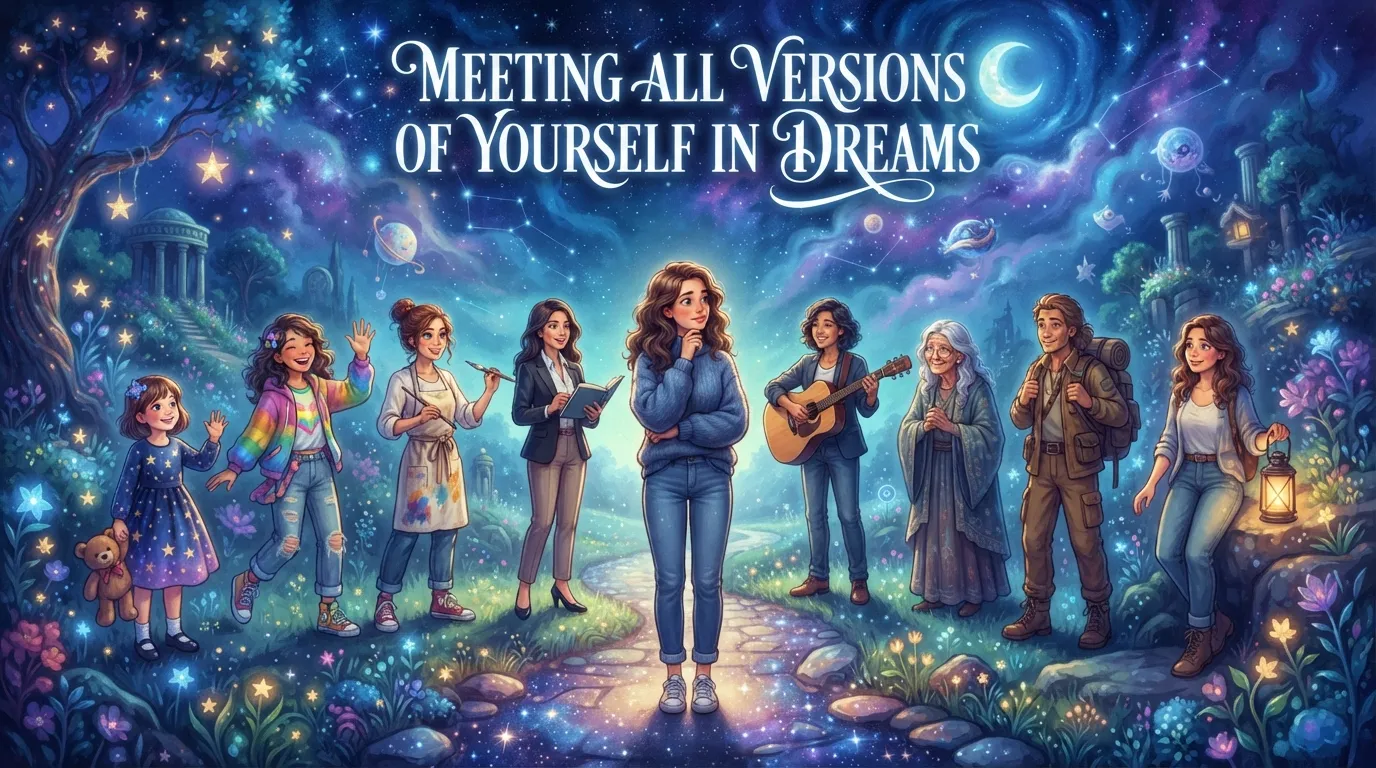
There is a room, and in it stand several people who are all you. One is younger, one is older, one is the version of you that took the other road, and one is someone you barely recognize but cannot stop looking at. Dreams of meeting all versions of yourself are among the strangest the mind produces, and also among the most honest. They gather the selves you have been, the selves you might become, and the selves you have tried to forget, and put them in one place.
Such a dream can symbolize self-reflection, identity, personal growth, or an inner reckoning. It often arrives during a period when the question “who am I?” has stopped being abstract and become urgent.
The gathering
The versions of yourself in the dream are rarely random. A child version may carry old wounds, old joys, or a quality you lost along the way. A future version may carry hope, dread, or a warning. A version that made a different choice may carry regret or relief. What each version looked like, what each one said, what happened between you, what you felt, and how the dream ended all shape the meaning.
Pay attention to which version drew you most. The one you avoided may matter as much as the one you embraced. The one who spoke may be carrying something the waking you has been unwilling to say. The one who stayed silent may represent a part of your life you have stopped narrating.
Questions the dream leaves on the table
Dreams like this tend to leave questions rather than answers: Who am I becoming? What parts of myself have I ignored? Am I living according to my true values? What emotions have I been avoiding? How has my past shaped who I am today?
These questions often surface during transitions: starting a new career, ending a relationship, moving to another place, getting married, becoming a parent, recovering from a major setback, changing personal beliefs, or entering a new stage of adulthood. Transitions force a comparison between who you were and who you are becoming, and the dream stages that comparison literally.
When one of the versions chases you
Not every version in the dream is friendly. Sometimes one of them pursues you, or a shadow moves among the versions. Being chased in a dream often reflects something you are trying to avoid: a memory, a feeling, a decision, or a truth about yourself. When the pursuer is another version of you, the dream may be unusually direct. The thing you are running from is yourself, or at least a part of yourself you have not yet faced.
In Jungian psychology, the shadow represents aspects of ourselves that we do not fully acknowledge, accept, or express. Meeting all versions of yourself may be the mind’s way of staging a confrontation with the shadow, not to defeat it but to recognize it. The goal, in Jungian dream work, is integration rather than elimination: understanding what each version represents and what it needs. From a Freudian perspective, dreams can express unconscious wishes, fears, and conflicts. The different versions may dramatize a conflict between what you want and what you believe you should want.
What the versions may be trying to say
Each version of yourself can be read as a messenger. The younger self may be asking for the compassion you did not receive then. The older self may be offering perspective, or warning you about a road you are already on. The self who made the other choice may be carrying the grief of a path not taken, or the relief of an escape you forgot to celebrate. The stranger version, the one you barely recognize, may represent a part of you that is still forming: an identity you have not yet named.
Some spiritual traditions interpret such dreams through the language of awakening, energy, or the soul’s journey, seeing the gathering as a sign of growing self-awareness. These are spiritual frameworks rather than established scientific explanations. Used as metaphors, they can be useful: the dream may be less a message from elsewhere and more an invitation to pay attention to your own inner life.
The science of a crowded dream
From a scientific perspective, dreams are closely connected with sleep and brain activity. During REM sleep, the brain becomes highly active while the body remains largely still. Dreaming appears to involve emotional processing, memory, imagery, and the integration of experiences. The brain can combine recent experiences with older memories, emotions, concerns, and symbols into stories that rarely follow waking logic. A dream of many selves may be the brain’s way of processing identity across time: sorting memories, rehearsing futures, and testing which version of you feels most true.
Stress can amplify this kind of dream. When waking life contains unresolved pressure, the brain continues processing emotional information during sleep. If the dream leaves you deeply distressed, or if it repeats alongside poor sleep and daytime anxiety, speaking with a qualified mental health professional can help.
Working with the gathering
Write down the dream soon after waking: who appeared, what each version looked like, what happened, what you felt, what each version said, how the dream ended, and what you felt after waking. Then, for each version, ask one question: what does this version of me want me to know?
You may find that the versions are not enemies. They may be a committee, and the dream may be the first meeting you have held with yourself in a long time. The most useful response is not to choose one version and exile the rest, but to listen for what each one is carrying: grief, hope, anger, curiosity, or a need you have been ignoring.
Conclusion
Meeting all versions of yourself in a dream is the mind’s way of holding a mirror with many faces. The dream may be less about which version is real and more about the fact that all of them are yours: the past you carry, the present you inhabit, and the future you are still writing. If you want a wider frame for thinking about how identity forms and changes over a lifetime, Wikipedia’s article on self-concept offers a clear overview of the psychology behind it.










