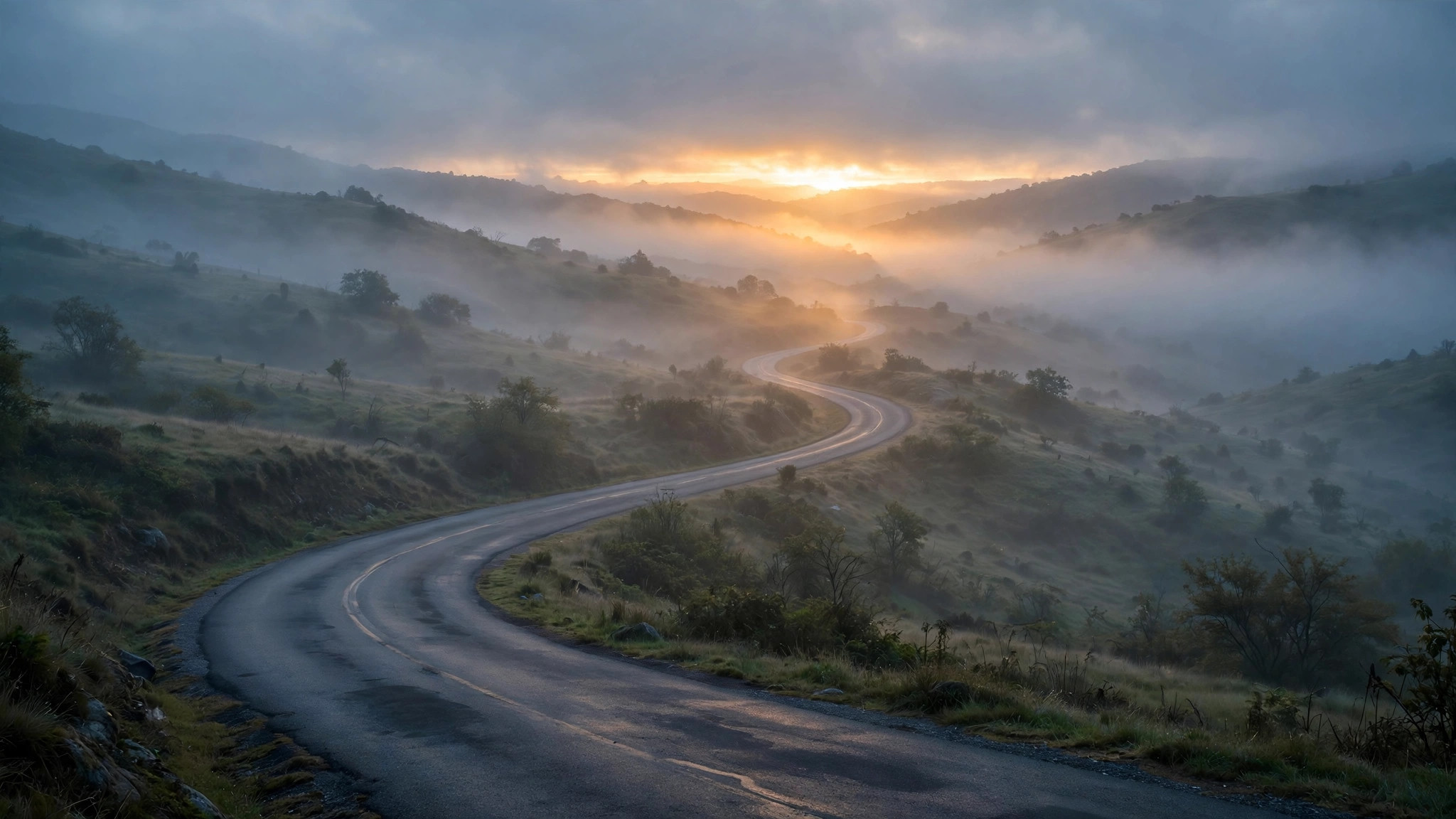
Traveler, stop for a moment. The dust is still on your shoes, the horizon is doing that thing it does — promising and withholding at once — and the road beneath you is asking a question you have been avoiding in daylight. Every road in a dream is your road. Let us walk it and hear what it has to say.
The Road Is the Story of Your Direction
Of all dream symbols, the road may be the most honest, because it refuses to be about anything except the journey. Where you have been, where you are headed, and — most revealing — how you feel about the way forward. The road does not describe your circumstances so much as your relationship with your own unfolding.
The old readers saw the soul’s pilgrimage here: a meaningful point on the path, a season of testing or a stretch of grace. A clear, sunlit road suggested alignment — the way made smooth, guidance present, the traveler on the right path whether they felt it or not. A dark or broken road suggested the lamp must be carried, not found: faith, patience, and inner steadiness for a stretch where the destination is hidden.
The depth psychologists agreed, in their own language. The journey is the central archetype of becoming — the lifelong work of growing into who you actually are — and the road is that work made visible. Its condition is a direct report from the interior: lost on the road often means directionless awake; cruising with confidence usually means you trust your current direction more than you admit.
Reading Your Road
The open road
A long, straight highway unspooling to the horizon signals clarity. You know where you are going — or you are finally ready to. This dream frequently arrives right after a real decision has been made, when the way forward feels right in the body before the mind has caught up.
The fork
Curves and forks are the dream’s way of pausing you. A fork in particular carries weight: a choice of consequence is approaching, and it deserves your full, unhurried attention. Notice which path drew your eye in the dream — the pull you felt is data about what you actually want.
The blockage
Fallen trees, construction barriers, a bridge washed out mid-crossing — obstacles on the road symbolize whatever is blocking you awake. Sometimes the barrier is external: circumstances, other people’s decisions. Sometimes it is internal: fear, self-doubt, an old story about what you cannot do. The dream’s question is practical, not mystical: what needs clearing, and what is the first small clearing you could do today?
Companions on the road
Who was walking with you matters as much as where you were going. Companions represent the people journeying through this season of life beside you — their presence, absence, or difficulty in the dream mirrors the current state of those bonds. Walking alone is not automatically lonely; sometimes it means the next stretch is yours to walk unaccompanied, by choice or by necessity.
What Your Feet Already Know
Before you analyze the road, consult the feet. Were you striding or trudging? Barefoot or shod? Moving forward, stuck at the shoulder, or — tell the truth — walking backward while pretending otherwise? The body in the dream keeps the records the mind edits. A smooth stride on a rough road says your spirit is stronger than your circumstances; exhaustion on an easy road says the weariness is not about the path at all, and the rest you need cannot be found by arriving faster.
There is an old, quiet practice for road dreams: take the dream for a walk. Go outside, move at the pace of the dream, and let your feet do the thinking your head cannot finish. Direction is not only a metaphor. Sometimes the body knows the way before the mind agrees to follow it.
Asked Often
What does a road symbolize in dreams?
Your life’s journey in its simplest form — direction, progress, choices, and your felt sense of where you are headed.
What does a fork in the road mean?
An approaching decision of real consequence. The dream highlights the choice and invites careful, conscious deliberation rather than drift.
Why do I keep dreaming of being lost?
Being lost usually mirrors waking uncertainty about direction — career, relationships, purpose. But there is hope built into the image: the dream only shows you lost because some part of you is already searching for the way.
Does a smooth road mean good luck?
More than luck, it reflects alignment — a felt sense of rightness about your path, whether already present or approaching. Take it as encouragement, not a guarantee.
In the end every road dream returns to the traveler. Smooth or twisted, crowded or empty, the road was showing you where you stand — and reminding you, gently, that the journey itself is the destination. For more on the paths humans have built and walked for millennia, explore the Wikipedia article on roads.










