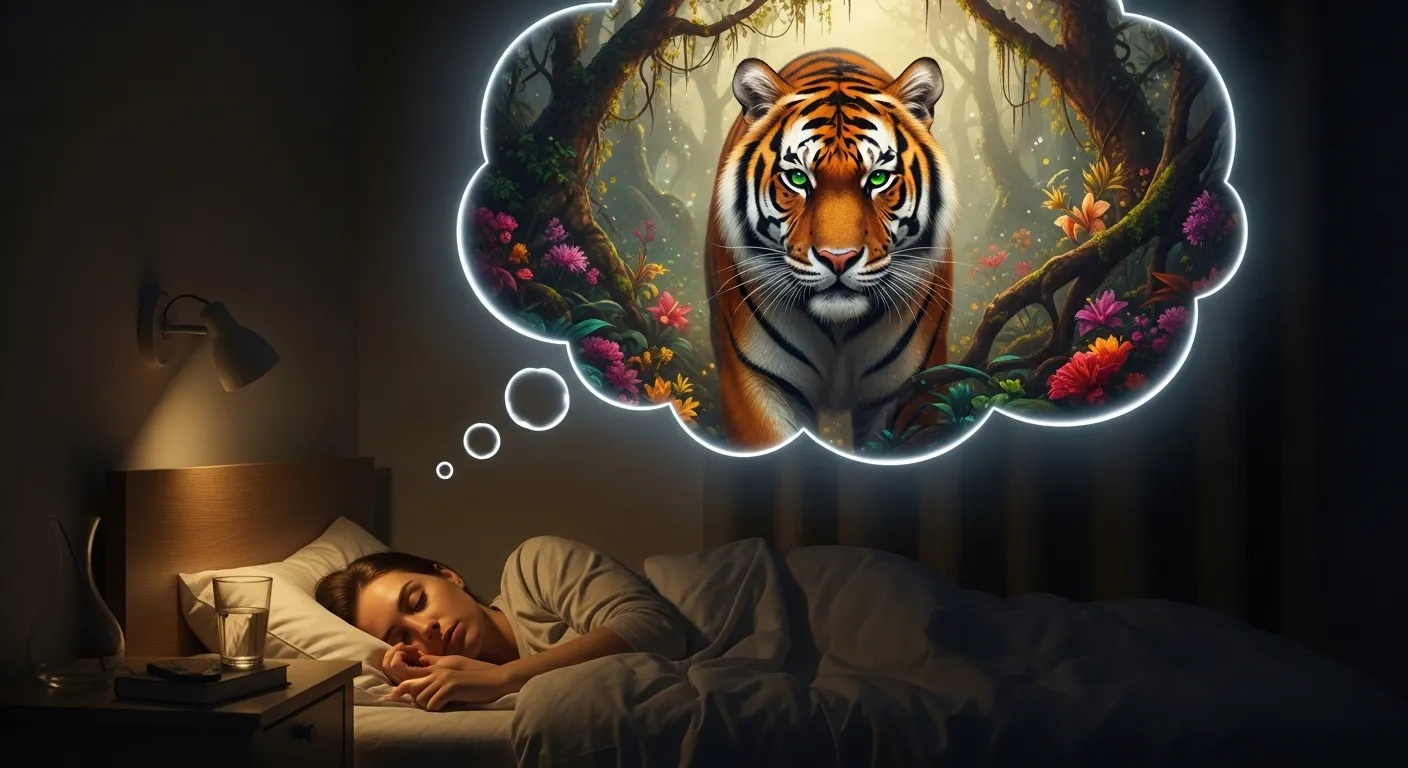
No two tigers have the same stripes. Each pattern is unique, unrepeatable, impossible to fake — nature’s fingerprint rendered in orange and black. Keep that in mind, because a tiger in your dream is usually about your particular power: the raw, instinctive, unapologetic force that is yours alone and can’t be borrowed from anyone else.
Raw, Unapologetic Power
The tiger is power without committee meetings. It doesn’t negotiate, apologize, or explain itself — it acts. In dreams, the tiger typically embodies vitality: life force, passion, ambition, physical energy, the part of you that wants something and isn’t interested in being reasonable about it.
This is neither good nor bad on its own; it’s fuel. The dream’s question is about the fuel’s management. A tiger moving calmly through your dream suggests your power is integrated — present, available, under control. A tiger out of control suggests the opposite: drives overwhelming judgment, anger or desire running the show, instinct drowning out wisdom.
Tigers are also solitary, unlike lions. A tiger dream often concerns personal power rather than social power — not your authority over others, but your command of yourself.
Fear Is the Point
Let’s be honest: tiger dreams are usually frightening, and the fear is doing work. Psychologists note that the dreaming brain amplifies emotion — during REM sleep, the fear centers run hot. But the fear also carries information. What you fear in the dream is usually what you fear in yourself: your own capacity for aggression, your own hunger for more, the wildness you’ve been keeping caged behind good manners.
Carl Jung’s concept of the shadow applies here with particular force. The tiger is the shadow at full strength — not a whisper of repressed feeling but a roar of it. The dream isn’t saying you’re dangerous. It’s saying you’re alive in ways you’ve been editing out, and the editing is costing you.
Scenarios
Running from a tiger is the classic: fleeing your own intensity. The avoided thing is usually a passion, an ambition, or an anger you’ve decided is unacceptable. The tiger keeps pace because it’s part of you — you can’t outrun your own nature, only exhaust yourself trying.
Facing the tiger marks the turn. Dreamers describe a moment of stopping, turning, and meeting the tiger’s eyes — and the terror converting to something like recognition. This symbolizes integrating your power: acknowledging your fierceness without being ruled by it.
A tiger that never catches you suggests a standoff with your own drives — desire and restraint locked in stalemate. The dream asks which side needs to yield, and which needs to be heard.
The tiger disappearing means the confrontation worked or the intensity passed. Either the power integrated, or the season of urgency ended.
A caged or wounded tiger deserves attention: power suppressed or injured. Are you caging your own strength to stay acceptable? Is your vitality wounded — by burnout, by criticism, by a life too small for you?
Balancing Instinct and Wisdom
The tiger’s final lesson is about partnership between two inner forces: instinct and wisdom. Instinct without wisdom is destruction; wisdom without instinct is paralysis. The healthiest tiger dreams — the animal powerful and calm — show both operating together: the courage to want, governed by the judgment to choose well.
Practically: identify one desire you’ve been suppressing because it felt “too much.” Ask whether it’s actually destructive, or merely inconvenient to your self-image. The tiger doesn’t ask you to act on every impulse. It asks you to stop pretending you don’t have them. Owned power is safe power; only disowned power goes feral.
The Tiger’s Gaze: Being Seen
There’s a variant of the tiger dream people describe with particular intensity: the tiger isn’t chasing — it’s looking. Watching from the trees, eyes locked on yours, perfectly still. This is a different dream from the chase, and it deserves its own reading. Being seen by the tiger means being seen in your fullness — the wild, the powerful, the parts you usually keep hidden — and not being devoured for it.
For many dreamers, this is the most moving tiger dream of all, because it reverses the usual fear. The thing you were afraid would destroy you if it truly saw you… sees you, and waits. Psychologically, this can represent self-acceptance arriving: the moment you stop performing tameness and allow your actual intensity to exist. If your tiger looked at you without attacking, consider that the dream may be showing you what acceptance of your own power feels like — still, direct, unafraid.
Stripes as Identity
Return to the stripes for a moment — no two tigers share the same pattern. In a dream, those markings can represent your own unrepeatable identity: the particular combination of strengths, appetites, and instincts that is yours alone. A tiger dream is sometimes simply your subconscious insisting on your distinctness — against the pressure to conform, to be reasonable, to be smaller. The stripes say: this is what you’re made of. Stop apologizing for the pattern.
Solitary, striped, and unmistakable — the real animal is as extraordinary as its symbolism, as you’ll see in the Wikipedia article on tigers.










