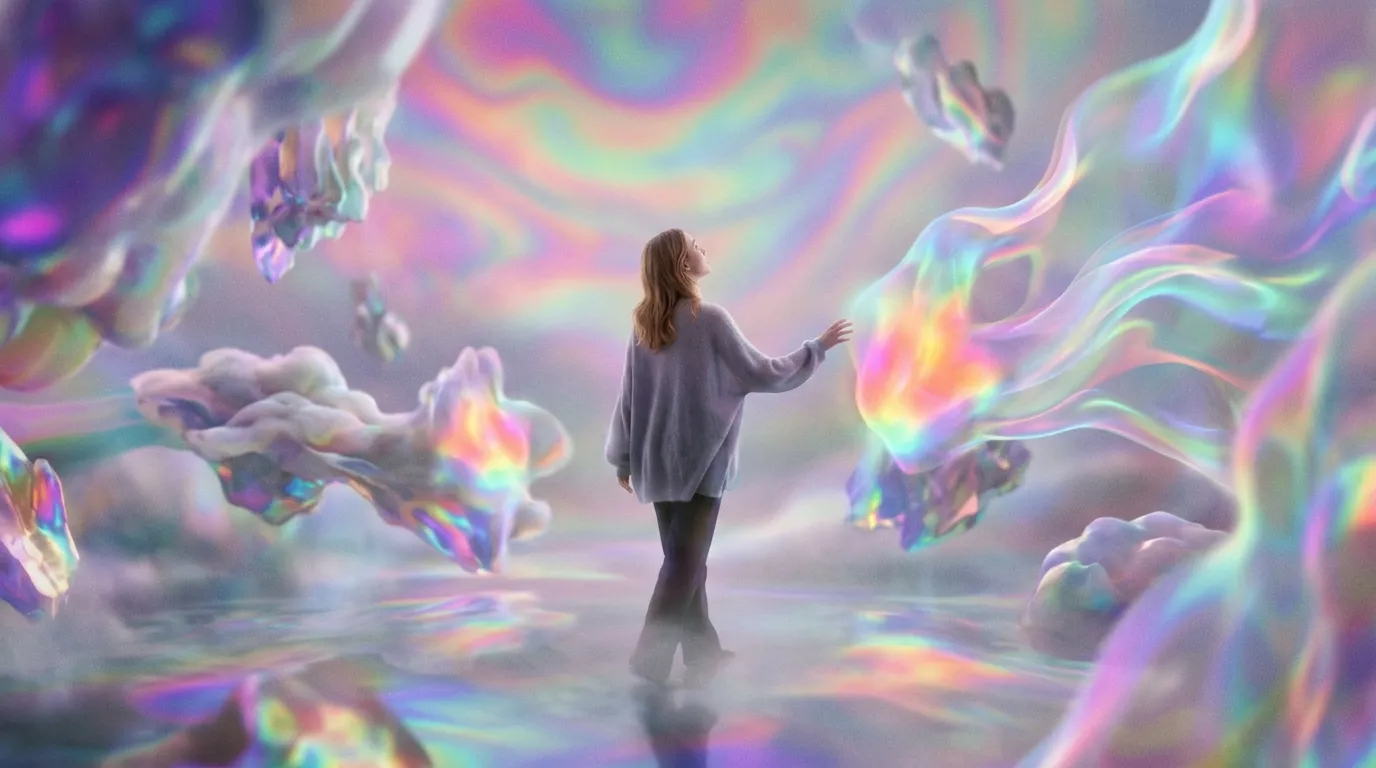
Artists have a word for the moment a color refuses to be named: they call it a color beyond the palette. Dreamers know that moment too. You wake from a dream carrying a shade you have never seen with open eyes — not quite blue, not quite light, something that glowed from inside itself — and you find, absurdly, that ordinary language has no shelf for it. The color was real to you. The world simply has no sample chip for it.
Why the dreaming brain invents colors
Color in dreams is not painted by the eyes. It is assembled by the brain from memory, emotion, and expectation. During sleep, the visual cortex is free from the job of reporting the world accurately, so it starts improvising. The result can be hues that feel richer, deeper, or stranger than anything in daylight — colors that seem to carry feeling the way music does.
Neuroscientists note that dreaming is a whole-brain event: regions that process emotion, memory, and vision fire together in patterns waking life rarely allows. An impossible color may be the brain’s way of tagging an experience that has no ordinary label — a feeling you have not yet named, a memory that is still forming, a piece of yourself that is still in draft.
The color that had a feeling attached
Most people who report impossible colors remember the emotion more vividly than the hue. That is the first clue to interpretation. Ask yourself what the color felt like, not what it looked like:
- A color that felt like peace often arrives during healing — after grief softens, after a long conflict ends, after you finally rest. The brain may be rendering relief in a shade it has never needed before.
- A color that felt like awe often marks expansion: a new idea, a spiritual opening, a sense of the world being larger than your old map of it.
- A color that felt like dread often belongs to the unknown in its harder form — a change you sense coming but cannot picture, a truth you are not ready to look at directly.
- A color that felt like joy often signals creative energy. Many painters, musicians, and writers report impossible colors before a burst of work, as if the imagination were warming up.
What the color was doing matters
A color that filled the whole sky behaves differently from a color that appeared on a single object. A sky of impossible color suggests a mood or a season of life — something atmospheric, surrounding everything. A color on a flower, a garment, or a person’s face suggests a focused message: this one thing, this one relationship, this one part of yourself is where the newness lives.
Color that moved — shimmering, pulsing, changing — often belongs to transition. Color that stayed still and radiant often belongs to conviction: something you have come to know deeply, even if you cannot yet explain it.
Old traditions had names for this
Mystics across cultures have long described colors that do not exist on earth. The “clear light” of Tibetan Buddhism, the radiant hues of near-death accounts, the jewel-toned heavens of medieval vision literature — all describe seeing as a form of knowing. You do not have to take these accounts literally to notice the pattern: when people describe encounters with the sacred, ordinary color vocabulary breaks down. Your dream may be brushing the same edge — not necessarily a supernatural event, but a genuine experience of the mind perceiving beyond its usual limits.
Keeping the color alive after waking
Impossible colors fade fast, like dreams of music. If one visits you, try to capture it within minutes of waking: scribble the feeling in a notebook, mix approximate paints, describe it in metaphor (“like the sound of rain on warm stone”). The point is not accuracy — accuracy is impossible by definition — but preservation. The metaphor you choose becomes a handle you can return to.
Then ask the practical question: what in my life right now also has no name yet? A new feeling toward someone. A project that does not fit old categories. A version of yourself that is emerging but unfinished. Impossible colors often appear precisely when the inner life outgrows its labels. The dream is not asking you to name the color. It is asking you to make room for the unnamed thing it stands for.
Some dreamers treat such dreams as creative commissions: paint the color, write the poem, compose the song that comes closest. Even a failed attempt does something useful — it turns a fleeting vision into a made thing. The color may remain impossible. What you make from it does not have to be. Researchers continue to study colors the eye cannot normally see; the Wikipedia page on impossible colors explains the science in plain terms.










