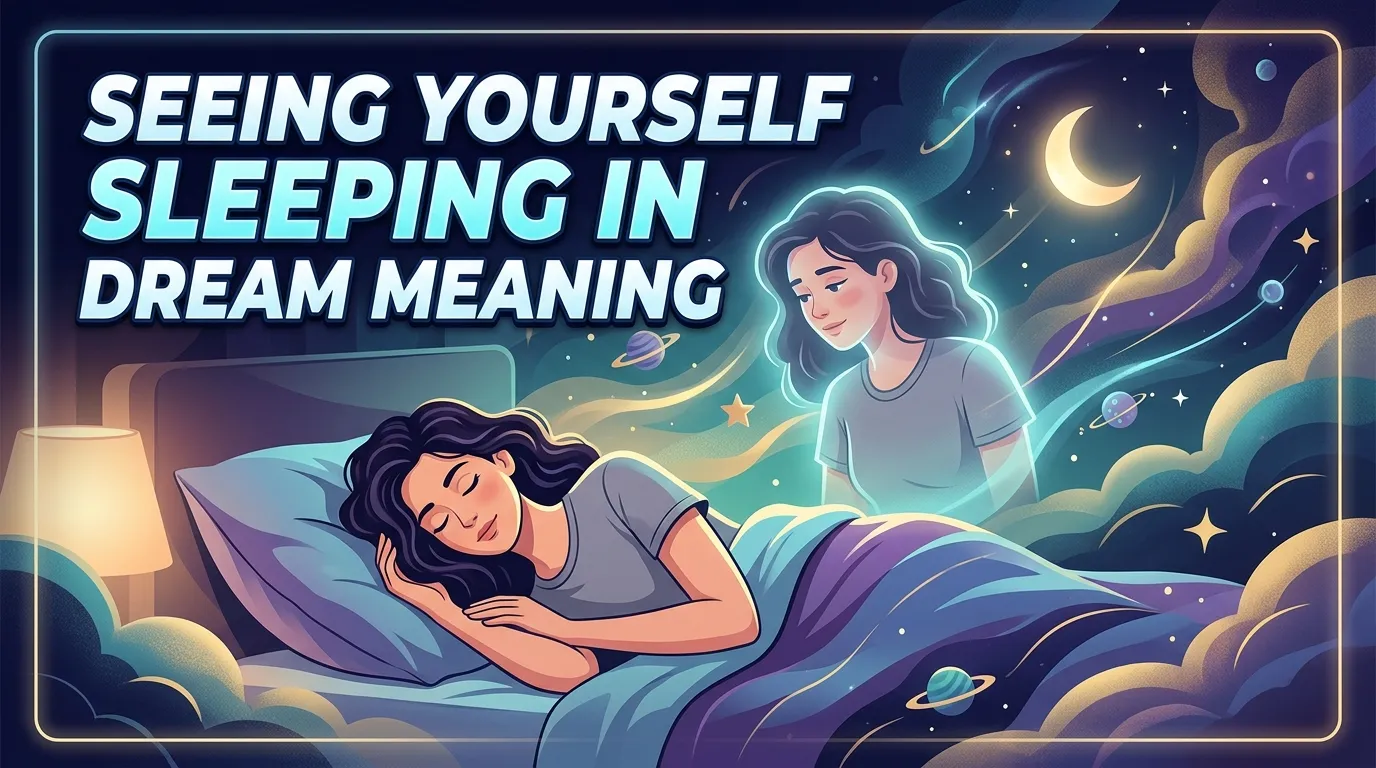
There are two of you in this dream. One is lying in bed, asleep, unaware. The other is standing nearby, watching — and the watcher is the one who remembers the dream afterward. That split, more than anything else, is what the dream is about: a part of you observing another part of you from the outside.
People describe this experience in strikingly similar terms. The room looks almost right, but slightly off — the light is wrong, the furniture is shifted, the air feels thick. The sleeping figure looks peaceful, or vulnerable, or strangely unfamiliar. The watcher may feel calm, curious, frightened, or desperate to wake the sleeper up. Each of those emotional tones points in a different direction.
The watcher and the sleeper
Think of the dream as a portrait of self-awareness. The sleeper represents the part of your life that is running on autopilot: routines you follow without thinking, feelings you have shelved, needs you have not voiced. The watcher represents the part of you that has started to notice. You are, in a sense, waking up to yourself — and the dream stages that realization literally, by showing you your own sleeping form.
This is why the dream often arrives during periods of transition. People report it when they are rethinking a career, recovering from burnout, questioning a relationship, or coming out of a long stretch of emotional numbness. Something in you has started paying attention, and the dream gives that attention a shape.
When the watcher cannot wake the sleeper
One of the most unsettling variants is the one where you try to wake yourself and cannot. You shake your own shoulder, call your own name, and nothing happens. That helplessness usually mirrors a waking-life frustration: you can see what needs to change, but you feel unable to make yourself change it. The dream is not accusing you of laziness. It is showing you the gap between insight and action — you know, but you have not yet moved.
The gentler variant is the one where the watcher simply observes, peacefully, and drifts back into the sleeper. That version tends to arrive when a period of rest is genuinely needed and genuinely being taken. It can be read as permission: the part of you that never stops monitoring things has finally stood down.
Is it a lucid dream, or something else?
Some people wonder whether seeing themselves asleep means they were having an out-of-body experience. Sleep researchers generally explain it differently. During dreaming sleep, the brain can generate a convincing model of the body from an outside perspective, just as it generates every other scene in a dream. A related phenomenon, sleep paralysis, can also produce the eerie sensation of hovering near your own body while unable to move. Neither explanation makes the dream less meaningful — it simply places it inside the ordinary, remarkable machinery of sleep rather than outside it.
What the room was telling you
Pay attention to the setting, because it is rarely random. A childhood bedroom suggests that the part of you being observed is an older version of yourself — perhaps a pattern formed long ago. A strange or unfamiliar room suggests a part of your life you do not yet recognize as yours. A room full of people who ignore the sleeping figure can point to feeling unseen in waking life. The room is the context; the sleeping figure is the subject.
A short practice for after the dream
Take five minutes and write two short paragraphs. In the first, describe the dream from the watcher’s point of view: what did you see, and how did it feel to see it? In the second, imagine the sleeper’s point of view: what would that version of you say if it could speak? People who try this often find that the second paragraph contains the insight — the thing the sleeping self has been trying to say all along.
A note on sleep paralysis
Some people who report this dream also report a related experience: waking up unable to move, with a heavy pressure on the chest and a sense that someone — or something — is in the room. That is sleep paralysis, a well-documented state in which the mind wakes before the body’s sleep paralysis wears off. It is frightening, but it is not dangerous, and it is not the same thing as seeing yourself asleep in a dream. The two can overlap, though: a person who has experienced sleep paralysis may later dream of watching their own sleeping body, because the sensation of being a helpless observer has already been rehearsed. If episodes of paralysis happen often, or come with severe daytime sleepiness, a sleep clinician can help. For most people, the combination of the two experiences is simply the mind’s way of saying that the boundary between sleeping and waking has been feeling thin lately — and that the part of you that watches is working overtime.
If you want to understand the broader phenomenon of becoming aware inside a dream, the Wikipedia entry on lucid dreaming covers the research in plain language.










