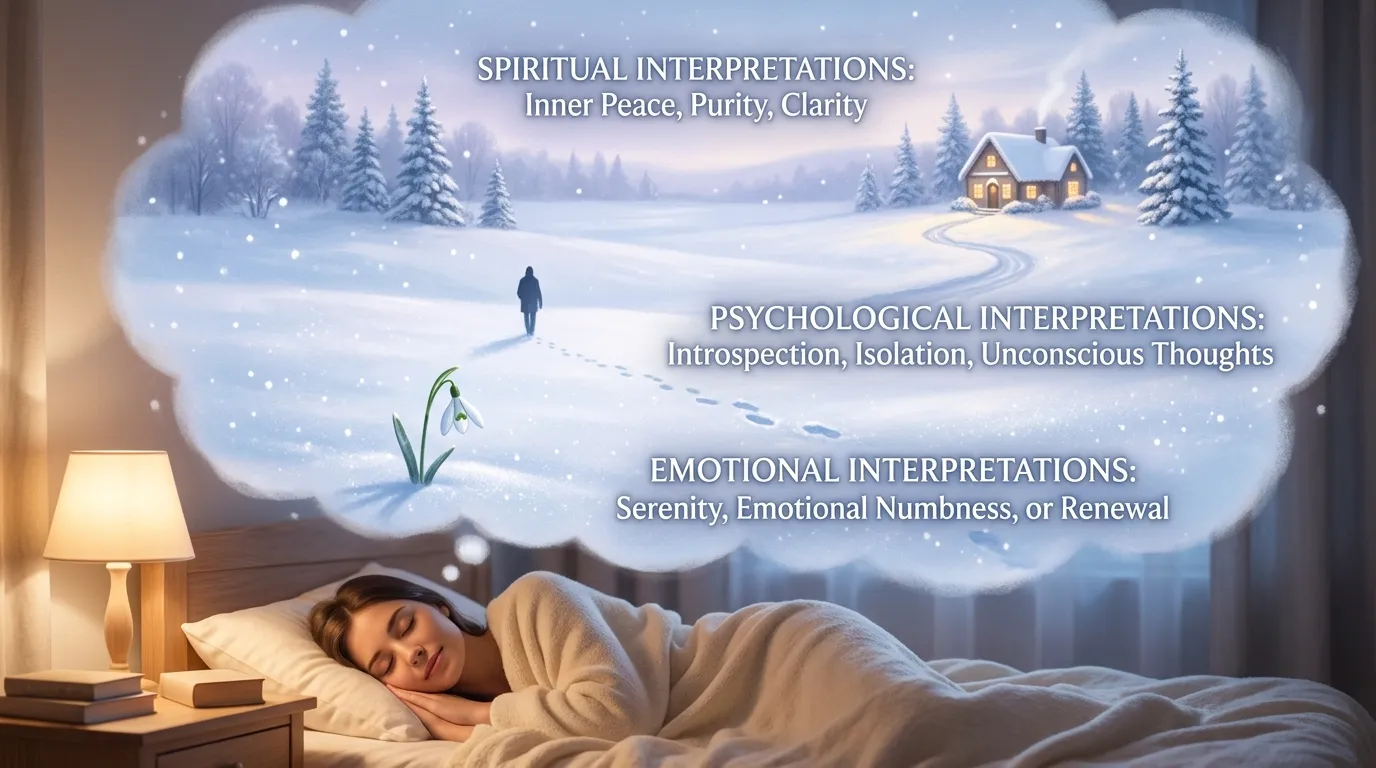
Snow changes a landscape without changing its shape. The same street, the same field, the same roof — but covered, softened, silenced, made new. Dreams of snow work the same way. They rarely introduce something new. They cover something familiar with a new condition: cold, quiet, whiteness, stillness.
To understand a snow dream, you have to ask what, in your life, is being covered — and whether the covering feels like peace or like burial.
The Two Faces of Snow
Snow in dreams carries two opposite emotional charges, and the dream’s feeling tells you which one is active. The first is peace. Snow quiets the world: it muffles sound, slows movement, and gives everything a clean surface. A snow dream that feels calm, beautiful, or joyful often points to a need for exactly that — rest, quiet, a fresh start, a clean page. It can arrive after a period of noise and conflict, like the mind’s own snowfall, settling the dust.
The second is cold. Snow also freezes, isolates, and buries. A snow dream that feels lonely, frightening, or oppressive often points to emotional coldness: a relationship gone cold, a period of feeling cut off from others, a grief that has frozen rather than healed. The same white blanket can be a comfort or a shroud, and the dream’s feeling is the difference.
What the Snow Was Doing
The snow’s behavior is the dream’s most reliable guide:
- Gently falling snow often suggests a gradual change — a slow accumulation of feeling, a situation developing quietly, or a peace that is settling in by degrees.
- Heavy snow or a blizzard often suggests overwhelm: too much arriving at once, a situation that is burying your ability to move or see clearly.
- Fresh, untouched snow often suggests a new beginning — a clean surface on which nothing has yet been written. It is one of the dream’s most hopeful images.
- Dirty, melting, or slushy snow often suggests a purity that has been compromised: a fresh start that has gone stale, an ideal that has met reality, a hope that is dissolving.
- Snow you are lost in often points to disorientation: a life in which the landmarks have disappeared, and you cannot tell where you are or where you are going.
- Snow you are playing in — building, throwing snowballs, sledding — often points to a recovery of playfulness, or to a part of life that has become joyful again after a cold season.
Your Relationship to the Cold
Notice how you related to the snow in the dream. Were you warm inside it — dressed for it, comfortable, at home? That suggests resilience: you are equipped for the cold season you are in. Were you cold, underdressed, shivering? That suggests vulnerability: a situation in which you feel exposed, unprepared, or unsupported.
Notice also whether you were alone. Snow is isolating by nature — it closes roads, empties streets, keeps people indoors. A snow dream with a companion often points to intimacy surviving a cold season: two people keeping each other warm. A snow dream in solitude often points to the isolation itself, and to the question of whether it was chosen or imposed.
Snow and the Seasons of a Life
Winter is the season of dormancy, not death. Under the snow, things are not gone; they are waiting. That is one of the dream’s most useful messages. A snow dream during a period of apparent stagnation — a career plateau, a creative block, a relationship in its quiet phase — may be saying that the quiet is not emptiness. It is preparation. The seeds are under the snow, and they are not dead.
This is why snow dreams often arrive at turning points. They mark the pause between chapters: the job has ended but the next one has not begun, the relationship has changed but the new form has not yet appeared, the old self is gone and the new self is not yet visible. The snow is the blank page between paragraphs. It looks like nothing is happening. That is the nature of blank pages.
The Body’s Layer
There is also a literal layer worth a moment. Snow dreams are more common in winter, in cold bedrooms, and during illness — the body registering its environment. If you woke from a snow dream feeling cold, the dream may have been the body’s thermostat talking. If it arrived with a fever, the snow may have been the mind’s image of the body’s chill. Dreams are not above the obvious, and the obvious should be checked before the symbolic is embraced.
When the literal layer is set aside, the snow dream leaves a simple question: what in your life needs covering, and what needs uncovering? Some things deserve a fresh blanket — an old shame, a finished quarrel, a season that is over. Some things deserve to be dug out of the snow before they are lost. The dream shows you the blanket. You decide what lies beneath it. For the science of the substance itself, the Wikipedia article on snow explains how it forms and why it silences the world.










