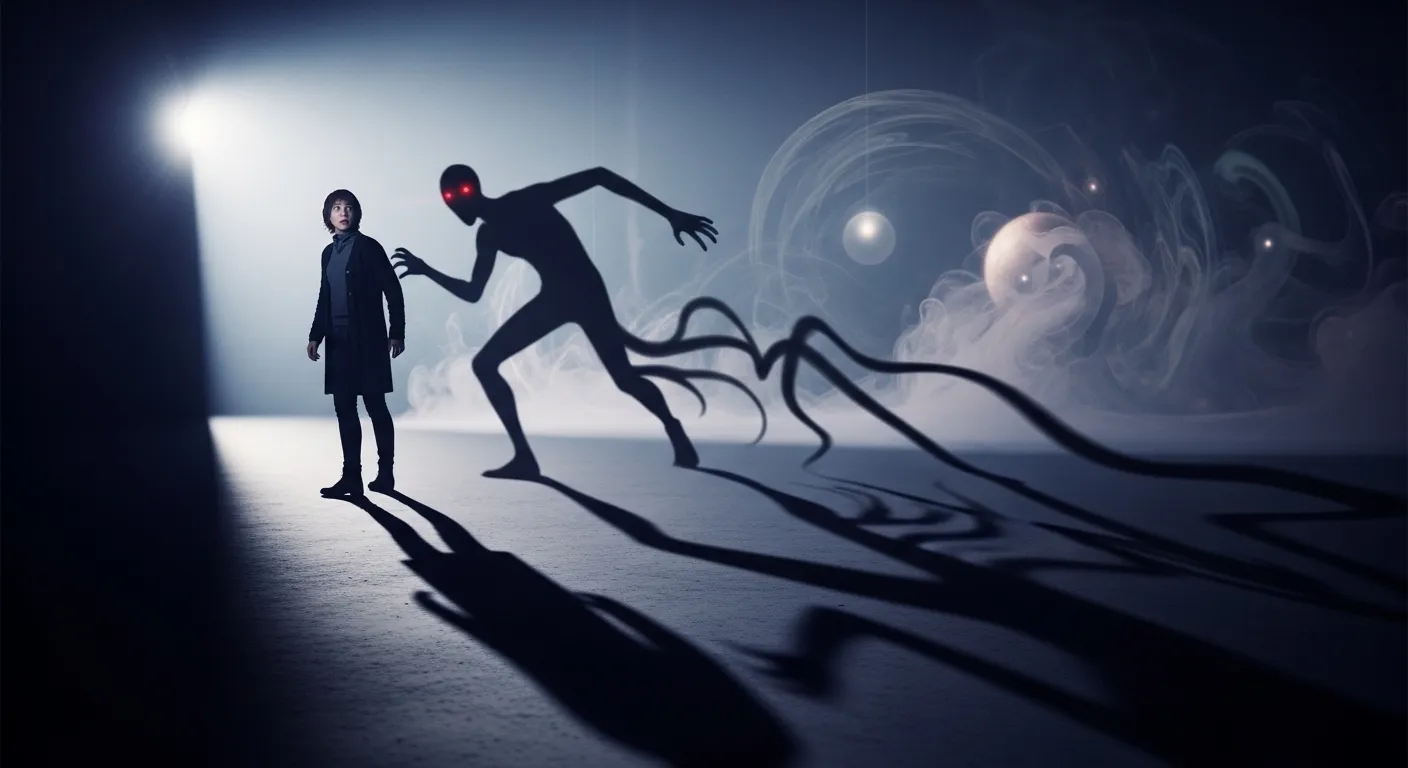
The hallway is one you’ve walked a thousand times, but tonight the light falls wrong. Your shadow stretches ahead of you — and then it keeps going. It detaches from your feet with a soft, terrible independence and starts running, and before you understand what you’re seeing, you’re running too. Not away from a monster. Away from the dark shape of yourself.
Of all chase dreams, this is the one psychologists find most telling, because the pursuer requires no interpretation. The thing hunting you is, unambiguously, you — or rather, the parts of you that you have been outrunning in daylight.
The shadow, in plain language
The term comes from Carl Jung, but the idea is older than psychology. The “shadow” is Jung’s name for everything about yourself that you’ve decided isn’t you: the anger you’ve never expressed, the ambition you’ve called selfish, the grief you’ve scheduled for later, the tenderness you’ve mistaken for weakness, the parts of your history you’ve edited out of the story you tell.
None of this is exotic. Everyone has a shadow; it’s the psychological equivalent of the back of the house — the rooms you don’t show guests but still live in. The shadow isn’t evil. It’s unacknowledged. And Jung’s central claim — the one that made this dream famous — is that what remains unacknowledged doesn’t disappear. It follows you. In dreams, it runs.
Why the chase framing matters
Being chased by your shadow is structurally different from merely seeing your shadow. The chase adds a verdict: you are not just carrying unacknowledged material, you are actively avoiding it, and the avoidance itself has become the problem.
Notice the dream’s physics. In most versions, the shadow never quite catches you — it stays a fixed distance behind, no matter how fast you run. That’s the giveaway that this is an inside job. A real pursuer gains or loses ground. The shadow maintains exactly the distance of your avoidance: always present, never confronted. The dream is showing you the precise geometry of denial.
And there’s a second, quieter detail many dreamers report: the exhaustion. Shadow-chase dreams are tiring in a way other nightmares aren’t. You wake up spent. Avoidance is work — constant, low-grade, invisible work — and the dream lets you feel the true cost of it for one night.
Five ways the dream ends, and what each suggests
Endings are where this dream does its real talking:
1. You outrun it — barely, gasping. The most common ending. It suggests the avoidance strategy is still working but failing: you’re staying ahead, but the margin is shrinking. Waking life usually contains a parallel — the conversation you’re postponing, the feeling you’re managing rather than feeling.
2. It catches you, and it’s terrible. Being caught and overwhelmed tends to track moments when avoidance has collapsed in waking life — the secret found out, the grief breaking through, the burnout arriving. Frightening, but dreamers often report these as relieving in retrospect: the feared thing happened, and the world didn’t end.
3. It catches you, and it’s… you. The shadow resolves into your own face, your own body. This is the dream’s thesis statement, delivered without subtlety: the thing you’ve been fleeing is yourself, and it was never actually dangerous — just unmet. These dreams often precede periods of unusual self-honesty.
4. You stop running and turn around. The rarest ending and the one Jung would have celebrated. Turning to face the shadow in a dream is consistently associated, in dream research, with subsequent emotional resolution — not because the dream is magic, but because the dreamer has rehearsed the act of facing. The rehearsal transfers.
5. The shadow stops chasing and walks beside you. Integration, rendered literally. The denied part stops pursuing because it no longer needs to — it’s been acknowledged. Dreamers describe this ending with a specific word: accompanied. You wake up feeling less alone, because in a real sense, you are.
What integration actually looks like awake
Jung’s prescription — “integrate the shadow” — sounds mystical until you translate it into behavior. In practice, it means three unglamorous things.
First, naming. The shadow loses power when it’s specified. Not “I feel bad” but “I’m angry at my brother and ashamed of being angry.” Not “something’s off” but “I’ve been pretending this job is fine.” Vagueness is the shadow’s camouflage; precision is the light.
Second, allowing the feeling without obeying it. Integration doesn’t mean acting on every impulse — it means admitting the impulse exists. You can acknowledge rage without raging, acknowledge envy without scheming, acknowledge grief without drowning. The shadow wants witness, not control.
Third, retrieving what’s useful. Here’s the part people miss: the shadow doesn’t only contain wounds. It contains exiled strengths — the assertiveness you called aggression, the sensitivity you called weakness, the ambition you called selfishness. Shadow work isn’t just healing damage; it’s reclaiming equipment.
A final reframing
It’s natural to experience this dream as a horror: something dark hunting you through familiar halls. But consider the shadow’s perspective for a moment. It isn’t trying to destroy you. It’s trying to rejoin you. It runs because you run; it would walk if you’d walk. Every chase dream is, from the other side, a reunion attempt.
The next time the dream comes, try an experiment inside it — dreamers who practice this report startling results. Instead of running faster, slow down. Turn. Look at what chases you and ask it, in the dream, what it wants. The answers people report — you never listen, I’m tired too, I just want to come home — sound less like monsters than like neglected parts of a person asking for exactly what Jung said they wanted: to be seen.
Jung’s concept has been debated, refined, and argued over for a century, but its core image — the disowned self in pursuit of its owner — remains one of psychology’s most durable ideas, surveyed in the entry on the shadow in Jungian psychology. Your dream staged it as a chase. The ending, as always, is up to the one being chased.










