You’re reaching into a jacket pocket for your keys, and your hand closes around something else — heavy, cold, unmistakable in its shape even though you’ve never held one. You don’t take it out. You just stand there in the dream-street with your hand in your pocket, heart hammering, understanding that everything has changed because of the weight of this thing you’re carrying. You wake up before you decide what to do with it. The question follows you into the morning: what was I carrying?
Let’s be clear about what this article is and isn’t. It isn’t about weapons, and it contains no instructions related to them. It’s about a symbol — one of the most electrically charged in the dream vocabulary — and what the sleeping mind means when it hands you something whose entire symbolic job is irreversible consequence.
Why this symbol startles
Gun dreams disturb people out of proportion to their content, and the reason is neurological before it’s symbolic. The human threat-detection system doesn’t fully distinguish between dreamed danger and real danger — the amygdala responds to the image of threat with genuine alarm. You wake with a racing heart because, as far as the older parts of your brain were concerned, the threat was real.
Knowing this reframes the dream usefully: the intensity is physiological, not prophetic. The dream isn’t warning you about literal danger (with rare exceptions involving genuinely unsafe situations, which deserve waking attention on their own merits). It’s using the most alarming image available to flag something that feels that alarming — and the gap between the symbol’s violence and the situation’s actual stakes is where the meaning lives.
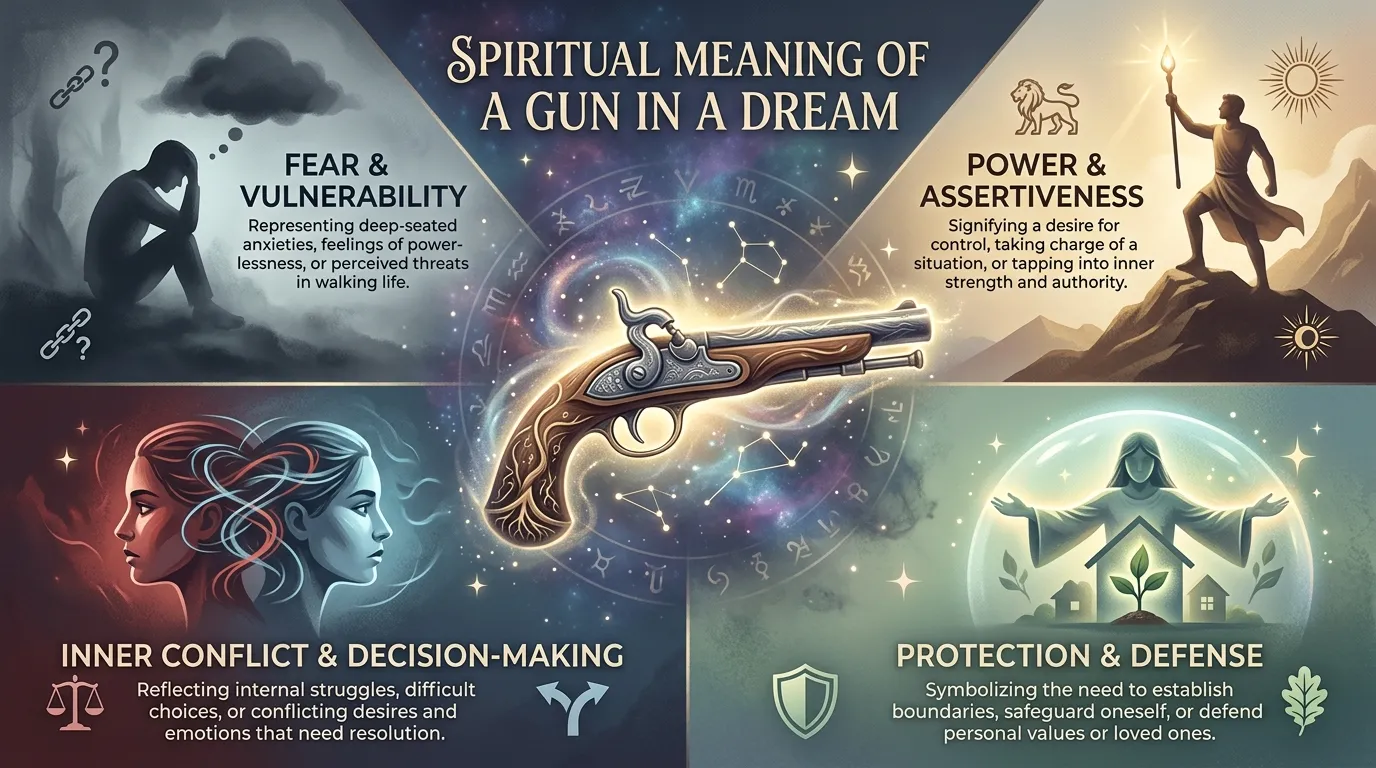
Protection versus pressure: the two poles
Almost every gun dream organizes itself around one of two poles, and they feel completely different:
The protection pole. You’re holding it calmly, or it’s present as a kind of insurance — the weight in the pocket, the object in the drawer. The felt sense is capacity: I could handle what comes. These dreams tend to appear when the dreamer is developing boundaries in waking life — learning to say no, leaving a harmful situation, or simply deciding to stop being agreeable at their own expense. The symbol is crude, but the message is precise: you are becoming someone who can defend themselves.
The pressure pole. The gun is pointed at you, or going off uncontrollably, or present as pure menace. The felt sense is threat without agency. These track situations where the dreamer feels emotionally cornered — the impossible boss, the escalating conflict, the internal critic that won’t stand down. The gun isn’t the enemy; it’s the felt intensity of the enemy, rendered in the mind’s most urgent visual language.
Which pole was yours? The answer usually names the waking dynamic in a single word: empowerment or threat.
Being aimed at versus holding
The dream’s grammar — who holds the symbol — is its syntax of power:
- Someone aims at you. The classic threat dream. Identify the holder if you can — the dream often casts a real figure (the critical parent, the intimidating colleague) or a faceless one (anonymous pressure, the future itself). The aim is the point: you feel targeted by something in waking life, and the dream has literalized the targeting.
- You hold it, calmly. Agency, possibly newly claimed. Note what you do with it — the dreamers who hold without firing are usually the ones integrating power without aggression: the boundary held, not the bridge burned.
- You hold it and it goes off accidentally. The fear of your own impact: saying the thing you can’t unsay, the anger escaping before you meant it to, the fear that your newfound assertiveness will wound someone. This is the responsibility dream wearing a weapon costume.
- You can’t find it / it’s taken from you. Disarmament anxiety — the fear of being left defenseless. Often appears when a support is being removed: the job ending, the relationship shifting, the old coping strategy failing.
- Hearing shots without seeing the source. Ambient threat — anxiety without a clear object. The dread has a sound but no address. These are worth taking as general distress signals rather than specific messages.
Anger with nowhere to go
Let’s name the emotion these dreams most often carry: anger that hasn’t been expressed. Not rage, necessarily — often just the steady, unvoiced frustration of someone who’s been accommodating too long. The dreaming mind, denied a waking outlet, stages the most dramatic possible version of force — and then, crucially, usually doesn’t use it. The gun appears; the trigger, in most dreams, is never pulled.
That restraint is the real message. The psyche isn’t urging violence — it’s containing it, showing you the scale of what’s being held back so you’ll take the holding-back seriously. The healthy response isn’t alarm at the symbol but curiosity about the pressure: what keeps going unspoken? Where does the frustration actually live? What would it look like to address it at its real size, in daylight, with words?
People who do this work — who find the actual outlet, the real conversation, the genuine boundary — consistently report the same thing: the gun dreams stop. Not because the anger was dangerous, but because it was heard. The symbol was always a messenger. Messengers leave when the message is delivered.
When to take the distress seriously
A brief, responsible note. Most gun dreams are symbolic pressure-valves, as described above. But dreams don’t exist in isolation — if yours arrive alongside waking distress that’s not lifting (persistent dread, intrusive thoughts, the feeling of being unsafe in your actual life), the dream may be one signal among several worth discussing with a counselor or trusted professional. Taking a recurring nightmare seriously is never an overreaction; it’s the same instinct the dream itself is modeling — pay attention to the alarm.
For the ordinary version — the startling, vivid, ultimately symbolic dream — the work is interpretive, not urgent. Ask what felt threatening, what felt powerful, and where in your waking life those two feelings are currently negotiating. The dream staged the negotiation in high contrast so you couldn’t miss it. You didn’t miss it. That’s why you’re reading this.
As a symbol, the gun carries a weight out of proportion to its size — an object whose cultural meaning is almost entirely about irreversible action, as the history of the gun as a concept shows. Your dreaming mind chose the heaviest symbol in the drawer to deliver a message about power, pressure, and the feelings caught between them. The weight in the dream-pocket was never really metal. It was consequence — and the quiet, growing knowledge that you get to decide what to do with it.










