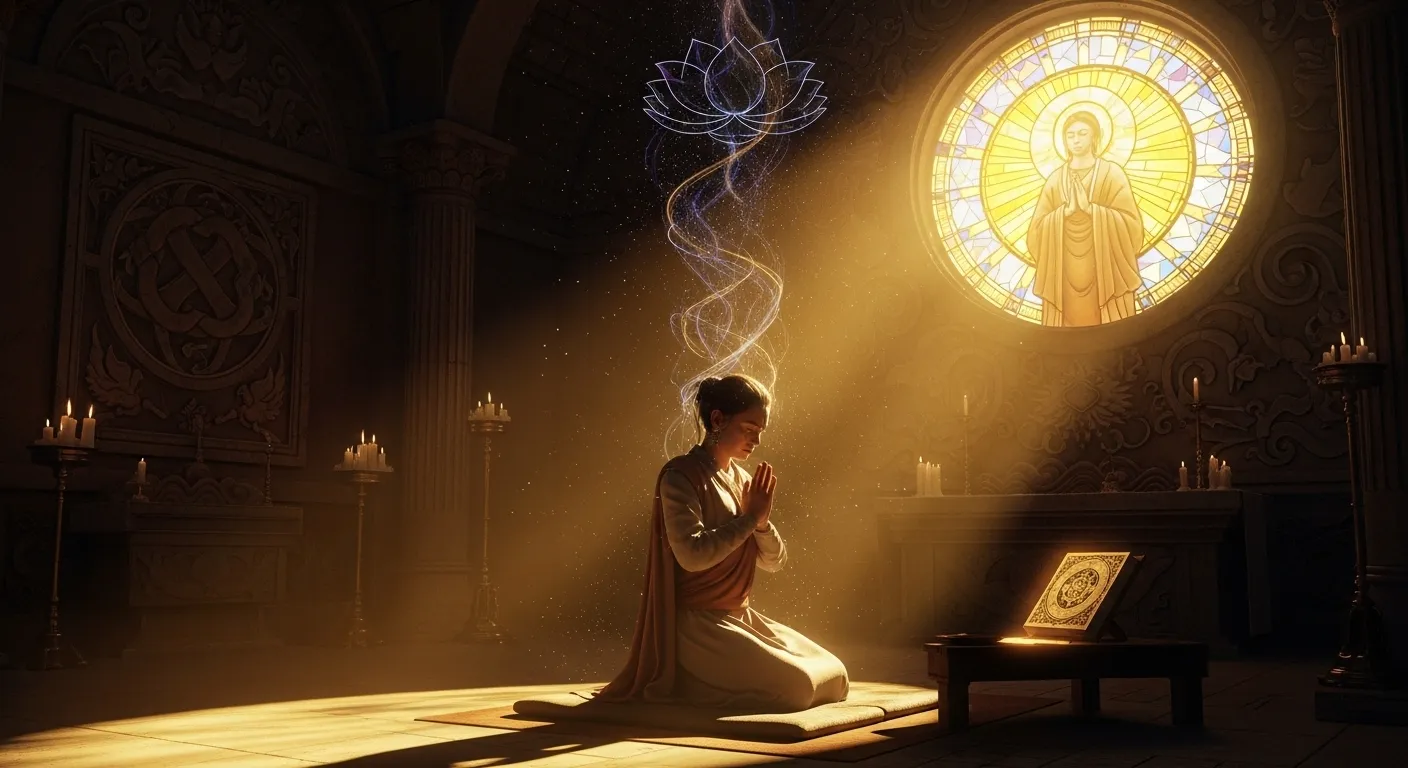
There is a particular stillness to dreaming of prayer. The noise of the dream quiets. Hands fold, or lift, or press together. Words form that you might never say awake, or no words come at all, just the posture of asking. People who haven’t prayed in years dream of praying. People of every faith, and of none, recognize the gesture instantly. It seems to belong to a layer of the human deeper than doctrine.
Dreams of praying are threshold dreams. They arrive at the edges of things: before decisions, during crises, in the aftermath of loss, at the beginning of change. The dreaming mind, faced with what it cannot solve, does what humans have always done at the limit of their power. It asks.
Prayer Dreams Arrive at Thresholds
Notice when these dreams come. They rarely visit during easy, settled seasons. They come when you’re standing before something: a diagnosis, a departure, a choice with no good options, a grief too large to carry alone. The dream isn’t necessarily religious. It’s positional: it places you in the posture of one who needs help, which is the most honest posture there is.
This is why prayer dreams often feel more real than other dreams. They engage the part of you that deals in ultimate things: mortality, meaning, love, forgiveness. The dreaming mind doesn’t pray about trivia. When it prays, it’s about what matters most, which is why these dreams can feel like the most important ones you’ve ever had.
The Postures of Dream Prayer
Praying Alone
Solitary prayer in a dream emphasizes the personal, unmediated nature of your spiritual life. No congregation, no ritual, just you and the silence. These dreams often arrive when you’re working something out privately, and they suggest your own inner resources are deeper than you think.
Weeping While Praying
Tears in prayer dreams are almost always cleansing. They represent grief, guilt, or overwhelm being released in the safest possible context: before the divine, however you conceive it. Waking with tear tracks after such a dream is common, and it’s nothing to be embarrassed about. Something moved.
Praying in Fear
Desperate, urgent prayer, the foxhole kind, reflects waking helplessness honestly. There’s no shame in it. Every tradition honors the cry for help as the most basic and most answered form of prayer. The dream may simply be giving your fear a dignified shape instead of letting it run wild.
Peaceful Prayer
Calm, luminous prayer dreams, the kind suffused with warmth or light, are often experienced as genuine encounters. Whether you read them psychologically (deep integration, profound rest) or spiritually (real communion), they tend to mark turning points. People remember these dreams for decades.
Unable to Pray
Trying to pray and finding the words won’t come, or feeling blocked from the act, is the prayer dream’s difficult variant. It usually reflects spiritual disconnection: distance from your faith, your values, or your own inner life. The dream isn’t condemning the distance. It’s reporting it, and quietly asking whether you’d like to close it.
Others Praying
Watching others pray, or being prayed for, shifts the focus to community and support. These dreams often appear when you’re being carried by others’ care, or when you need to let yourself be. Receiving prayer in a dream can be profoundly comforting, regardless of theology.
What the Dream Asks of Your Waking Life
Prayer dreams are unusual in that they often come with an implicit assignment. The dream prayed; now what? The answers vary, but they rhyme: slow down, ask for help (divine or human), forgive something, release control of an outcome, make room for silence. The dream’s posture suggests the waking posture.
You don’t need to convert the dream into a program. But you might try praying awake, in whatever form is honest for you, for a few mornings after such a dream. Many dreamers report that the waking practice “completes” something the dream started, as if the dream were an invitation and the waking prayer the RSVP.
A Note on Traditions
Prayer belongs to everyone and to specific someones simultaneously. Your dream prayer may wear the clothes of your upbringing, or none at all, or a surprising blend. All of these are legitimate. If your tradition has specific teachings about dreams, those teachings deserve a place in your interpretation alongside everything here. And if you have no tradition, the dream’s prayer is still yours. The gesture predates every institution that now houses it.
One caution: be wary of anyone who tells you a prayer dream requires a specific ritual, payment, or act of theirs to be safe or effective. The dream came to you freely. Its meaning is yours to discern, ideally with trusted guides, not purchased from strangers.
Prayer Dream Questions
Is praying in a dream a good sign?
Overwhelmingly, yes. It suggests humility, hope, and connection with your deeper values. Even the difficult variants (unable to pray, praying in terror) are constructive: they show you exactly where you stand.
Why do I pray in dreams when stressed?
Because stress strips away pretense. When coping mechanisms fail, the mind returns to its oldest tool for the uncontrollable: asking for help. It’s a sign of health, not weakness.
Can prayer dreams predict the future?
Not in any literal sense. But they can be prescient about you: about what you’ll need, what you’re ready for, what you’re being prepared to face. That inner foresight is the real gift.
What if I don’t pray in waking life?
The dream may be introducing you to a capacity you didn’t know you had, or reconnecting you with one you set aside. You don’t need to adopt a religion to honor it. You only need to take the asking seriously.
The Amen
Every prayer ends, and so does every prayer dream, usually with a feeling that’s hard to name: settled, heard, accompanied. Carry that feeling into the day deliberately. Let it soften one interaction, steady one decision, quiet one fear. The dream prayed on your behalf while you slept. The daylight hours are your turn. For the vast human history of the gesture your dream made in the dark, Wikipedia’s article on prayer surveys how every culture on earth, independently, arrived at the same folded hands.










