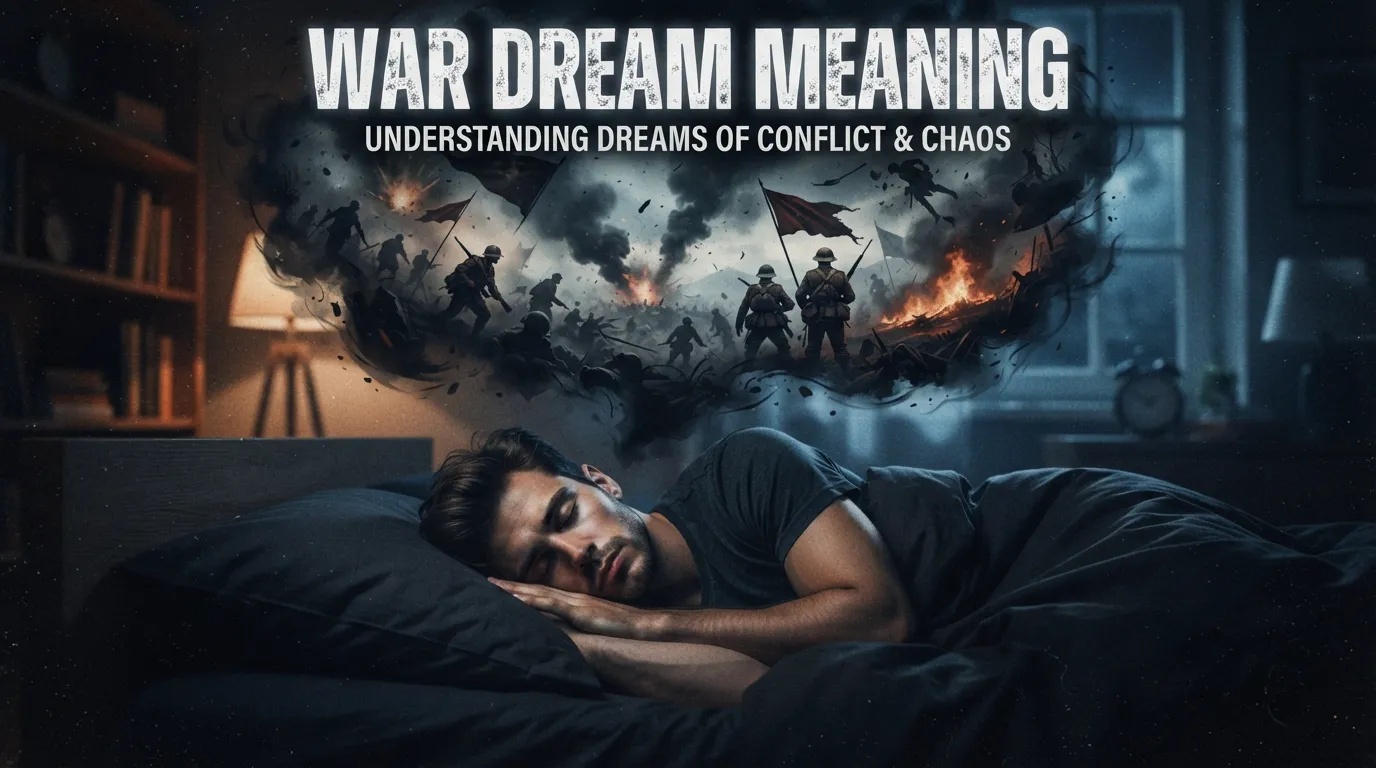
A war dream is not really about war. It is about a conflict that has no referee, no ceasefire, and no neutral ground — the kind of conflict that follows you from the day into the night and sets up camp there. The battlefield in the dream is a map. The trick is learning to read which front you are actually fighting on.
Most war dreams fall on one of four fronts. Identifying yours is the fastest route to understanding the dream, because each front asks a different question.
Front one: the war inside you
This is the most common front, and the hardest to admit. Two parts of you want opposite things: the part that wants to leave and the part that wants to stay; the part that wants to speak and the part that wants to keep the peace; the part that is tired of who you have been and the part that is afraid of who you might become. In the dream, this inner split becomes two armies. You may be fighting on both sides at once, or watching the battle helplessly, or switching uniforms mid-dream. The emotional signature is usually guilt or exhaustion rather than fear — the weariness of being at war with yourself.
Front two: the war at home
When the dream battlefield is a house, a street you grew up on, or a place full of family members, the conflict is usually relational. Unspoken resentments, old family roles, a marriage under strain, a friendship quietly breaking down — the dream drafts all of it into uniform. Pay attention to who is fighting beside you and who is on the other side. The dream’s casting is often brutally honest about alliances you have not admitted to in waking life.
Front three: the war at work
A dream of organized combat — ranks, orders, strategy, territory — often maps onto professional pressure: competition, a hostile workplace, a project that feels like a siege, a boss or colleague who feels like an adversary. The dream may also be flagging burnout. Soldiers in dreams rarely get to rest, and neither do people who dream of war while working sixty-hour weeks.
Front four: the war with the world
Sometimes the dream is not personal at all. People who consume a great deal of news about real conflicts, or who live through genuinely unstable times, often dream of war because war is in the air they breathe. The dream may simply be the mind processing images it absorbed during the day. If you fell asleep to news footage, the dream may be little more than an echo — and the right response may be to change what you consume before bed rather than to decode the dream.
Your role in the battle matters
- Fighting. You are engaged in the conflict, not avoiding it. The question is whether you are fighting the right battle — or pouring energy into a fight that does not deserve you.
- Hiding. You are surviving rather than engaging. This often points to a conflict you have been dodging in waking life, and to the cost of that avoidance.
- Protecting someone. You are shielding a child, a partner, a stranger. This suggests the conflict threatens something you value, and the dream is measuring how far you would go to defend it.
- Watching from above. You observe the battle without participating. This is the dream of the person who has gone numb — present for the conflict but emotionally checked out of it.
What to do with a war dream
Resist two temptations: treating it as a prophecy, and dismissing it as meaningless. A better response is practical. Name the front. Name the role. Then name one waking-life step, however small, that addresses the real conflict: a conversation you have been postponing, a boundary you need to set, a workload you need to reduce, a news habit you need to break. War dreams tend to stop recurring once the real conflict gets a hearing — because the dream was never the war. It was the war report.
After the war: the peace treaty
War dreams rarely show the peace treaty, but the treaty is the part that matters most in waking life. Every conflict the dream dramatizes — inner, domestic, professional — eventually needs a settlement, and settlements are unglamorous: an apology, a compromise, a boundary agreed in writing, a workload renegotiated, a decision finally made. Notice whether your dream showed any sign of the war ending. A ceasefire, a handshake, an enemy laying down a weapon, a battlefield going quiet — these are the dream’s most hopeful images, and they suggest that some part of you already knows what the settlement looks like. If the dream showed no ending at all, the work is to imagine one. A conflict without an imagined ending tends to continue indefinitely. Give it an ending in your mind first — the conversation, the concession, the boundary — and the dream will usually follow, because the dream was never the war. It was the war report, waiting for the treaty.
For historical context on how real warfare has shaped human societies, the Wikipedia overview of war offers a broad starting point.










