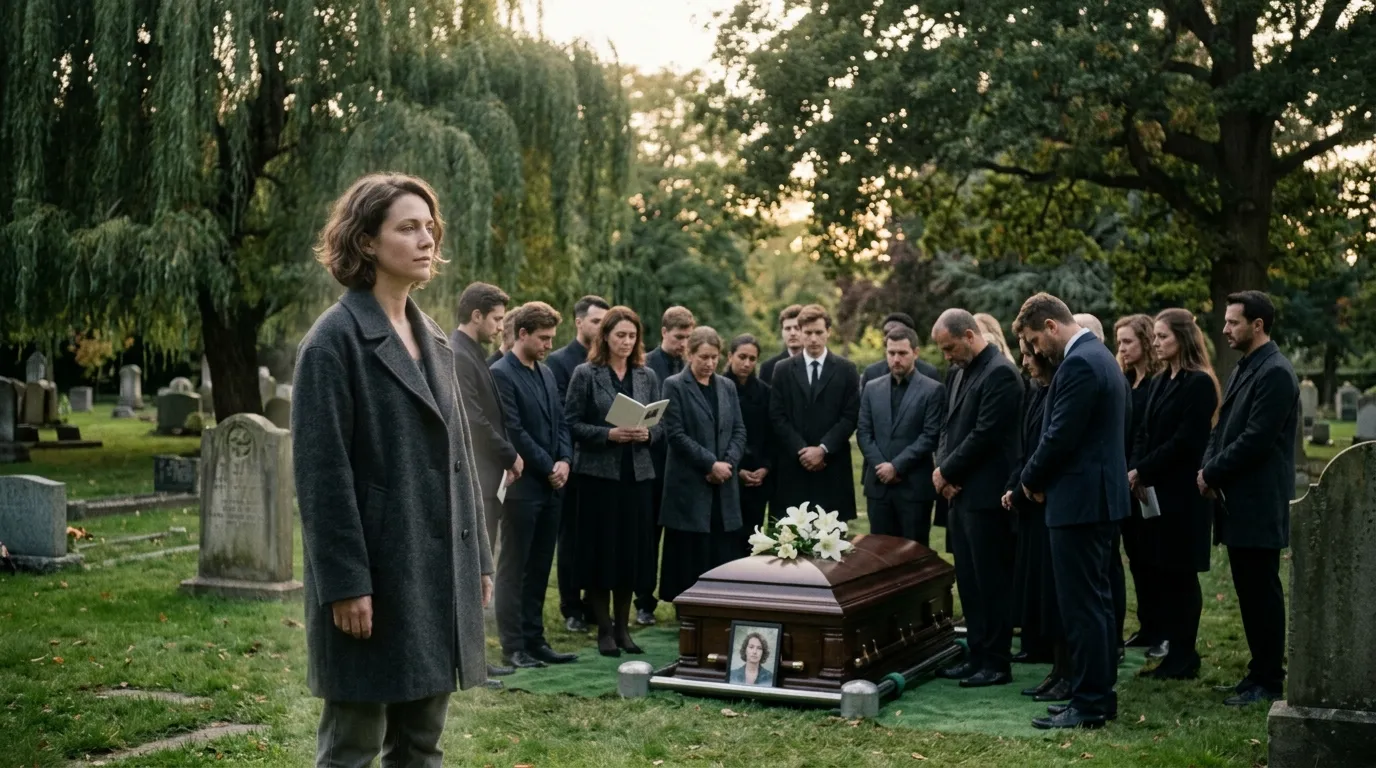
Witnessing your own funeral in a dream is one of the most startling images the sleeping mind can produce. You watch people gather, grieve, or speak about you — while you are still there, observing. The dream can feel mournful, surreal, strangely peaceful, or even strangely freeing. It is natural to wake up shaken and to wonder whether the dream means something ominous. It almost never does. In dream symbolism, funerals are more often about endings and transitions than about literal death.
It helps to say that plainly at the start: a dream of your own funeral is not a prediction. It does not mean you are in danger, and it does not mean something bad is about to happen. Dreams use dramatic images to represent inner events. A funeral is the mind’s strongest image for “something has ended.” The dream is asking what has ended — or what is ending — in your life.
Watching, rather than being buried
The most important detail in this dream is your position. You are not in the coffin. You are watching. That distance changes everything. The dream places you in the role of witness to your own life, as if you have stepped outside yourself to see how you are seen, what you have meant to people, and what remains after a chapter closes.
That witnessing stance can be surprisingly clarifying. You may notice who is present and who is absent. You may hear what people say about you, or notice what they do not say. You may feel grief, relief, anger, or peace. Each of those reactions is information. The dream is not staging a literal funeral; it is staging a review — a moment of taking stock of a life, a phase, or an identity.
If you felt peaceful in the dream, the funeral may represent an ending you have already accepted. If you felt distressed, it may represent an ending you are still resisting. If you felt detached, as if watching strangers, it may represent a part of your life that already feels distant — a former self you no longer recognize.
The ending the dream may be marking
Funeral dreams commonly appear at thresholds. A few of the most common:
- The end of an old identity: leaving a job, a role, a faith, a relationship, or a version of yourself that no longer fits. The funeral mourns who you were, so that who you are becoming has room.
- The end of a relationship or chapter: a breakup, a move, children leaving home, a friendship fading. Even chosen endings deserve grief, and the dream may be giving you a place to feel it.
- A reckoning with time: birthdays, anniversaries, or the death of someone close can prompt reflections on mortality. The dream may be processing the simple, human awareness that life is finite — and therefore precious.
- A release: sometimes the funeral is for a burden rather than a person: a habit, a resentment, a fear, a story you told about yourself. The dream buries it for you.
None of these requires you to feel sad in a particular way. Grief in dreams, like grief in waking life, does not follow a script. Relief at a funeral in a dream is not callous. It may mean you are genuinely ready to let something go.
Who attends, and what they say
The mourners in the dream deserve attention. Loved ones who appear may represent the relationships that matter most to you right now, or the ones you fear losing. Strangers may represent parts of yourself or your life that feel anonymous or unacknowledged. The absence of someone important can be just as telling — it may point to a relationship that feels distant, or to a fear of being forgotten.
Words spoken in the dream — eulogies, whispers, apologies — often carry the dream’s emotional core. A kind word may reflect a need to be appreciated. A harsh word may reflect guilt or self-criticism. Silence may reflect a feeling of being unseen. You do not need to treat these words as messages from beyond. Treat them as echoes of your own inner conversation about your life and your worth.
If the dream leaves you frightened
Some people wake from this dream with real anxiety, especially if they are already coping with illness, grief, or the loss of someone close. That anxiety deserves gentleness, not dismissal. A frightening dream does not make the fear true, but the fear itself is real and worth attending to.
It can help to ground yourself: remind yourself that the dream is symbolic, talk about it with someone you trust, and notice whether the fear attaches to a specific waking worry. If anxiety about death or loss is persistent, intrusive, or interfering with sleep, consider speaking with a counselor or a trusted professional. There is nothing weak about seeking support for the heaviest questions a mind can ask.
It can also help to turn the dream into a question rather than a verdict: if I were looking back on this phase of my life, what would I want to have honored? What would I want to have released? What would I want the people I love to know? Those questions are the constructive version of the dream — and they are questions you can answer while fully alive, with time still to act on them.
An ending that is also a beginning
Many traditions treat funerals as thresholds rather than full stops: a passage from one state to another. This dream often works the same way. The funeral closes something, and the fact that you are watching it means you survive the closing. You remain. The dream is not about your absence. It is about your presence at the edge of a change, witnessing it, feeling it, and continuing past it.
If you take one thing from the dream, let it be this: something in your life is ready to be laid to rest — a role, a resentment, a fear, an old story — and you are still here to choose what grows in its place. That is not a frightening message. It is a freeing one. Human beings have marked such passages with ceremony for as long as we have had communities, and funeral rites across cultures share the same purpose: honoring what ended while supporting the living who remain — which is, in the end, what this dream is doing too.










