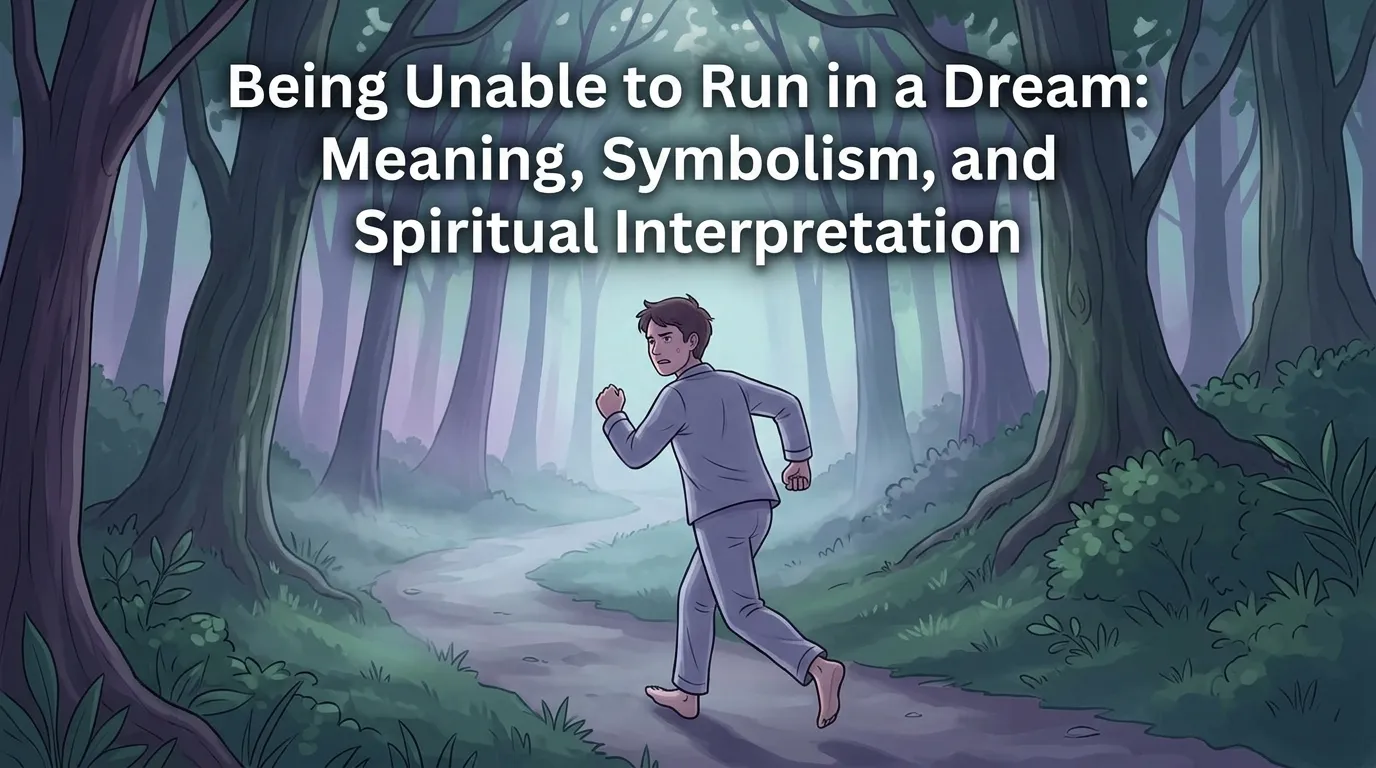
It is one of the most frustrating dreams in existence: you try to run, and your legs will not cooperate. They feel like lead. Or like they are moving through water, or through sand, or as though the ground itself is holding your feet. Something may be chasing you. Something may be waiting. And your body — the thing that is supposed to save you — refuses.
This dream is so common that it has both a psychological and a physiological explanation, and the truth is that both are probably involved. Understanding either one takes away much of the dream’s power to frighten, because the dream turns out to be less a warning than a report: about your body in sleep, and about your life while awake.
First, the body: why your legs will not move
During dreaming sleep, the brain deliberately paralyzes the body’s voluntary muscles — a state called sleep atonia. It exists for a good reason: so that you do not act out your dreams and injure yourself. When you dream of running, your legs are, in reality, switched off. Most of the time you never notice, because the dream supplies the sensation of running anyway. But sometimes the sleeping brain half-notices the paralysis, and the dream absorbs it: your legs feel heavy, slow, or stuck, because in the bed, they are.
This is also why the dream often comes with a sense of urgency that cannot be discharged. The alarm is real; the body’s response is offline. Knowing this does not make the dream pleasant, but it does reframe it: part of what you experienced was not symbolic at all. It was your brain accurately reporting that your muscles were, at that moment, unavailable.
Then, the symbolism: what the stuckness means
With the physiology acknowledged, the symbolic layer still matters — because the dreaming mind chooses when to stage this particular frustration, and it tends to choose moments when waking life feels similarly stuck.
Being unable to run in a dream usually points to a situation where you feel unable to move, escape, or change something: a job you cannot leave, a relationship you cannot fix, a decision you cannot make, a fear you cannot outrun. The specific flavor depends on the feeling:
- Terror while unable to run usually pairs with anxiety or a perceived threat — a situation that feels dangerous and inescapable.
- Frustration while unable to run more often pairs with blocked goals: you know where you want to go, and something keeps preventing progress.
- Exhaustion while unable to run — legs giving out, breath failing — tends to accompany burnout or emotional depletion.
- Strange calm while unable to run is the most interesting variant. It can signal a dawning acceptance: the realization that running was never going to solve this, and that the answer lies in standing still and facing whatever is coming.
What is chasing you?
Many unable-to-run dreams include a pursuer, and the pursuer is worth identifying. It may be a person, a creature, a shadow, or a vague sense of dread. In dream logic, pursuers usually represent avoided material: a conversation, a decision, a feeling, a truth. The dream’s cruelty is precise — it gives you something to flee from and then removes your ability to flee — because that is exactly the structure of avoidance. You cannot outrun the thing you carry with you.
But some unable-to-run dreams have no pursuer at all. You are simply trying to get somewhere — to a door, a train, a person — and you cannot. These dreams are usually about progress rather than threat: a goal that feels unreachable, a life that feels stalled, a sense of running hard and staying in place. The question they pose is practical rather than frightening: what, in waking life, feels like effort without movement?
When the dream is telling you to stop running
There is a reading of this dream that most interpreters miss, and it is the most hopeful one. Spiritually and psychologically, the inability to run can be a message of its own: stop running. The dream may be staging the failure of escape as a way of redirecting you toward confrontation, acceptance, or rest. The thing you cannot outrun may be the thing you need to turn and face — a grief, a decision, a part of yourself.
Dreamers who have this dream repeatedly often report that it stops once they address the underlying situation: have the conversation, make the decision, admit the feeling, rest properly. The dream is not a punishment. It is a pressure gauge, and it releases when the pressure is dealt with at its source.
If the dream comes with a waking sense of being stuck, try the smallest possible act of movement in waking life: one decision, one conversation, one boundary, one honest sentence. The dream’s stuckness is rarely solved by a grand escape. It is solved by a single step — which, in the dream, was the one thing you could not take. The physiology behind the dream, including the way the sleeping brain switches the body off, is explained in the Wikipedia article on sleep paralysis and related sleep states.










