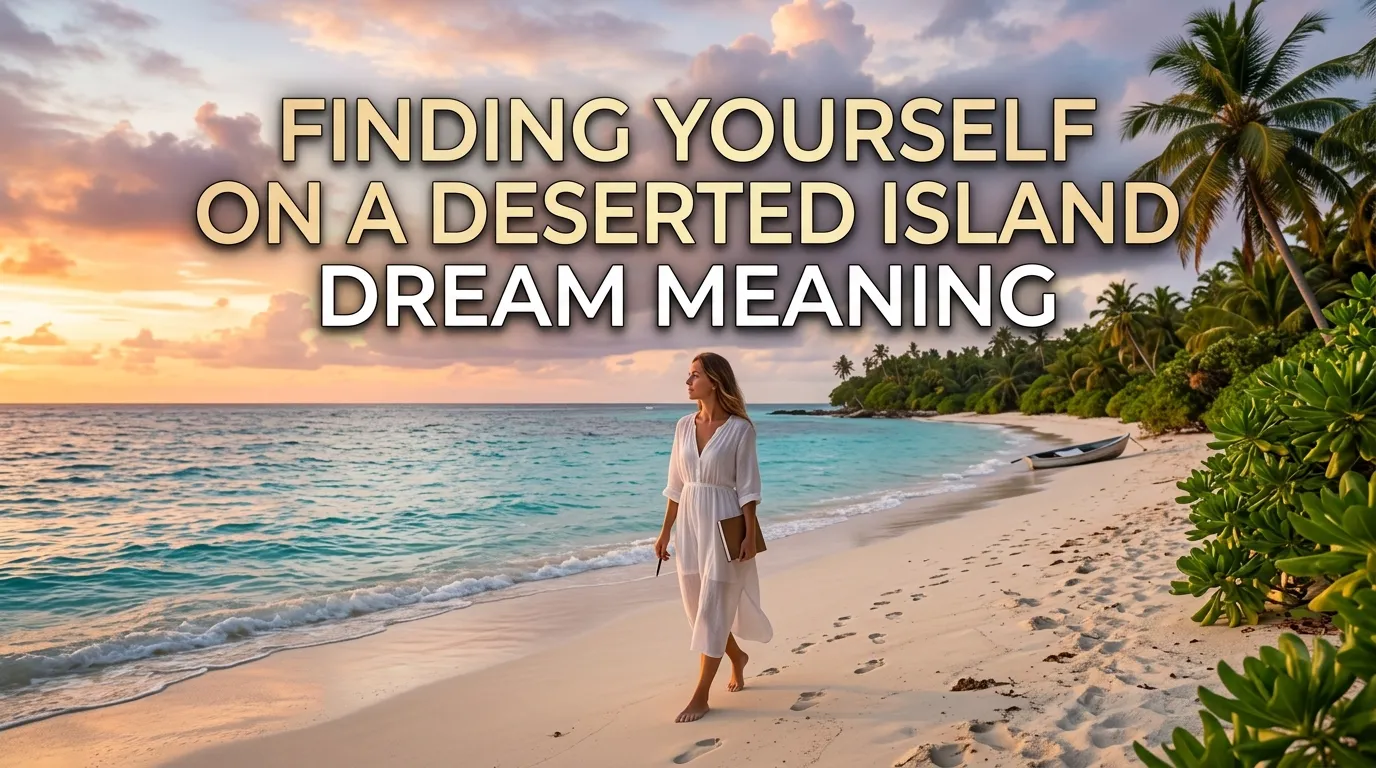
An island is the world’s simplest image of separation: land with water all around it, cut off from everything else. So when you dream of finding yourself on a deserted island, the dream is staging a question about separateness. Are you isolated — cut off from others against your will? Or are you alone — set apart by choice, or by need, in a way that might actually be good for you? The island looks the same either way. The feeling inside the dream is what tells them apart.
Deserted-island dreams are surprisingly varied in tone. Some dreamers wake lonely and afraid. Others wake peaceful, even refreshed, as though they had been on a holiday rather than stranded. Both are legitimate readings of the same symbol, because solitude and isolation are the same condition experienced from opposite sides.
Isolation: the island as abandonment
When the island dream feels frightening, it usually mirrors a real sense of disconnection. You may feel emotionally distant from the people around you — present in the same rooms, but not really reached. You may have moved, lost someone, ended a relationship, or entered a period where old friendships no longer fit. The water around the island is the distance you feel: visible, real, and not easily crossed.
Details sharpen this reading. A barren island — no food, no shelter, no shade — tends to pair with depletion: the feeling that you have nothing left to draw on. Stormy seas around the island suggest emotional turbulence cutting you off further. Searching the horizon for a ship, or signaling desperately, usually means part of you is actively looking for reconnection and has not found it yet.
Solitude: the island as refuge
But many island dreams are peaceful, and those deserve equal weight. A beautiful island — white sand, clear water, warm light — with a dreamer who feels calm is one of the dream world’s clearest images of healthy solitude. It tends to arrive when life has been noisy, crowded, or over-demanding, and some part of you is asking for quiet. Not loneliness. Quiet.
This variant often appears in people who are introverted, overworked, or coming out of a period of intense social or family demand. The island is the mind’s picture of the space they need: a place where nobody wants anything, where the only voice is their own. If your island dream felt like relief, trust that feeling. It may be the most honest part of the dream.
The island’s condition: a diagnostic
Like all dream landscapes, the island repays a close look:
- Lush and green — growth, possibility, inner resources. The island has what you need.
- Barren and rocky — depletion, or a situation that offers little nourishment.
- Small and shrinking — a sense that your space, freedom, or options are narrowing.
- Large and unexplored — an inner life with room you have not yet explored; the island as undiscovered self.
- With a hut, a fire, or a garden you built — self-sufficiency. You are learning to provide for yourself emotionally, and the dream is showing you succeeding.
The surrounding water
Water in dreams usually stands for emotion and the unconscious, and the water around an island is no exception. Calm, clear water suggests emotional peace — the separation feels safe. Rough, dark, or endless water suggests the opposite: feelings that are turbulent, or a distance that feels unbridgeable. A dreamer who swims confidently in the water around the island is usually describing someone comfortable with their own emotional depths. A dreamer who cannot swim, or who fears the water, may be describing feelings they have not yet learned to move through.
What the island teaches
The island dream’s deeper message is about self-sufficiency — not the grim kind, but the real kind. On an island, there is no one to perform for, no one to please, no one to hide from. You meet yourself without an audience. That is why the island is such a powerful setting for self-discovery: it strips away every social role and leaves the person underneath.
If the dream felt lonely, the waking response is connection: reach for one person, honestly, and close some of the distance. If the dream felt peaceful, the waking response is protection: guard some solitude in a life that may be trying to fill every silence. And if the dream felt like both — lonely and peaceful at once — then it has told you something true about the human condition: that we need others and we need ourselves, and the island is where we learn the balance.
Leaving the island
One last detail matters: how the dream ended. If a boat arrived, or you swam away, or you simply decided to leave, the dream may be signaling that a period of isolation or solitude is coming to an end — that you are ready to rejoin the world, or that the world is ready to have you back. If the dream ended with you still on the island, the season it describes is still in progress, and there is no need to force an exit. Islands are not prisons unless we treat them as such; sometimes the wisest response to an island dream is to stay a little longer, listen to the quiet, and leave when leaving feels natural rather than desperate.
The real-world history of people actually stranded on islands — and the stories that grew from them — is covered in the Wikipedia article on desert islands.










