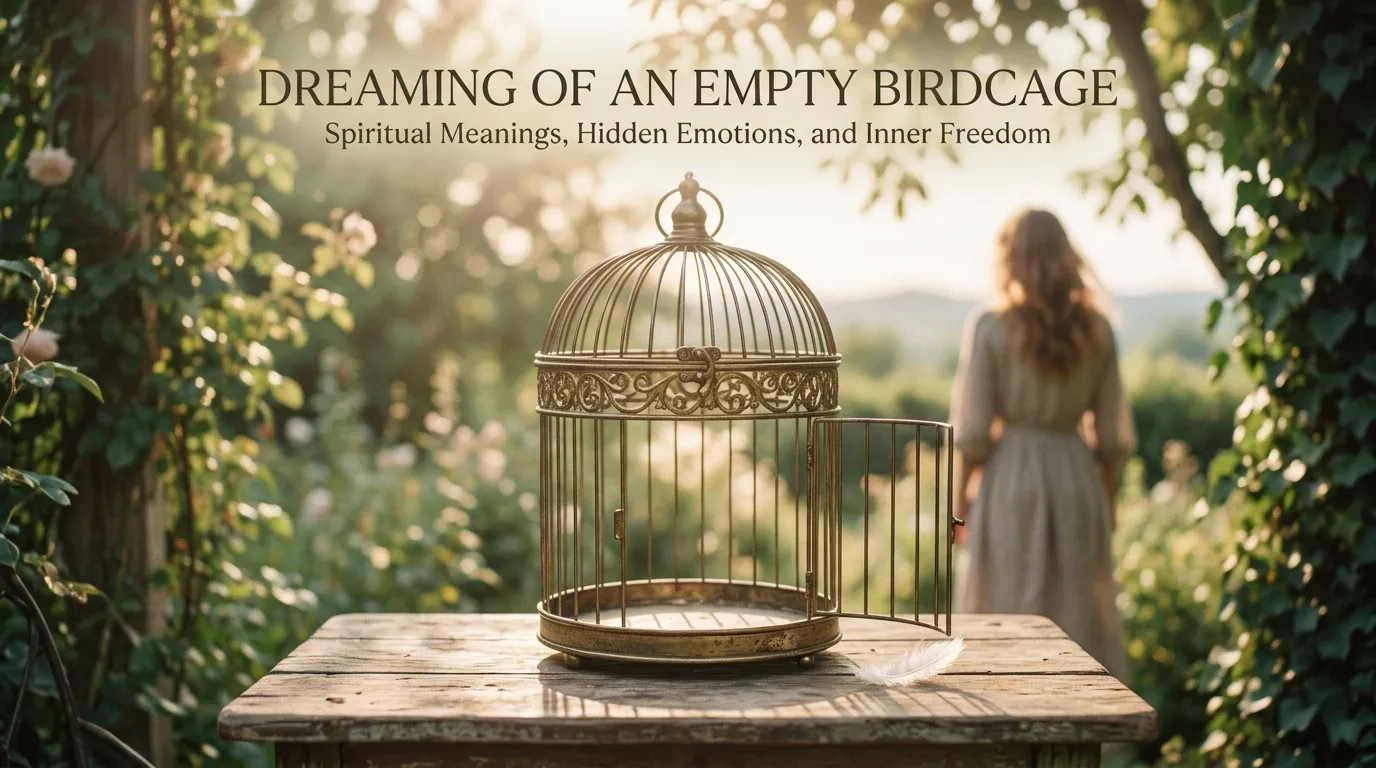
Sunlight comes through the window in bars — real bars, from the real window — and falls across the birdcage on the table. The cage is beautiful: brass, ornate, the door hanging open. And it’s empty. Not broken-into, not abandoned mid-escape. Just empty, the way a room is empty after someone has left it cleanly. You stand there in the dream looking at the empty cage for a long time, and you can’t decide whether what you’re feeling is loss or relief. The dream, refusing to help, lets you feel both.
The empty birdcage is one of dream symbolism’s perfect paradoxes: an object that means confinement, containing nothing. The cage says “held.” The emptiness says “gone.” Held and gone, at once. Every interpretation of this dream is an attempt to hold those two truths in the same hand.
The cage and the emptiness: two ideas at once
Start by separating what the dream fused. The cage, on its own, is the mind’s standard image for restriction — the role that’s too small, the belief that’s too tight, the relationship with bars, the version of yourself you’ve been keeping. The emptiness, on its own, is the image of absence — what’s left, what’s gone, what hasn’t arrived yet.
The dream’s genius is combining them, because the combination asks a question neither image asks alone: what was being held here, and where did it go? Everything in the interpretation flows from your honest answer — or rather, from noticing which answer your chest gives before your mind catches up.
The grief reading versus the liberation reading
These are the dream’s two great rival interpretations, and dreamers usually know which is theirs within seconds — even when they wish it were the other one.
The grief reading. Something precious has left. The cage is the shape of its absence — the routines built around a person who’s gone, the identity built around a role that’s ended, the daily structure that held a love or a purpose that isn’t there anymore. The emptiness aches because the cage remembers what it held. These dreams cluster around real losses — deaths, breakups, children leaving, careers ending — and they’re often part of grief’s slow furniture-rearranging: the mind walking through the rooms of the loss, noting what’s no longer in them.
The liberation reading. Something has been released — and the open door is the giveaway. In this version, the emptiness feels like space, not absence. The bird isn’t lost; it’s out. These dreams arrive after real liberations: the lease signed on your own place, the resignation sent, the belief finally discarded, the recovery that’s actually holding. The cage remains as a monument — look what I don’t live in anymore — and the dream is a quiet celebration the waking mind hasn’t permitted itself yet.
The door is the diagnostic. Open door: release, chosen or accepted. Closed door, empty cage: the stranger version — something left through the bars, or vanished without explanation. That one usually tracks to losses that don’t make sense yet: the friend who drifted without a fight, the faith that evaporated without a crisis. The dream is sitting with the mystery, not solving it.
What escaped — or what you released
If you can, identify the bird. Dreamers often know what bird the cage held, even though it’s gone — the way you know a room was lived in. The species is the message:
- A songbird — joy, expression, the part of you that sings. Its absence asks about silenced happiness: when did you last do the thing just because it delighted you?
- A bright, colorful bird — vitality, visibility, the showy self. Gone quiet, gone gray — the dream of anyone who’s been dimming themselves to fit somewhere.
- A bird of prey, caged — the strangest and most telling. Something powerful was being kept small — ambition, anger, appetite — and now the cage is empty. Whether that’s escape or release depends on the feeling, but either way, something strong is out in the world now.
- You never saw the bird — the cage was always empty, as far as you know. This is the potential version: a structure built for something that never arrived — the nursery never used, the plan never started, the capacity never filled. Sadder and stranger than loss, because there’s nothing to grieve, only something to wonder about.
The open-door variation
There’s a version of this dream that deserves its own paragraph, because dreamers report it with a particular wonder: the cage with the open door, and the bird still inside — or the dreamer watching the door, waiting to see if the bird will go. The prison is open. The prisoner stays.
This is the dream of freedom not yet taken: the bad situation you’ve already mentally left but haven’t physically left, the belief you’ve disproven but still obey, the door that’s been open for months while you sit in the cage out of habit. The dream stages it without judgment — just the open door, the waiting bird, the question hanging in the air like sunlight. It’s the gentlest ultimatum the psyche ever issues: the way out is open. It’s been open. What are you waiting for?
Living with the empty cage
Whichever reading is yours, the dream leaves the same practical question: what do you do with a cage you no longer need? The dreamers who resolve these dreams in waking life tend to do something the dream only implied — they dismantle it. Not metaphorically, at first: they clean out the actual equivalent. The ex’s shelf. The old routine. The story about who they are that the loss already disproved.
And some keep the cage — deliberately, on a shelf, door open, catching light. A monument to the confinement survived and the release accomplished. There’s wisdom in that too: the empty cage, kept honestly, becomes the opposite of a prison. It becomes evidence — that you were held, that you’re not anymore, and that the sky, whatever it holds now, is where you belong.
Cages were designed to hold what wants to fly — a tension humans have been negotiating for as long as we’ve kept birds, as the history of the cage shows. Your dream emptied one for a night to ask you the oldest question confinement ever posed: what was in there, where is it now, and are you — finally — ready to follow it out?










