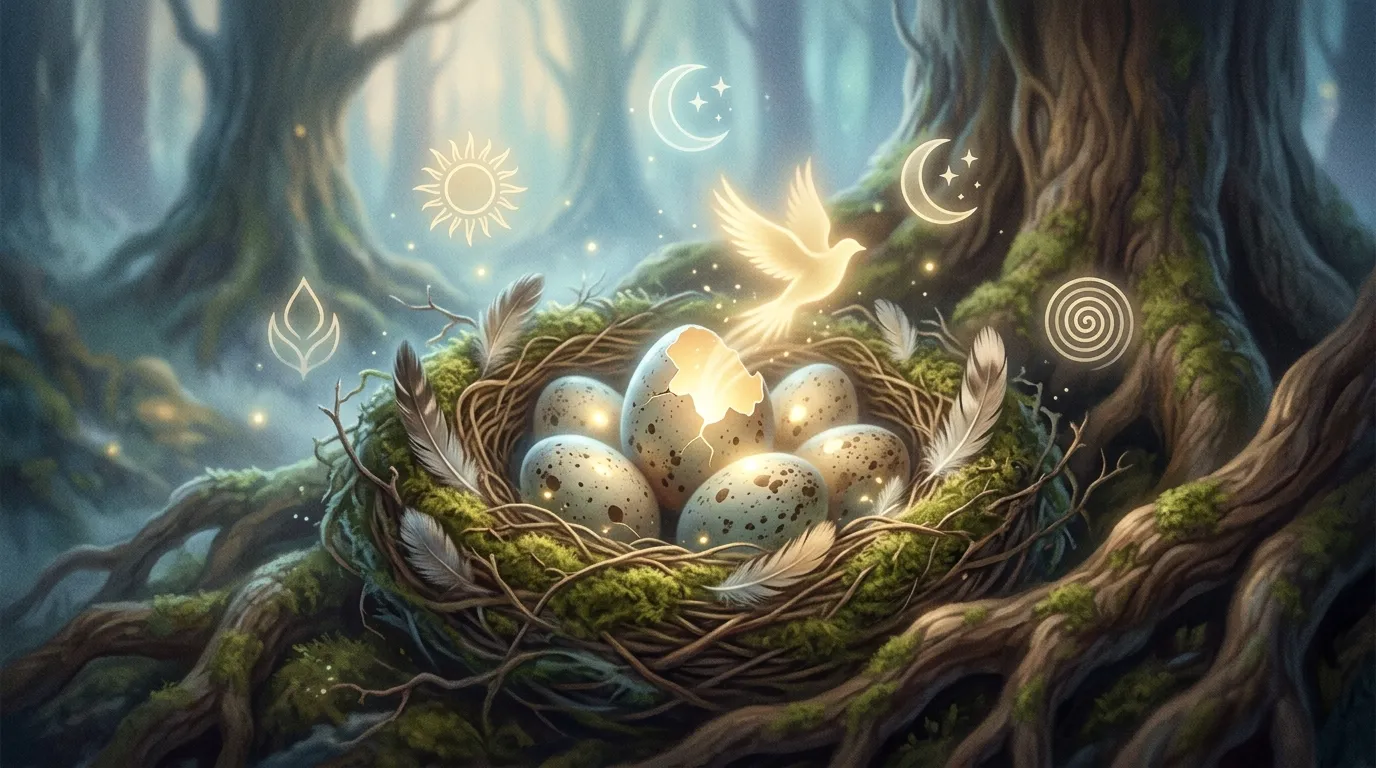
In the corner of a garden you’d forgotten you had, there’s a nest. You didn’t build it. You don’t remember planting the garden. But there it is — woven, deliberate, holding three eggs the color of morning — and you understand, with the total certainty that only happens in dreams, that something is about to begin. You don’t know what. You don’t need to know. The eggs know.
This is the egg dream in its most hopeful form: not a symbol of fragility but of futurity. The dream isn’t warning you. It’s announcing you — telling you that something in your life has conceived, is gestating, and will, in its own time, hatch.
The egg as a held future
What makes the egg such a potent dream image is its temporal quality. Most dream symbols are about the present — the house is your self now, the chase is your fear now. But an egg is always about later. It contains a future in a present-tense package. Dreaming of eggs is the psyche’s way of saying: something is already underway that you can’t see yet.
This is why egg dreams so often arrive during the quiet middle of things — the months of the pregnancy before the showing, the year of the degree before the graduation, the long slow building of the business before the launch. Nothing looks different on the outside. The dream is reporting from the inside: it’s happening. It’s real. It’s growing.
The number matters, if you noticed it. Dreamers who count their dream-eggs often find the count meaningful — not mystically, but emotionally. One egg: the single precious thing — the project, the hope, the new love. Many eggs: abundance, or the slightly anxious feeling of too many beginnings at once. An empty nest where eggs should be: the beginning that hasn’t conceived yet — the wish still in its wishing phase.
Hatching: the moment of arrival
If whole eggs are about potential, hatching is about emergence — and hatching dreams have their own electric charge. The shell cracking, the first wet head, the impossible smallness of the new thing: dreamers describe these scenes with a vividness that suggests the psyche considers them important.
Hatching dreams tend to arrive at actual thresholds — not before, not after, but during: the week the book is published, the month the baby comes, the season the new identity starts fitting. The dream isn’t predicting the emergence. It’s witnessing it, the way a midwife witnesses — present at the arrival, honoring the effort of it.
Note what hatches, because the dream is specific and the specificity is the message. A bird: freedom, perspective, the part of you that’s been ready to fly. Something unexpected — a light, a flower, a tiny human hand: the dream telling you the new thing won’t look like you expected. Nothing hatching, just the straining shell: the emergence that’s overdue — the dream’s gentle pressure on the thing you’ve been keeping incubating too long.
Protecting what’s not ready
Many egg dreams aren’t about the eggs at all — they’re about your behavior toward them. You’re carrying them carefully. Hiding them from someone. Keeping them warm. Building the nest better. The dream has cast you as guardian, and the guardianship is the point.
This is the dream of the tender early phase — the idea too new to share, the hope too fragile for skepticism, the plan that would die if exposed to the wrong conversation. The psyche is showing you your own protectiveness and approving of it. Not everything needs to be announced. Some things need to be incubated — kept warm, kept quiet, kept safe from the cold air of other people’s opinions until they’re strong enough to survive it.
If someone in the dream threatened the eggs — tried to take them, break them, or rush them — note who. The dream is usually quite direct about identifying the threat to your tender beginning: the critical voice (sometimes wearing a familiar face), the premature demand for results, your own impatience. The guardian posture the dream gave you is the correct one. Keep guard.
When potential meets reality: broken and rotten
Not every egg dream is hopeful, and the difficult versions deserve honesty. Broken eggs — dropped, crushed, cracked open to nothing — stage the grief of interrupted becoming: the miscarriage, the failed launch, the relationship that ended before it began. The grief is specific and under-acknowledged in waking life — mourning not what was, but what would have been. The dream gives that particular grief a shape, which is the beginning of honoring it.
Rotten eggs are different — and darker. These aren’t about interrupted potential but corrupted potential: the opportunity that’s gone bad while you waited, the situation that’s been incubating too long in the wrong conditions. The smell in the dream is information — trust it. The dream is telling you that something you’ve been patiently nurturing has spoiled, and patience is no longer the virtue the situation requires.
The distinction matters: broken eggs ask for grief; rotten eggs ask for action. The dream knows which one you need. The feeling will tell you — sorrow for the broken, revulsion for the rotten. Listen to the feeling. It’s never wrong about this.
The oldest symbol in the book
Eggs as beginnings aren’t a dream-invention — they’re one of humanity’s oldest images. The “world egg” appears in creation stories across continents: the cosmic egg of Hindu tradition, the Orphic egg of Greek mystery religion, the egg of Egyptian and Finnish cosmogonies — the universe itself, hatched. When your dreaming mind reaches for an egg, it’s reaching past personal symbolism into the species-level image for everything beginning.
Which is why these dreams feel the way they do — larger than their content. Three eggs in a garden shouldn’t feel cosmic. But they do, because the image carries ten thousand years of mornings. The dream isn’t just telling you something is beginning. It’s placing your small, specific beginning inside the oldest story there is: the one where everything, always, starts as something small and whole and full of not-yet.
So if you dreamed of eggs — whole, warm, waiting — take the dream at its word. Something is underway. You may not be able to name it yet. You may not need to. The eggs know what they’re becoming, and they’re in no hurry. Neither, the dream suggests, should you be. Just keep them warm. Keep them safe. And when the shell starts to crack — as it will, as it always does — be there for the hatching. It’s the moment the whole dream was about.
Few images have carried the weight of beginning as long or as universally as this one — a symbolism explored across biology and culture in the natural history of the egg. Your dream borrowed humanity’s oldest emblem of potential for a night. What it’s incubating is yours to discover — but the dream has already told you the most important part: it’s alive in there.










