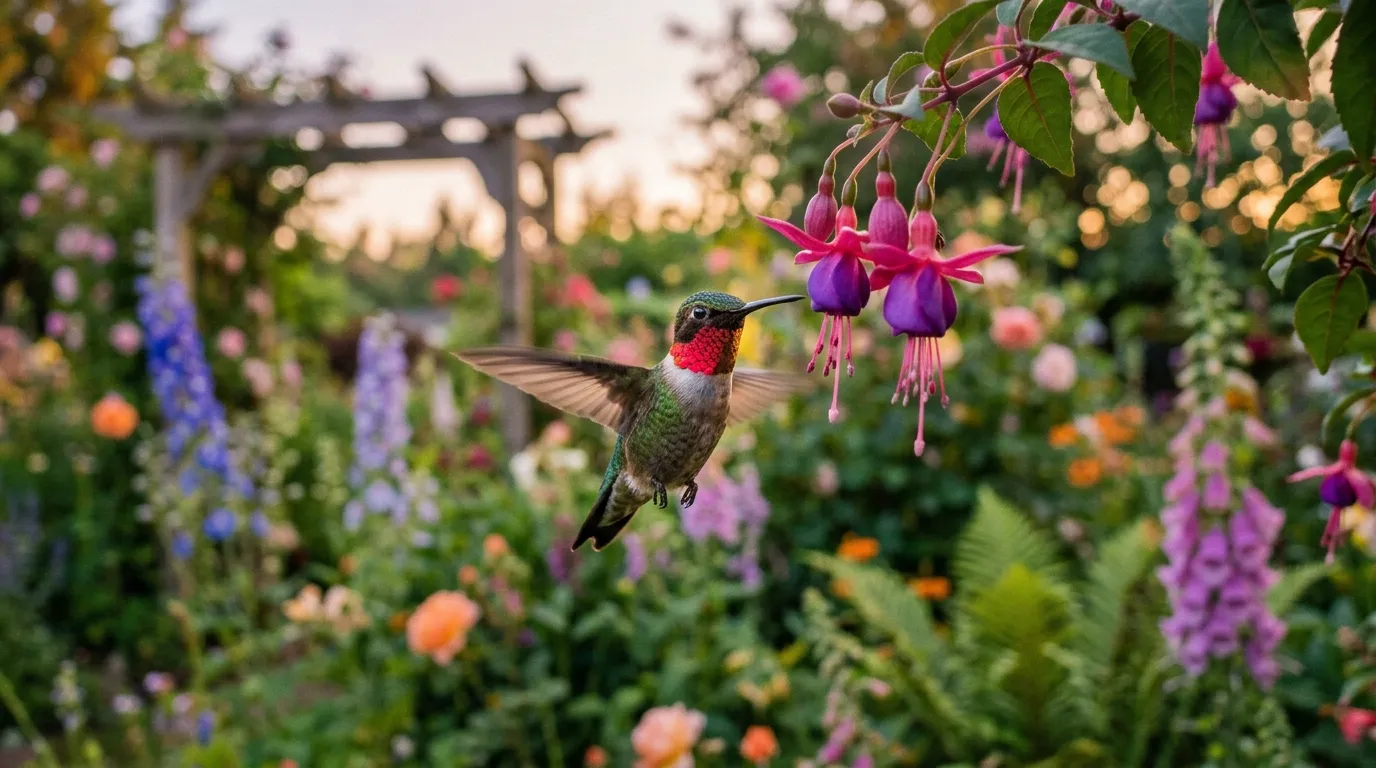
A hummingbird does not land and deliver a speech. It stops the air. For a few seconds, the fastest creature in the bird world holds perfectly still, right in front of you, as if the whole point of all that speed was to arrive at this one pause. A dream of a hummingbird hovering before you is a dream about that pause — a moment of attention so complete it feels like being chosen.
The hover is the message
Most hummingbird dreams are about movement: the bird darts, feeds, vanishes. This dream is different. The bird stays. It holds your gaze. In a dream world that usually rushes, a hovering hummingbird is the equivalent of someone putting a hand on your shoulder and saying, stop, look, this matters.
What it wants you to notice is the first question to ask. A hovering hummingbird often appears during periods when life is loud and fast — when you have been skimming days instead of living them. The dream stages the opposite of skimming: a creature that could be anywhere in a second, choosing to be exactly here. The invitation is not complicated. It is attention itself.
The feeling of being seen
Dreamers describe this dream with unusual tenderness. The bird feels deliberate. It feels personal. Some say it felt like a visit from someone they had lost; others say it felt like being recognized by the world itself. That feeling of being seen is central. A hummingbird hovering in front of you is a dream of being noticed — of a small, bright part of life insisting that you matter enough to stop for.
If the dream came during grief, the hovering bird often carries comfort: a sense that love continues in some form, that the bond was not erased by absence. You do not need a doctrine to receive that comfort. The dream offered it; it is yours to keep.
The physics of the symbol
A hummingbird’s wings beat dozens of times per second, yet the bird appears motionless. That paradox — furious effort producing perfect stillness — is part of the dream’s meaning. It speaks to the kind of work that looks effortless from outside: the parenting, the caregiving, the healing, the quiet maintenance of a life. If you have been doing invisible work and feeling unseen, the dream may be the mind’s way of honoring it. The stillness you achieve costs effort, and the dream knows.
The bird’s size matters too. Hummingbirds are among the smallest birds in the world, and the dream’s choice of something tiny to carry a large message is deliberate. The message is about smallness itself: that the small blessings — a morning coffee, a child’s laugh, a few minutes of peace — are not the consolation prizes of life. They are the main event. The hummingbird, which lives on drops of nectar, has always been the patron of that idea.
A second way to read the pause
The hover can also be read as a comment on speed itself. A hummingbird lives faster than almost any other bird, yet the dream shows it choosing stillness. That choice mirrors a question many people carry: whether a life lived at full speed is actually getting anywhere. The bird’s answer is not to slow down forever. It is to prove that stillness is available even to the fastest among us — that a pause is not a failure of momentum but a use of it. If your days have felt like one long blur of tasks, the dream may be offering a new definition of productivity: not more motion, but motion interrupted, deliberately, by moments of full attention.
When the hover feels like a warning
Not every version is gentle. If the hovering bird felt threatening, agitated, or too close, the dream may be about attention of a harder kind: something in your life is demanding to be noticed — a health concern, a relationship strain, a deadline — and you have been flying past it. The bird hovers because you have not stopped. The remedy is the same as the gift: stop, look, and let the thing be seen.
A practice for the morning after
Try a two-minute hover of your own. Sit still, breathe, and let one small good thing in your immediate surroundings hold your attention — light on a wall, a sound from another room, the feeling of your own breath. Do not analyze it. Just hover with it. This is not mysticism; it is the dream’s posture, practiced while awake. People who do this often find the dream’s tenderness lasts longer, and the day’s noise gets a little quieter.
Then ask the simplest question the dream poses: what in my life deserves a hover — a pause, a closer look, a moment of full attention? It might be a person, a project, a feeling, or yourself. The hummingbird did not come to decorate your sleep. It came to teach you how to stop. The bird itself is a marvel of engineering and endurance; the Wikipedia article on hummingbirds describes how such a tiny creature manages its impossible flight.










