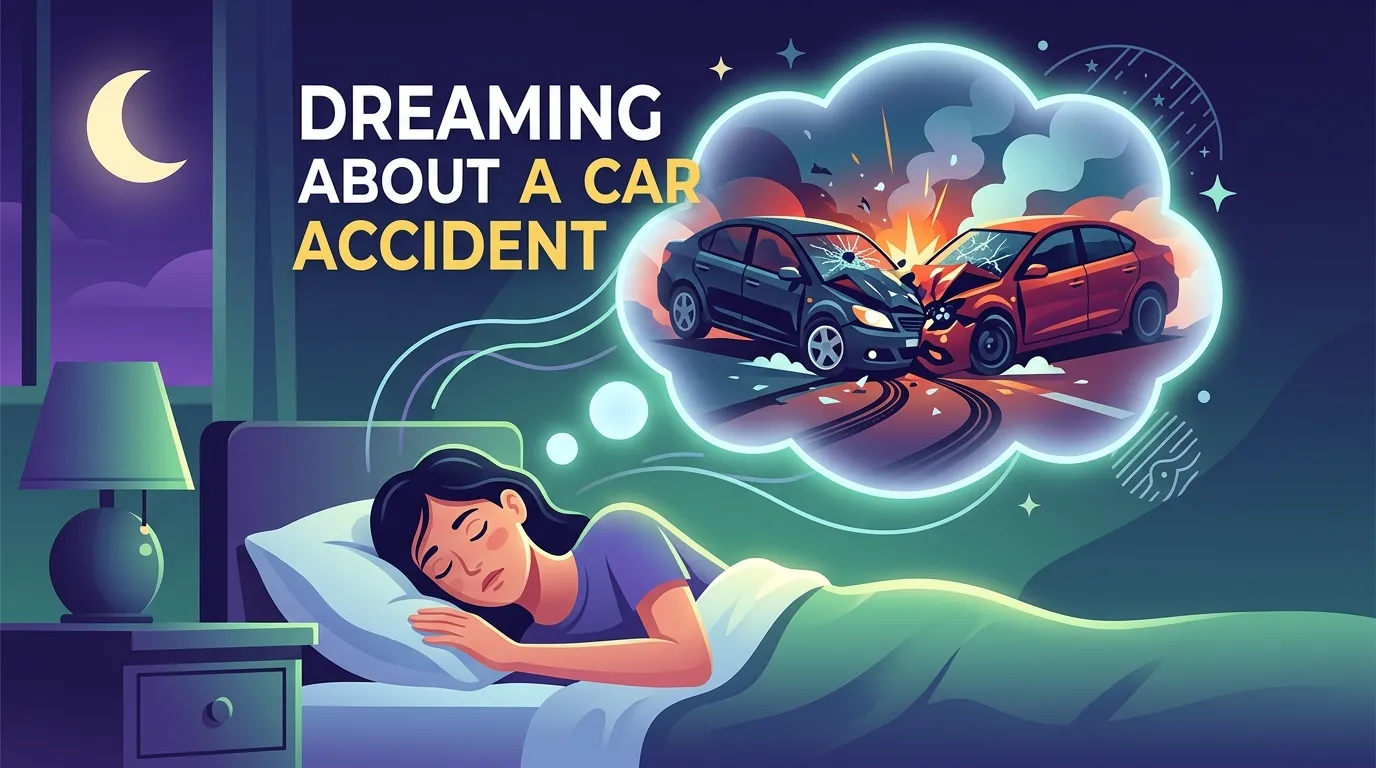
Think of a car-accident dream as a crash report. Like any report, it has fields: who was driving, who was in the car, what happened, who was hurt, and what the road looked like. Fill in those fields, and the dream stops being a vague fright and becomes a specific message about control, direction, and the people you are traveling with.
Field one: who was driving
You were driving. This is the most common version, and the most direct. The dream is about your own sense of control over your life’s direction. A crash while you were driving suggests a fear that you are steering badly — a decision you doubt, a speed you cannot sustain, a distraction that has taken your eyes off the road. It is rarely about driving skill. It is about life steering: are you going where you meant to go, at a speed you can survive?
Someone else was driving. Now the dream is about trust. You have handed the wheel to someone — a partner, a parent, a boss, a belief system — and part of you is afraid of where they are taking you. The dream may be flagging a real loss of agency: a situation in which your direction is being set by someone else’s choices.
No one was driving. A car moving on its own, or a crash with an empty driver’s seat, points to a situation that feels driverless: a relationship drifting, a project running on momentum, a life being steered by habit rather than choice.
Field two: your seat in the car
The driver’s seat. Responsibility. The dream is about your choices and their consequences.
The passenger seat. Influence without control. You can see the crash coming but cannot prevent it — a common feeling in family crises, workplace disasters, and relationships where you have warned someone and not been heard.
The back seat. Powerlessness, or a child’s perspective. For adults, this often points to an old pattern: feeling like a child in a situation run by adults.
Watching from the roadside. You are a witness to someone else’s collision — a friend’s divorce, a colleague’s downfall, a family member’s crisis. The dream may be processing your helplessness, or your relief that it was not you, or your guilt about that relief.
Field three: the crash itself
A head-on collision suggests direct conflict — two wills, two directions, meeting with force. A rear-end collision suggests being blindsided, or being the one who did not stop in time. A car rolling off the road suggests a slow drift that ended in disaster: the long, gradual loss of control rather than a single bad moment. A crash in which you walk away unhurt is the dream’s reassurance: the situation feels catastrophic, but you will survive it. A crash in which you are trapped suggests a waking-life situation from which you cannot yet see an exit — a job, a debt, a relationship that feels like a wrecked car with jammed doors.
Field four: the road
Do not overlook the road. A familiar road suggests the crash is about your daily life, your routine route. An unfamiliar road suggests new territory — a new job, a new city, a new relationship — where you feel out of your depth. A dark or foggy road suggests uncertainty: you cannot see where you are going, and the dream is dramatizing that blindness. A road that ends suddenly suggests a path that has run out — a plan, a career, a relationship that has reached its terminus.
What the report is for
A crash report exists so that something can change: a dangerous intersection gets a light, a faulty car gets recalled, a driver slows down. Treat your dream the same way. Ask: where have I lost control, or handed it away? What collision — of wills, of plans, of values — is actually happening in my life? And what is one small adjustment to my speed, my route, or my driver that would make the next stretch safer? The dream is not a prediction of a real accident. It is a report on the road you are already on — and a chance to drive it differently.
When the dream repeats
A single car-accident dream is usually a single warning. A recurring one is a pattern, and patterns deserve a different kind of attention. If you keep dreaming of crashes, the dream is likely pointing to a chronic condition rather than a single event: a lifestyle that is permanently over speed, a relationship that is permanently on a collision course, a workload that has been unsustainable for months. Recurring dreams do not stop because you interpret them correctly. They stop when the conditions they dramatize change. If the crash dream keeps returning, the honest question is not “what does it mean?” but “what in my life is still on a collision course, and what would it take to change lanes?” The dream is a dashboard light. It will keep glowing until the engine is fixed.
For data on real road safety and what actually causes collisions, the Wikipedia article on traffic collisions provides a grounded overview.










