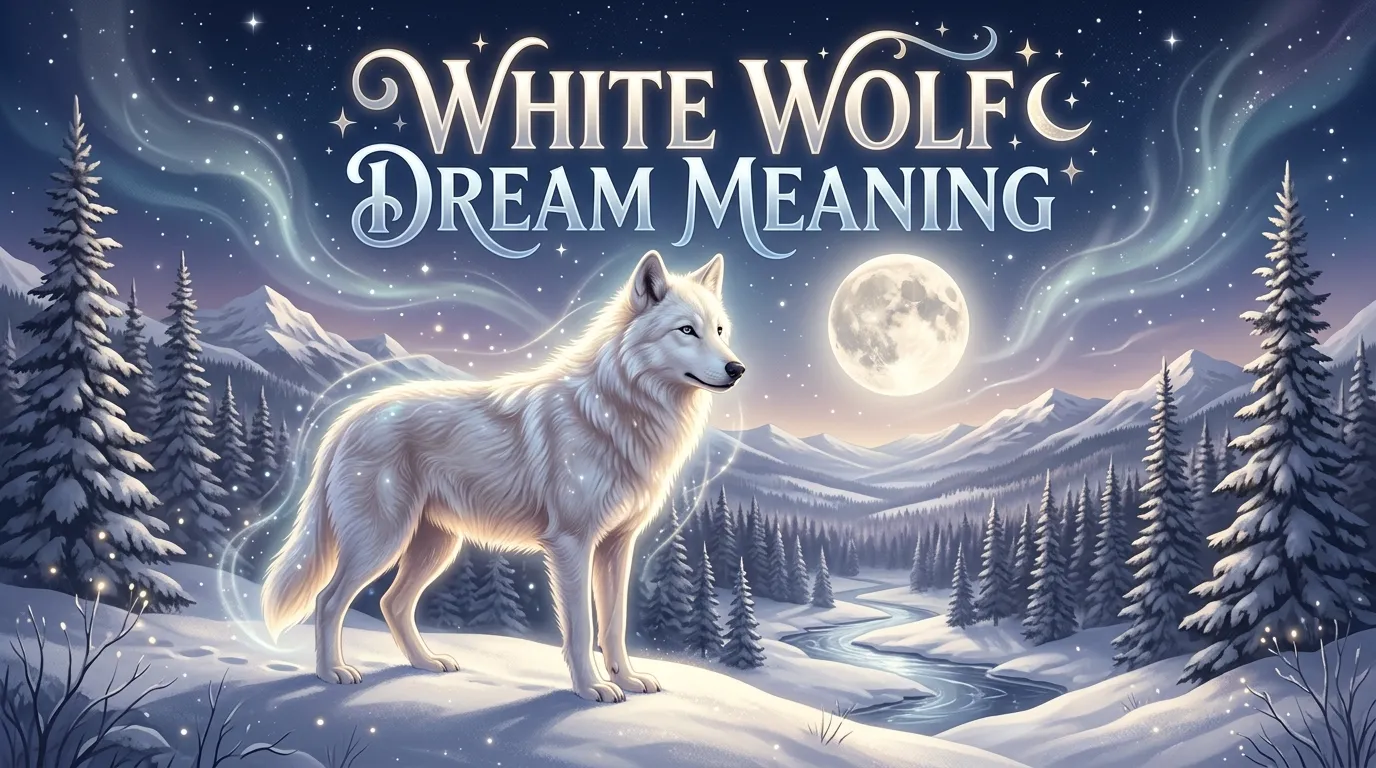
Color changes everything in a dream. A wolf is already a powerful figure — wild, intelligent, social, dangerous. Make it white, and the dream adds a second layer: purity, the unknown, the spiritual, the thing that stands out against the dark. A white wolf is not just a wolf. It is a wolf that cannot hide, and a message that does not want to be missed.
The central tension of the white wolf dream is between two readings that look alike: the wolf as guide, and the wolf as threat. Telling them apart is the work of the dream.
The guide: when the wolf leads
In the gentler version of the dream, the white wolf walks ahead of you, or beside you, or simply watches you with calm eyes. It does not attack. It does not flee. It is present, and its presence feels meaningful — even sacred. This is the dream of the inner guide: intuition, instinct, a deeper knowing that you have been learning to trust. The whiteness marks it as something set apart — a part of yourself that is not ordinary, not social, not performative. It is the part that knows things before you can explain them.
People often report this dream during periods when they are learning to trust themselves again: after leaving a controlling relationship, after making a decision everyone advised against, after a long stretch of ignoring their own judgment. The white wolf arrives as confirmation: the instinct you have been second-guessing is sound.
The threat: when the wolf bares its teeth
The darker version is unmistakable: snarling, chasing, circling, eyes that feel hostile. A threatening white wolf usually represents a fear that is both pure and hard to name — a dread that feels spiritual rather than practical, a sense that something is wrong even though nothing has happened yet. It can also represent a person whose goodness you doubt: someone who appears pure or trustworthy but whose behavior has begun to alarm you. The whiteness, in this reading, is the disguise — the thing that makes the threat hard to recognize.
Your feeling in the dream is the deciding evidence. Awe points to the guide. Dread points to the threat. If you felt both at once, the dream may be holding both truths: the thing you fear is also the thing that would guide you, if you stopped running from it.
The lone wolf and the pack
Wolves are pack animals, and a white wolf dream often has something to say about belonging. A lone white wolf can represent the experience of being different — the person in the family, the office, or the community who does not fit, who stands out, who is valued and isolated at the same time. A white wolf running with a pack can represent the opposite: the discovery that your difference has a place, that there is a group where your strangeness is not a problem but a role. A white wolf leaving a pack can mark a necessary departure: a belonging that cost too much to keep.
What the wolf was doing
- Watching you. An aspect of yourself is waiting to be acknowledged — a talent, a truth, a grief.
- Running beside you. You are not as alone as you feel. Your instincts are keeping pace with you.
- Howling. A call that has not been answered — your own voice, or someone else’s, asking to be heard.
- Attacking you. A part of yourself, or a situation, that you have been fighting instead of understanding.
- Protecting you. A strength you did not know you had, standing guard over something vulnerable in you.
A question to carry forward
After a white wolf dream, ask yourself one question: what in my life is both wild and white — both untamed and pure? The answer is often a part of yourself you have been trying to civilize: a fierce protectiveness, an inconvenient honesty, a hunger for freedom that does not fit a tidy life. The white wolf is not asking you to tame that part. It is asking you to let it walk beside you.
The white wolf in story and myth
The white wolf has run through human stories for centuries. In some Native American traditions, the white wolf is a teacher and a spirit guide — the animal that appears when a person is ready to learn. In Norse myth, the wolf is a world-ending force, a reminder that wildness can also destroy. In modern fiction, from fairy tales to fantasy novels, the white wolf is almost always set apart: the rare one, the chosen one, the one that does not belong to the ordinary pack. A dream white wolf can carry any of these associations, and the one that fits is usually the one that stirs something in you. If your wolf felt like a teacher, the dream may be about a lesson you are ready to learn. If it felt like a warning, the dream may be about a wildness you have underestimated. The wolf is old. It brings its stories with it.
For the natural history of the real animal, the Wikipedia article on the wolf covers behavior, pack life, and the wolf’s long relationship with humans.










