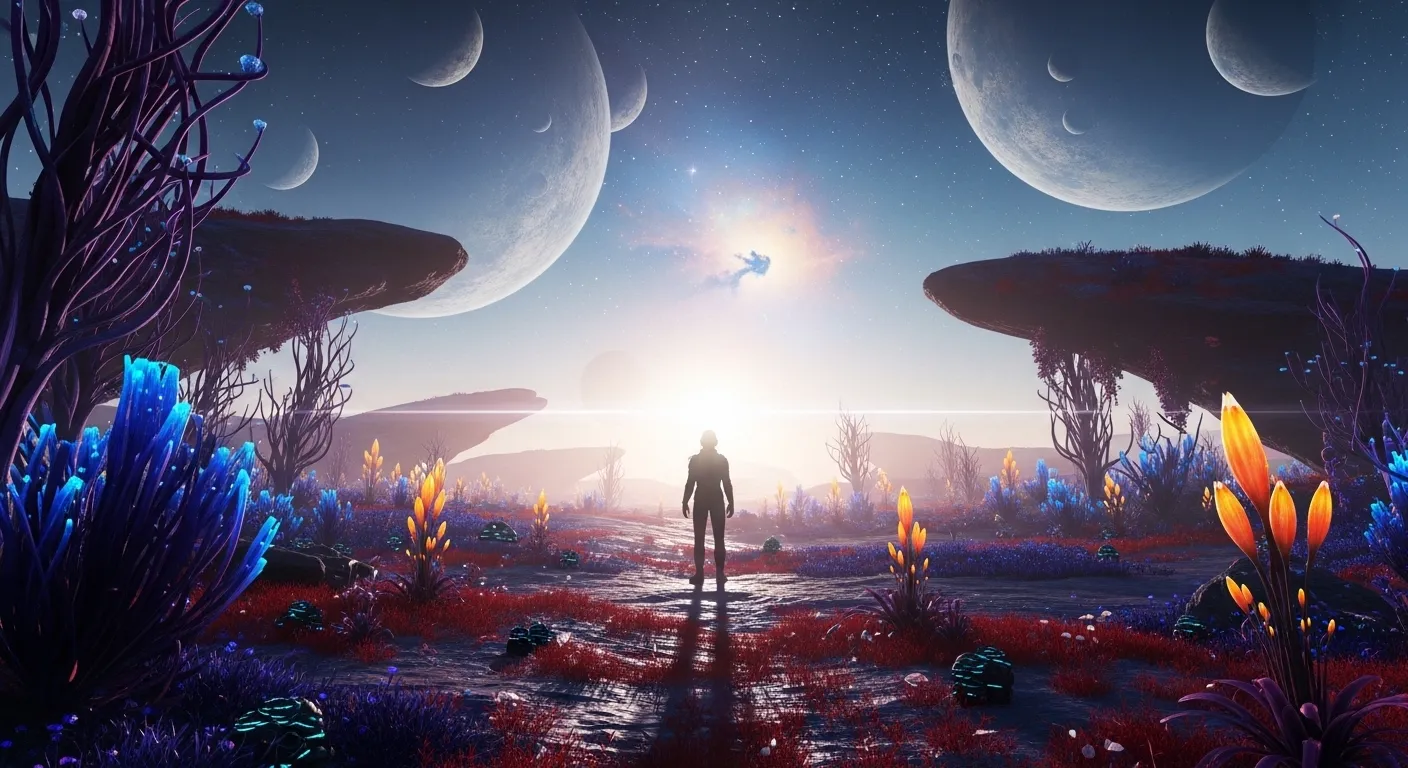
The sky is the wrong color — a deep violet you’ve never seen outside a dream — and there are two moons, one small and sharp, one huge and blurred at the edges. The ground crunches under your boots like frost, though the air is warm. Nobody else is here. You stand in the middle of an alien field, breathing alien air, and the feeling that rises in your chest isn’t fear. It’s recognition. I’ve been feeling like this for months, you think. I just didn’t have the landscape for it.
That’s the secret of another-planet dreams: the planet is never really about space. It’s about the felt distance between you and the life you’re living — rendered as actual distance, on an actual (dream) world.
Alienation, rendered beautifully
Let’s use the precise word: alienation. Not loneliness, exactly — loneliness wants company. Alienation is stranger and quieter: the sense of being a foreigner in your own life. The job is fine but doesn’t feel like yours. The friends are kind but the conversations feel dubbed. You go through the days competently, like an astronaut following a checklist on a planet that isn’t home.
The dream gives this condition a landscape worthy of it. And here’s what’s psychologically astute about the image: on another planet, alienation isn’t a problem — it’s the correct response. Of course you feel out of place; look where you are. The dream, with unusual compassion, relocates the wrongness from you to the setting. Maybe you’re not broken. Maybe you’re just on the wrong planet right now.
The planet as a mirror of your inner climate
Dream researchers note that dream landscapes tend to externalize emotional states, and other-planet dreams are the purest examples. The planet’s conditions are usually a weather report from the interior:
- Beautiful but empty — violet skies, crystalline formations, not a soul in sight. The classic version. Life looks fine from the outside but feels uninhabited. Common during high-functioning depressive stretches: everything works, nothing lives.
- Hostile and harsh — thin air, burning ground, storms on the horizon. The environment is actively difficult, which usually means the dreamer feels the world is difficult right now — not just their place in it. These track external pressure more than internal distance.
- Strange but welcoming — odd flora, unfamiliar light, but a sense of rightness, of breathing easier. These are the hopeful ones: the psyche auditioning a new life and finding the air breathable. They often precede real changes — moves, career shifts, new relationships.
- Populated by others who belong — aliens or fellow travelers who are clearly at home here while you’re the visitor. This stages a specific social feeling: everyone else seems to know how to be a person, and you’re still reading the manual.
A brief, real science interlude
It’s worth pausing on the fact that your dreaming mind staged this on a planet — because real planets beyond our solar system turn out to be stranger than most dreams. Astronomers have now confirmed thousands of exoplanets: worlds where it rains glass sideways, where two suns set at once, where the sky might genuinely be violet. The dream’s imagination, it turns out, was working well within the universe’s actual range.
This matters for interpretation in an oblique way. The dream chose the largest possible metaphor for distance — not another city, not another country, but another world. When the psyche reaches for the cosmic, it’s telling you the felt gap is total: not “I need a vacation” but “I need a different order of existence.” Take the scale seriously. Small adjustments rarely answer planet-sized dreams.
Loneliness versus exploration: which flavor is yours?
Two dreamers can stand on identical violet soil and have opposite dreams. The difference is posture:
In the loneliness version, you’re trying to get home. You look for the ship, the portal, the way back. The planet is a predicament. The dream’s question is about disconnection: what would home even feel like now? These dreams ask you to inventory what “home” means — the people, the work, the feeling of being from somewhere — because the dream suggests you’ve lost the coordinates.
In the exploration version, you’re mapping. You walk toward the strange formations, you test the air, you feel the old pull of what’s over that ridge. The planet is an invitation. These dreams belong to the curious and the restless — often arriving right before someone does something brave. The psyche is rehearsing unfamiliarity and discovering it can be survived, even savored.
Most honest answer? Many dreamers report both in sequence: first the stranded panic, then, as the dream continues, the slow turn toward wonder. If your dream moved that way, it may be showing you your own trajectory — from feeling exiled by change to becoming, gradually, an explorer of it.
Coming home
Another-planet dreams rarely end with a dramatic rescue. They end the way they began: with a shift in recognition. You wake up, and the bedroom looks briefly alien too — and then, as the kettle boils and the day assembles itself, the familiar returns. But something has been recalibrated. You’ve seen your life from another planet, which is to say: from far enough away to notice its actual shape.
The practical question the dream leaves is disarmingly simple: what would make this planet feel like home? Not a different planet — this one, your actual life, with its actual violet-skied strangeness. The dream didn’t show you an alien world to make you despair of this one. It showed you one so you’d finally see this one clearly — and start, deliberately, the small terraforming project of making it habitable.
The real universe, meanwhile, keeps supplying landscapes stranger than any dream — thousands of confirmed worlds beyond our own, catalogued in the ongoing survey of exoplanets. Your sleeping mind visited one for a night. It came back with a field report about the only planet that actually matters: the one you’re standing on, and how it feels to live there.










