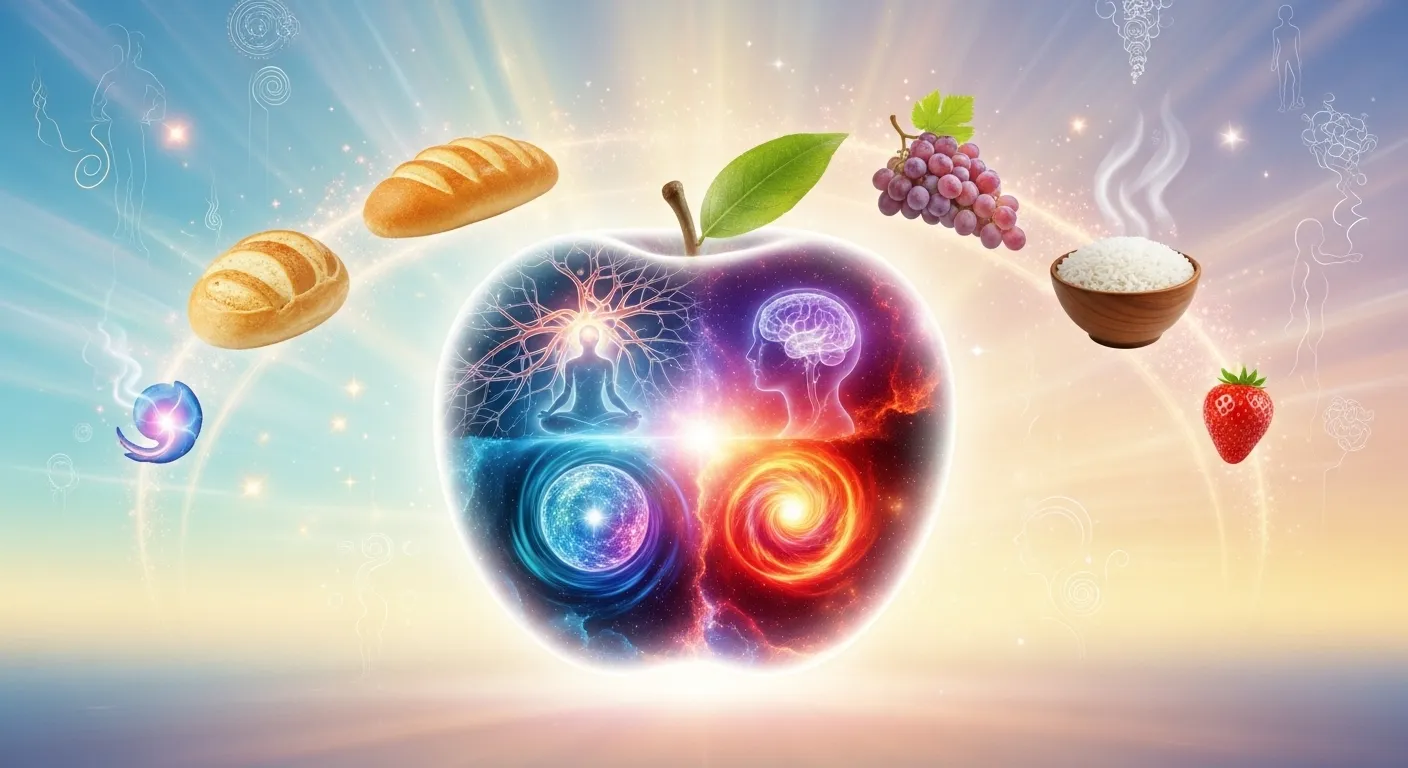
The banquet table stretches longer than the room should allow. Steam rises from dishes you almost recognize — your grandmother’s recipe, but wrong in a way you can’t name. Everyone is eating. You’re holding a plate, and the plate is empty, and nobody will meet your eye long enough for you to ask why. You wake up hungry in a way that has nothing to do with your stomach.
Food is the dreaming mind’s mother tongue for need. Long before we had language for loneliness, ambition, or spiritual hunger, we had the experience of being fed — or not. Dreams about food speak in that first language, which is why they bypass analysis and go straight for the gut.
Feast, famine, and the spoiled plate
Food dreams sort themselves, roughly, into three banquets:
The feast you can’t quite join. Abundance is present but inaccessible — the food is behind glass, or everyone else is served first, or your plate stays empty. This is the dream of unmet need in the presence of plenty: the successful friend group while your career stalls, the loving family that somehow doesn’t see you, the spiritual tradition you admire but can’t enter. The pain of the dream isn’t scarcity — it’s proximity to fullness without participation.
The famine. Empty shelves, bare tables, searching and not finding. Simpler and older than the feast dream: the psyche reporting depletion. These cluster around burnout, grief, and the aftermath of giving too much — the caregiver’s dream, the new parent’s dream, the dream of anyone who has been feeding everyone but themselves.
The spoiled plate. Food that’s rotten, wrong, or turns to something else in your mouth. This is the dream of nourishment that’s gone bad: the relationship that once fed you and now sickens, the job that was once meaningful, the belief system that’s curdled. The disgust in the dream is information — trust it more than your waking rationalizations.
Food as emotional currency
Watch, in these dreams, the transactions — because food dreams are almost always about exchange. Who’s cooking? Who’s serving? Who’s eating first? The dream stages your economy of care with unusual bluntness:
- You’re cooking for others — the giver’s dream. Often appears when giving has become identity: you’re nourishing everyone, and the dream gently asks who’s nourishing you.
- Someone cooks for you — note who. The dream is telling you where you feel (or wish you felt) cared for. If the cook is someone unexpected — an ex, a stranger, a deceased relative — the dream is pointing at an unmet need wearing their face.
- You’re eating alone — not necessarily sad. Solitary eating in dreams sometimes signals self-sufficiency: finally feeding yourself, literally and otherwise. But if it felt lonely, it’s the simpler reading — hunger for company.
- You’re refused food, or it’s taken away — the rejection dream in edible form. The specificity matters less than the feeling: the small, hot shame of wanting and being denied.
- You’re force-fed or can’t stop eating — consumption without choice. These track compulsive patterns: the scrolling, the overwork, the relationship you can’t leave. The dream shows the mechanism without the usual disguises.
What the cravings reveal
The kind of food matters too, because the dreaming mind raids your personal associations, not a universal menu. But some patterns recur across dream journals:
Sweets and rich food tend to track comfort-seeking — the psyche reaching for soothing when waking life is thin on it. Fruit often carries sensuality and vitality — ripeness, readiness, pleasure. Bread and staples — the plain foods — usually mean basics: the dream asking whether your foundations are fed. And unfamiliar or impossible foods suggest the hunger is for something you haven’t named yet — a new direction, an unformed desire.
Then there’s the food you won’t eat in the dream — the dish you push away. Dreamers often remember this detail vividly and dismiss it. Don’t. The refused food is frequently the refused thing: the apology you won’t accept, the help you won’t take, the truth you won’t swallow.
A gentle self-check
Food dreams invite a particular kind of honesty, because hunger is hard to argue with. Try this inventory — not as diagnosis, as tasting:
What in your life currently feels nourishing? Name three things, specifically. What feels depleting? Name that too, without softening it. Where are you feeding others from an empty kitchen? And what would it look like, practically, to put one thing on your own plate first?
The dream already ran this inventory — that’s why it built the banquet. It showed you the empty plate, or the spoiled dish, or the feast you couldn’t join, because some part of you already knows the state of your inner kitchen. The dream wasn’t creating the hunger. It was just setting the table so you’d finally notice it.
There’s a reason every spiritual tradition on earth uses food as its central metaphor — communion, fasting, feasting, the shared meal as the basic unit of belonging. The anthropology of food is, among other things, a history of what humans have always known: that to feed and be fed is the first relationship. Your dream last night was speaking that first language. The hunger was real. The question is only what you’re hungry for.










