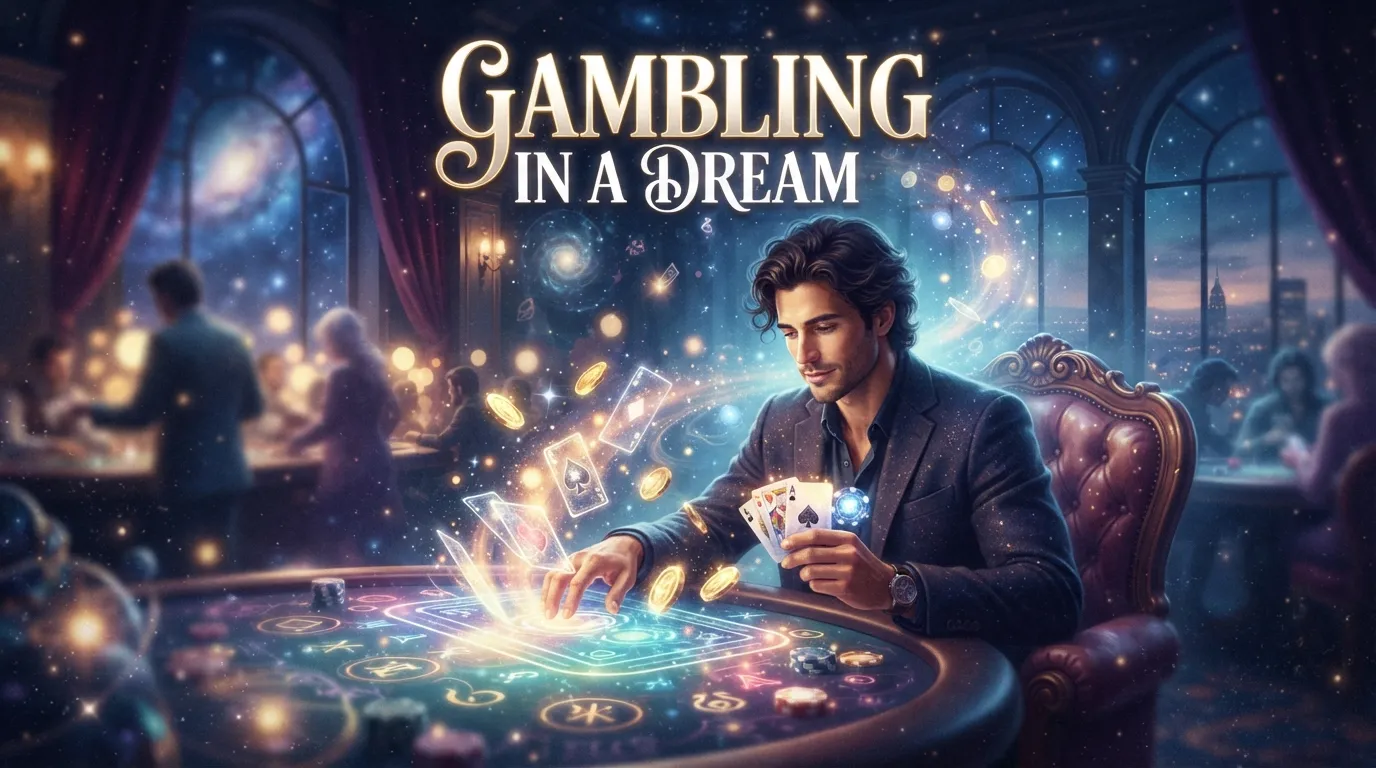
The chips are in your hand, the wheel is spinning, and the outcome is still unwritten. That suspended moment is the heart of a gambling dream. It is rarely really about a casino. It is about risk: the choices you have already made, the ones you are avoiding, and the part of you that wants to know the result before the wheel stops.
A gambling dream can reflect hope, confidence, fear of failure, regret, or a desire for a breakthrough. The details of the dream matter more than the setting. Gambling and winning may reflect hope, confidence, or a desire for a breakthrough. Gambling and losing may represent fear of failure or regret. Feeling excited may suggest that you are seeking stimulation or change. Feeling anxious may point to uncertainty in your waking life. Refusing to gamble may symbolize self-control or caution. Watching someone else gamble may reflect concerns about another person’s choices. Gambling with something valuable may represent fear of losing something important.
The table as a picture of your waking risks
Gambling dreams often appear during periods when something real is at stake: starting a new relationship, changing jobs, moving to a new place, making a financial decision, waiting for important news, taking an emotional risk, ending an old chapter, or starting something unfamiliar. The dream takes the abstract feeling of uncertainty and gives it a table, chips, and a result.
What you were gambling with matters. A relationship, your home, your career, your reputation, a personal secret, or something emotionally valuable can each appear as the stake. The dream may be asking what you feel you stand to lose, and whether the risk feels chosen or forced. A wager you place willingly tells a different story from a bet you feel pressured into.
Winning, losing, and walking away
Winning in a gambling dream can feel euphoric, and that euphoria may reflect a genuine hunger for progress: a breakthrough at work, a relationship turning a corner, a long effort finally paying off. It can also reflect wishful thinking, the mind rehearsing the outcome it wants most.
Losing may bring shame, panic, or a strange relief. The relief is worth noticing. Sometimes a loss in a dream represents a fear being faced rather than a failure being predicted. Refusing to play can be the most telling outcome of all. It may symbolize self-control, caution, or a growing awareness that a particular game is not worth the price of entry.
The shadow at the table
In Jungian psychology, the shadow represents aspects of ourselves that we do not fully acknowledge, accept, or express: suppressed emotions, unrecognized fears, hidden desires, anger, jealousy, insecurity, shame, unacknowledged ambitions, and traits we learned to hide. A gambling dream can bring the shadow to the table. The gambler in the dream may be the part of you that wants more: more excitement, more freedom, more validation, more control.
Being chased in a gambling dream, or feeling pursued after a loss, often reflects something you are trying to avoid, such as a debt, a decision, or a consequence that feels close behind. The dream may also stage an inner conflict: one part of you wants to keep playing, another wants to leave the table. Useful questions include: Why do I need control? Why am I afraid of change? Why do I seek external validation? Why do I keep repeating certain patterns? What does security really mean to me?
Control, attachment, and the need to know
From a Freudian perspective, dreams can express unconscious wishes, fears, and conflicts. A gambling dream might dramatize a tension between desire and restraint: the wish for a quick resolution versus the knowledge that real outcomes take time. From an energy-based or spiritual perspective, gambling imagery can symbolize feeling pulled between two choices, emotionally drained by uncertainty, blocked from making a decision, attached to a particular outcome, or afraid of losing control. These are frameworks for reflection rather than established scientific explanations.
What the dream may really be about is attachment to outcomes. Many of life’s hardest moments involve waiting: waiting for news, for a decision, for someone else to change. A gambling dream compresses that waiting into a single spin. The question it poses is not “will I win?” but “can I live with not knowing yet?”
When the dream repeats
A single gambling dream is usually just the mind processing a current uncertainty. A recurring one deserves more attention, especially if it repeats frequently, produces strong emotional reactions, connects clearly with current life circumstances, highlights an unresolved conflict, or changes the way you understand yourself. Dreams can also become more vivid during major transitions: beginning college, changing careers, starting a relationship, ending a relationship, moving, becoming a parent, experiencing financial changes, or starting a major project.
Stress is a common amplifier. Anxiety, personal associations, recent experiences, emotional stress, memories, expectations, media exposure, and sleep patterns can all shape dream content. If gambling dreams are leaving you distressed, or if they echo a real-life struggle with gambling, speaking with a qualified professional can help. The dream is not a diagnosis, but your emotional reaction to it is worth taking seriously.
Working with the dream
Write down the dream soon after waking: the main events, the people you saw, the locations, the strong emotions, the important objects, the colors or unusual details, and how the dream ended. Then ask what in your waking life currently feels like a wager. Often the answer arrives quickly, because the mind is not subtle about what it is worried about.
The dream may be pointing to a relationship that is changing, a decision that carries greater consequences than expected, an important issue you have been avoiding, shifting priorities, or a particular behavior that no longer feels right. The useful response is rarely to play the dream’s hand literally. It is to look at the real decision underneath it, and to ask whether the risk is one you would choose with a clear head.
Conclusion
A gambling dream is a portrait of uncertainty with the volume turned up. It shows you what you value, what you fear losing, and how much of your peace depends on an outcome you cannot control. The most honest response is not to chase the win or dread the loss, but to notice which wager in your waking life the dream is really about, and to decide, calmly, whether it is a bet worth placing. For background on how gambling itself works as a human activity, from games of chance to their history and regulation, Wikipedia’s article on gambling lays out the broader picture.










