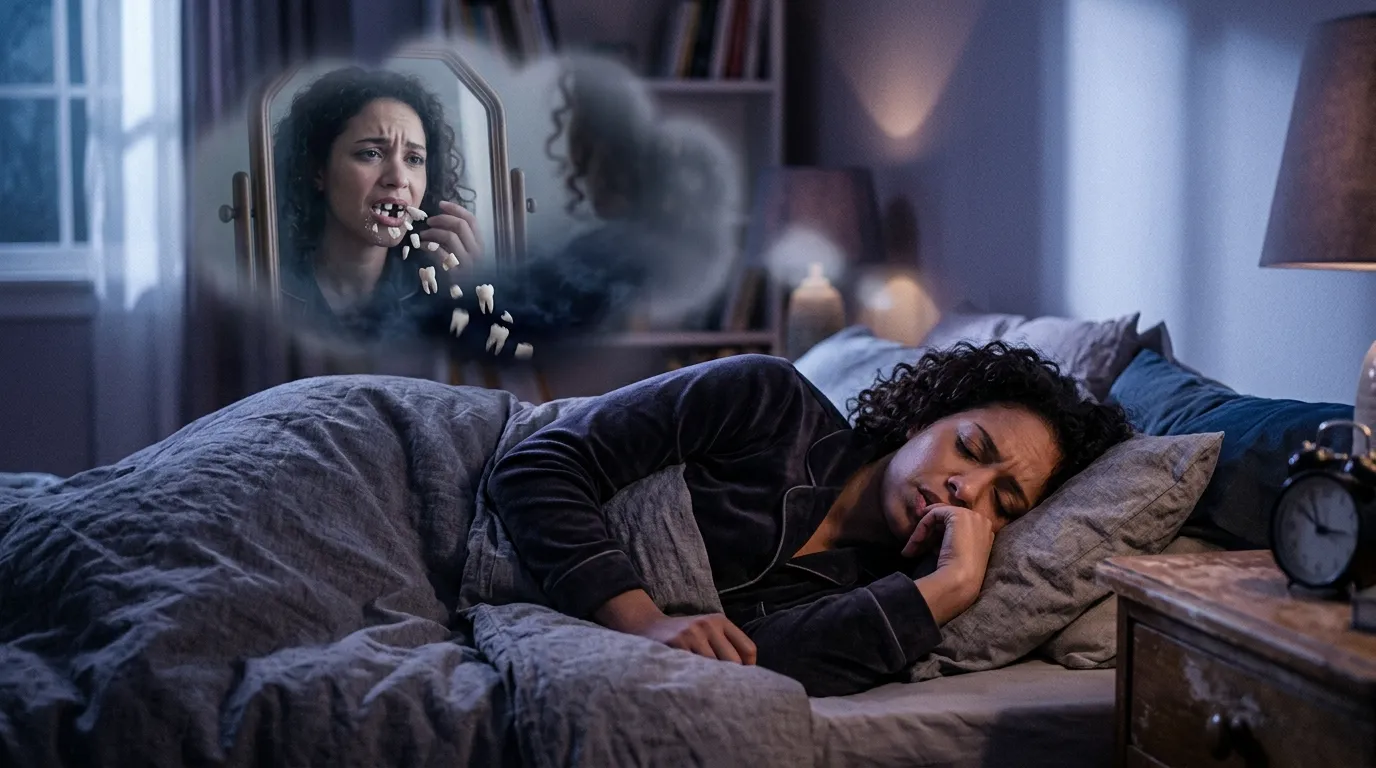
It happens without drama. You are talking, or eating, or laughing — and then your tongue finds the wrong texture. A tooth is loose. Or it crumbles like chalk. Or it simply falls into your palm, whole and bloodless, and you stare at it with a calm that frightens you more than the loss itself. In waking life this would be an emergency. In the dream, it is just… happening. And that absence of pain is the whole mystery: why does something that should hurt, not hurt at all?
The Strange Calm of Painless Loss
Dreams speak in sensation, and the sensation here is specific: disintegration without suffering. Things are coming apart, and you are not fighting it. Before reaching for symbolism, sit with what that feeling might be describing in your waking life — because most dreamers recognize it instantly once it is named. It is the feeling of a change you have already accepted before you admitted it: the relationship that ended months before the conversation, the ambition you quietly retired, the version of yourself you stopped defending.
Pain in dreams usually signals resistance. Its absence signals the opposite — that some part of you has already made peace with a loss your conscious mind is still processing. The dream is not warning you; it is informing you of a decision already taken downstream.
Teeth as Tools: What Exactly Is Coming Loose
Teeth do three jobs — they bite, they shape speech, and they show when you smile — and each job gives the dream a different reading:
- Power and bite — Teeth are the body’s tools of force. Losing them can mean a felt loss of power or assertiveness: a season where you cannot seem to “bite” into life, defend yourself, or chew through problems that used to be easy.
- Speech and expression — Teeth shape words. Crumbling teeth sometimes accompany periods of being unheard, misspeaking, or swallowing words that needed saying. The mouth is losing its instruments.
- Appearance and image — Teeth are visible; their loss is a social event. This reading concerns self-image and aging: the fear of being seen as diminished, the vanity-wound of time passing, the embarrassment of no longer matching your own photograph.
The painless qualifier reshapes all three. This is not a violent stripping of power, voice, or image — it is a quiet shedding. The old teeth are falling out the way baby teeth do: not as injury, but as development. Something in you is outgrowing its old equipment.
When the Teeth Are Someone Else’s
Occasionally the crumbling teeth belong to another person in the dream — you watch a friend, a parent, or a stranger lose theirs. This shifts the symbol outward: the quiet shedding is happening to them, or to your relationship with them. A parent’s failing teeth can mirror your perception of their aging or diminishing authority; a partner’s can reflect a felt loss of their strength, or your own waning ability to “bite” — to be honest, to confront — within the relationship.
There is also the dentist variant: you are in the chair, someone is working on your teeth, and the feeling is clinical rather than frightening. These dreams tend to accompany periods of deliberate self-repair — therapy, habit change, health regimens. The dream stages maintenance as dentistry: uncomfortable, necessary, and ultimately preservative. If the dental work in the dream goes well, take it as your mind’s quiet vote of confidence in the waking work you are doing.
And then there is the aftermath detail dreamers often forget to mention: the new teeth. Some dreams include the strange sensation of fresh teeth pushing up, or a mouth that feels different — smoother, stronger — after the loss. When this appears, the dream has told the whole story in one night: shedding and renewal, the old equipment gone and the new already arriving. Those are the dreams to trust most completely.
Shedding Without Crisis
That is the reading most worth carrying out of the dream: transformation that does not require catastrophe. We are taught to expect growth to hurt — no pain, no gain, the whole mythology of suffering as the price of change. The dream proposes an alternative: that some changes happen the way teeth fall out in childhood, painlessly, because the new thing was already pushing up underneath.
So the practical question is not what am I losing? but what is coming in underneath? Look at your life for the quiet arrivals: the new confidence that replaced the old anxiety, the softer strength replacing the brittle kind, the honesty replacing the performance. The dream showed you the shedding. The growth is yours to notice.
A note of groundedness: persistent dreams of teeth falling out sometimes coincide with actual dental stress — grinding, jaw tension, gum issues — and if the dream keeps returning, a dentist’s chair is as legitimate an interpretation as any symbolic one. On the literal side of the symbol, the Wikipedia article on the tooth covers the remarkable engineering of the things your dream keeps dissolving.










