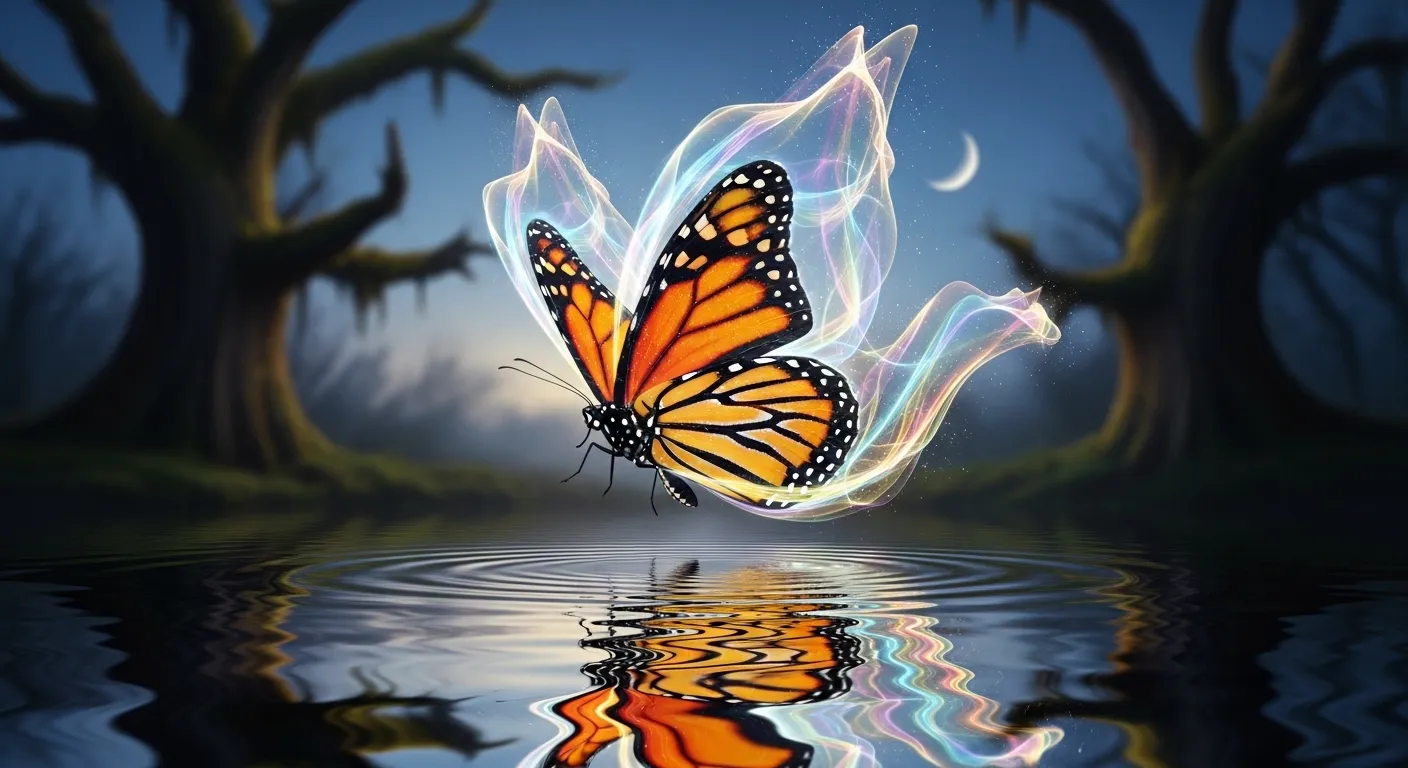
Something is ending. Or beginning. The butterfly doesn’t let you have one without the other — and that is precisely why it visits your dreams. Of all transformation symbols, the butterfly is the most complete: it doesn’t just change, it dissolves and rebuilds. If one appeared in your sleep, start with this question: what version of me is currently in the cocoon?
Metamorphosis as Mirror
The butterfly’s life cycle maps onto human change with unsettling accuracy. The caterpillar stage: consuming, growing, grounded. The cocoon: withdrawal, darkness, stillness — the part that looks like nothing is happening. The emergence: struggle, then wings. Butterfly dreams cluster around the cocoon phase, when a person feels stuck, hidden, or “in between” and can’t yet see the outcome.
The dream’s reassurance is biological, not just poetic: the cocoon is not a failure state. It is the required middle. If you are in a season of withdrawal — less social, less productive, more inward — the butterfly may be telling you that stillness is doing its work.
The Soul, in Many Traditions
In Greek, the word psyche means both “soul” and “butterfly” — one of the oldest symbolic links in dream interpretation. Across cultures, butterflies represent the soul: its fragility, its capacity for rebirth, its journey after loss. A butterfly dream following grief or a major ending often carries this meaning — not a message from the departed, necessarily, but a symbol of the soul’s resilience, including yours.
Psychologically, the butterfly also tracks identity. Carl Jung viewed transformation symbols as markers of individuation — the slow process of becoming who you actually are. A butterfly dream during an identity shift (new role, new city, new self-understanding) is the unconscious confirming: yes, this is really happening, and it’s real.
Five Small Scenes
A butterfly flying freely: liberation — from a situation, a mindset, or an old version of yourself. The most purely positive butterfly dream.
A butterfly landing on you: a blessing or message arriving personally. Pay attention to what was on your mind as you fell asleep.
Chasing a butterfly: pursuing a change that keeps eluding you. The dream may suggest the harder you grasp, the further it flies — some transformations can’t be forced.
A dead or dying butterfly: a transformation that stalled, or hope that needs reviving. It can also mark the natural end of a phase — not every cocoon produces wings, and that’s information too.
A vividly colorful butterfly: joy, creativity, and emotional vibrancy returning. Color in dreams often signals feeling coming back online after numbness.
Fear of Change Is Part of the Change
Some butterfly dreams feel anxious rather than hopeful — the butterfly is fragile, hard to catch, or slipping away. That anxiety is not a contradiction of the symbol; it’s part of it. The caterpillar doesn’t know about wings. Every real transformation involves a period of not knowing what you’re becoming. If the dream left you uneasy, name the change you’re resisting. Fear of the cocoon is normal. Staying in it forever is the only real danger.
A black butterfly deserves a specific note, since dreamers ask about it often. It is not a bad omen in any serious symbolic tradition. It typically represents mystery, the unknown phase of transformation, or — in some cultures — a soul visiting. Read the feeling of the dream, not the color’s reputation.
The Cocoon Phase: A Field Guide
If the butterfly dream found you mid-transformation, the cocoon phase deserves practical respect. It’s the part nobody photographs: no wings yet, no caterpillar either, just stillness that looks like stagnation. Here’s how to inhabit it well. First, stop demanding a timeline. Metamorphosis can’t be rushed, and pressuring yourself to “be transformed already” only adds suffering to a process that’s already working. Second, reduce input. Cocoons are dark for a reason — this is a season for less noise, fewer opinions, more quiet. Third, trust the dissolving. Parts of your old life, identity, or certainty are liquefying. That feels like loss because it is loss — but it’s loss in service of wings.
And watch for the struggle. When the butterfly emerges, it must fight its way out of the cocoon — the struggle pumps fluid into its wings. A too-easy emergence produces a butterfly that can’t fly. If your transition feels like a fight, the dream’s biology offers comfort: the fight is forming the wings.
A Note on Timing
One last thing the butterfly teaches: emergence can’t be scheduled. You can prepare the conditions — rest, honesty, patience — but you can’t force the wings. If you’re frustrated that your transformation is taking longer than expected, the dream’s answer is the cocoon’s answer: it’s not late. It’s developing. The butterfly that emerges too early can’t fly. Trust the timing, tend the conditions, and watch for the first crack of light.
Whatever is transforming in your life, the butterfly’s counsel is the same: the in-between is not empty, and wings take time. For the science of how this transformation actually works, the Wikipedia article on butterflies is a fascinating read.










