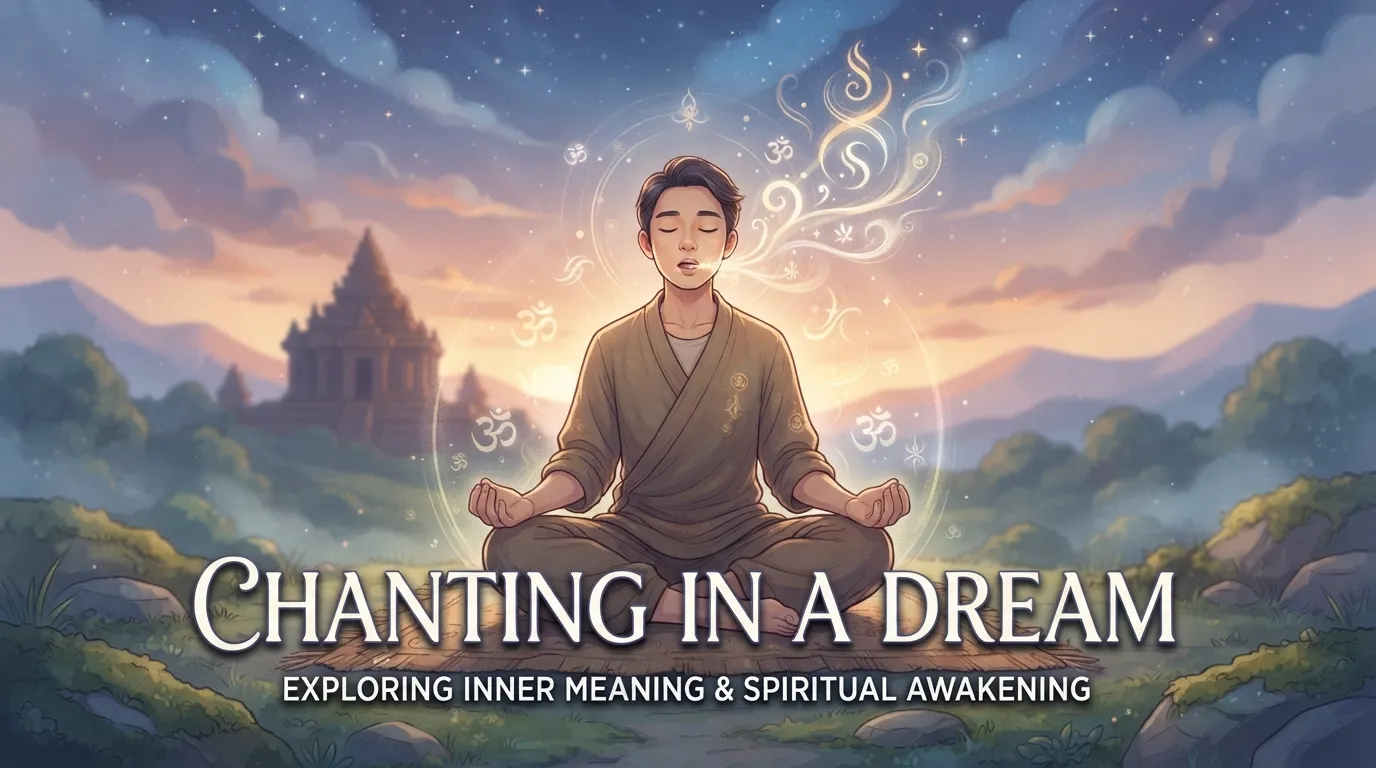
Long before there were playlists, there was the chant: a phrase repeated until the repetition itself became the point. When chanting shows up in a dream, it often carries that same quality. The words may be clear or half-formed, beautiful or unsettling, but the repetition is what stays with you. Something in the dream is being said again and again, as if your mind wants to be sure you hear it.
Chanting in a dream can point to spiritual awareness, inner peace, prayer or devotion, protection, emotional cleansing, a search for guidance, or connection with something greater than yourself. It can also point to something far more ordinary: a worry your mind is turning over, a feeling you cannot quite put into words, or a need for comfort during a period of change.
Why the voice repeats
A chant is, by nature, a loop. In waking life, people repeat phrases to calm themselves, to memorize, to pray, to protest, or to keep going through something hard. In a dream, repetition can mean your mind is circling something unresolved: repeating the same worry, looking for emotional comfort, seeking protection or reassurance, processing a spiritual question, trying to express feelings that are difficult to explain, moving through a period of personal transformation, or seeking a sense of control during uncertainty.
The details matter. The exact words or sounds you remember, who was present, where you were, what you were feeling, whether you were running or standing still, whether a shadow appeared, how the dream ended, and what happened in your life that day all shape the reading. A chant sung joyfully with others is a different dream from a chant whispered alone in a dark room, even if the words are the same.
Chanting as comfort
At its most peaceful, chanting in a dream can feel like being held steady. The rhythm gives the mind something to rest on. People going through spiritual questioning, grief, or major transitions sometimes dream of chanting when they are reaching for comfort, faith, acceptance, meditation, emotional balance, or spiritual reflection. The dream may be less about the content of the chant and more about the feeling it produced: a sense that, for a few minutes, the noise stopped.
Chanting can also represent a desire to express what is hard to say plainly. If you have been holding something back, the dream may give you a voice that does not need to argue or explain. It just repeats. That can be a relief, especially if waking life has left you feeling unheard.
Chanting as alarm
Not every dream chant soothes. Sometimes the repetition feels compulsive, urgent, or frightening, as if the chant is chasing you rather than calming you. In that form, the dream may be dramatizing anxiety, uncertainty, suppressed emotion, a sense of vulnerability, or an unresolved problem. The chant becomes the sound of a thought that will not leave you alone.
Being chased in a dream, with or without chanting, often reflects something you are trying to avoid: a difficult conversation, a painful memory, a major decision, an uncomfortable emotion, a change you do not feel ready to accept, or a responsibility that feels overwhelming. If a shadow appears alongside the chanting, the dream may be staging a confrontation between the part of you that wants peace and the part that is carrying fear.
Whose voice is it?
One of the most revealing questions about a chanting dream is also the simplest: who is chanting? If the voice is yours, the dream may be about your own need to speak, pray, or be heard. A crowd’s chant may be about belonging or pressure. If the voice is unfamiliar or sourceless, it may represent an idea or feeling you have not yet claimed as your own.
Equally important is whether you can join in. Chanting along may suggest participation, surrender, or acceptance. Being unable to speak, or finding that your voice will not come, may point to feeling silenced or uncertain. Dreams often use the voice as a symbol for agency: what you can say, what you cannot say, and what you are afraid to say. Questions worth sitting with include: Am I expressing what I really feel? Am I keeping something important inside? Do I feel heard by others? Am I afraid to speak honestly? Do I need to communicate a truth to myself?
The feelings underneath the sound
Chanting dreams can carry a wide emotional range: grief, anger, fear, loneliness, love, hope, guilt, or relief. The same chant can feel devotional in one dream and desperate in another. That is why the feeling, more than the words, is usually the truest guide to what the dream is about.
Stress often amplifies this kind of dream. During sleep, the brain combines memories, sounds, emotions, and recent experiences into stories that rarely follow waking logic. A chant may simply be the form your mind gave to a feeling that had been building all day.
What the inner frameworks say
In Freudian terms, chanting might represent a wish for protection, a fear of losing control, or a thought you keep pushing away during the day.
From a Jungian perspective, chanting may connect with the search for wholeness: the part of you that wants to integrate what has been split off, including the shadow, the name Jung gave to the aspects of ourselves we reject or hide. Facing a shadow in a chanting dream may symbolize a willingness to listen to something you have been avoiding. Some spiritual traditions read chanting dreams through the language of energy and awakening, seeing the repeated sound as an attempt to clear emotional heaviness or reconnect with spiritual awareness. These are frameworks for reflection, not proven explanations, and they work best when they help you ask better questions rather than supplying fixed answers.
Listening back: a small practice
Rather than decoding the chant like a riddle, try listening to it the way you would listen to a song that moves you. Write down what you remember, then ask which feeling in the dream feels most familiar in your waking life right now.
You might also try a waking version of the dream: sit quietly, breathe slowly, and repeat a short phrase that feels honest. Notice whether the repetition calms you or stirs something up. If the dream keeps returning alongside poor sleep and daytime anxiety, speaking with a qualified professional can help.
Conclusion
Chanting in a dream can be many things at once: a prayer, a worry, a comfort, a protest, or a mind rehearsing what it has not yet dared to say. The repetition is the clue. Whatever was being repeated was something your sleeping mind considered worth saying twice. If you want to understand the human history behind repeated sacred sound, from liturgy to mantra, Wikipedia’s article on chant traces how chanting has been used across cultures and centuries.










